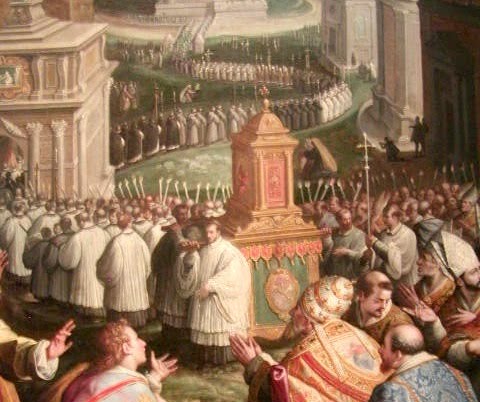
Friday, May 22, 2020

Homily by S. Gregory the Great: 29 on the Gospels: Monastic Breviary: Wednesday in Octave of the Ascension


THE first thing we must ask is this: How is it that at the Lord's Birth, when the Angels appeared, it is not said that they were arrayed in white garments, while it is said that they were arrayed in white at his Ascension? For it is written, while they beheld, he was taken up, and a cloud received him out of their sight. And while they looked steadfastly toward heaven as he went up, behold, two men stood by them in white apparel. Now, white garments signify joy and festivity. Surely then, if at the Lord's Birth the Angels did not appear in white apparel, while at his Ascension they did, it shows how greatly they rejoiced when God-made-Man penetrated the highest heavens. The humiliation of the Divinity is manifested in the Birth of the Lord, whereas the exaltation of the Humanity is shown in the Ascension. White apparel is more in keeping with exaltation than with humiliation.

IT is fitting, then, that at the Ascension the Angels were seen in white garments, for while in his Birth God appeared in his lowliness, in his Ascension he showed forth the sublimity of his Manhood. We must dwell on this point, beloved brethren, during this festival, for to-day is blotted out the handwriting of the day of our condemnation, and the sentence of our corruption is changed. No longer is it said of our human nature, Dust thou art, and unto dust shalt thou return; for to-day it returns to heaven. So, foreshadowing the resurrection of the body, blessed Job is a figure of the Lord when he is called a bird. He saw too that the Jews would not understand the mystery of the Lord's Ascension, and so he pronounced sentence on them, saying, He knew not the path of the bird.

THE Lord is rightly termed a bird, he who in a body of flesh soared up into the sky, and whoever does not believe that he ascended into heaven does not know the path of the bird. This festival was foretold by the Psalmist: Thou hast set thy glory above the heavens ; and again, God is gone up with a merry noise, and the Lord with the sound of the trump; and, Thou art gone up on high, thou hast led captivity captive and received gifts for men. And indeed, when Christ ascended up on high, he led captivity captive, for our corruption was swallowed up by the power of his incorruption. He did indeed give gifts to men, for by sending the Holy Spirit from above, to one was given the word of wisdom, to another the word of knowledge, to another faith, to another the gift of healing, to another diverse kinds of tongues, to another the interpretation of tongues.

Wednesday, May 20, 2020

Fr. Ronald Knox: The Ascension: from the London Oratory, 13 May 1956


Since the Ascension, we have found it easier to realize the love of God, because it is mirrored for us in the human sympathy of Jesus Christ. But there is something else—since the Ascension, it has been easier for us to imagine heaven as a desirable goal. Try as we will, the idea of heaven eludes us. Are we to think of it as place, from which every element of unhappiness is excluded? But we know how much our love of places is conditioned by moods and sentiments, by the desire for change, by association and by history! Or are we to think of it as a state? But then, how are we to think of a state except in terms of selfish enjoyment? Or should we look forward to being reunited with those we have loved? But how frail they are, these earthly bonds; how time impairs them! No, when we have tried everything, we shall find no better window on eternity than St Paul's formula, "to depart and be with Christ". If he has left us, and gone to heaven, it is so that we may no longer be disconcerted by the barrier of cloud that stands between us and it. We are not concerned to "go" here or there, to be in this or that state of existence. We want to find him. So little, and so much it is given us to know about the ascended Christ.

Tuesday, May 19, 2020

Homily of St. Leo the Great: The Ascension of our Lord


The sacred period of forty days following the blessed and glorious Resurrection of our Lord Jesus Christ, wherein by divine power he raised up in three days the true Temple of God which the impious Jews had destroyed—that period, dearly beloved, prescribed by God's holy providence that we might have the instruction we needed, has now come to an end. By thus prolonging his corporal presence, our Lord intended that faith in his Resurrection should rest on irrefutable proofs. The death of Christ had deeply troubled the hearts of his disciples. The anguish of the Cross, the yielding up of the spirit, the burial of the lifeless body, had gravely saddened their minds; the lethargy of doubt overshadowed them. Throughout the period from the Resurrection to the Ascension of our Lord, divine providence had in view that which God wished to teach to  his own, to impress upon their minds and hearts, the certitude that  the Resurrection of our Lord Jesus Christ was as true as his birth, his passion and his death.

Whence the blessed Apostles and all the disciples, though they had trembled at the outcome of the crucifixion and been left in doubt about the Resurrection, were so strengthened by the clear perception of this truth, that when our Lord was ascending, not only were they not sad, but were even filled with great joy. And a truly great and ineffable cause of rejoicing it was, when in the sight of a holy multitude, human nature ascended above the dignity of all celestial creatures, to pass above the angelic rank, to be raised beyond the highest archangels, to advance unimpeded from height to height until it was admitted to the presence of the Father, there to sit at his right hand and share the glorious throne of him to whose nature it was united in the person of the Son!

And since the Ascension of Christ is our ascension, and where the glory of the head has gone before, thither is the hope of the body summoned, let us exult, beloved brethren, with befitting joys, and rejoice with devout thanksgiving. To-day, not only have we been confirmed in the possession of Paradise, but in Christ have even penetrated to the heights of heaven. The blessings which the ineffable grace of Christ has merited for us outweigh those which the envy of Satan deprived us of; for those whom the venomous enemy cast down from the happiness of their first estate, these the Son of God has made to be of one body with himself and placed at the right hand of the Father.

Sunday, May 17, 2020

The Venerable Bede: The Greater Litanies


Our Lord and Savior, desiring that we arrive at the joys of the heavenly kingdom, taught us to ask these joys of him, and promised that he would give them to us, if we asked for them. 'Ask, ' he said, 'and it will be given to you, seek and you will find, knock and it will be opened to you.’ We must ponder these words of our Lord, dearly beloved brothers, earnestly and with our whole heart, because he bears witness that the kingdom of heaven is not to be given to, found by, and opened to those who are idle and unoccupied, but to those who ask for it, seek after it and knock [at its gates]. The gate of the Kingdom must be asked for by praying; it must be sought by living properly; it must be knocked at by persevering. It is not sufficient to ask in words only, if we do not also seek diligently how we ought to be living, so that we may be worthy to obtain that which we plead, as he bears witness, when he says: 'Not everyone who says to me, 'Lord, Lord, will enter the kingdom of but he who does the will of my Father who is in is in heaven, will  enter the kingdom of heaven'. And it is of no avail to have begun good [deeds] if such a one does not strive to bring the matters which one has begun well to a firm conclusion. Rather, ‘It were better not to recognize the way of righteousness, than after acknowledging it to turn back.’

Hence, my brothers, we must ask painstakingly and pray without respite.  ‘Let us fall down before God, let us weep before the Lord who made us.’ And that we may become worthy to be hearkened to, let us eagerly see how he wishes us to live, and what he who made us has us has ordered us to do. Let us seek the Lord and be strengthened; let us seek his face continually. And that we may deserve to find him and see him, ‘let us cleanse ourselves of every defilement of flesh and spirit,’ for only those with a chaste body are capable of being raised up to heaven on the day of the [final] judgement and  only those with a pure heart are capable glory of the divine Majesty.

Let us pierce the ears of our benevolent Maker with our unwearying desire for eternal happiness, and let us not falter in what we have begun before he opens [the gates] and we become worthy to be snatched from the prison of this death and to enter the gate of the heavenly fatherland.

Saturday, May 16, 2020

The Greater Litanies: Monday before Ascension: Homily by S. Ambrose, Bishop: Bk. 7 on Luke 11


THIS is another instance of the teaching that prayer is to be offered at all times, not only by day, but also by night. For behold, the man who sought out his friend at midnight and asked three loaves of him and persisted in his request, was not denied his prayer. What are these three loaves, except the food of the heavenly mystery? And if you love the Lord your God, you will be able to obtain it, and not only for yourself, but for others as well. For what greater friend have we than he who gave his body for us?

FROM him David asked bread at midnight, and received it. He asked when he said, At midnight I will rise to give thanks unto thee. Thus, he gained those loaves which he has set before us to eat. He asked when he said, Every night wash I my bed. Nor was he afraid of disturbing his friend's sleep, because he knew him to be always watchful. And therefore, mindful of the Scriptures, let us be instant in prayer day and night, and let us ask pardon for our sins.

IF David praised God seven times a day, and was always present at the morning and evening sacrifice, he who was so holy and so occupied with the needs of his kingdom, what must we do, who have greater need than he had to beseech God, since we fall so often through weakness of mind and flesh; what must we do to avoid being starved of that bread of life, that bread that strengthens man's heart; when we are wearied by our journey and exhausted by worldly duties and the winding path of earthly life? The Lord teaches us to be watchful, not only at midnight, but at practically every moment. For he comes at evening, and at the second watch, and at the third, and is apt to knock. Then, blessed are those servants, whom the Lord when he cometh shall find watching.

Friday, May 15, 2020

IN ASCENSIONE DOMINI


Ad I  & II Vesperas: saec. VII-VIII

Walsh-Husch: “It could be argued that this hymn more appropriately belongs to Holy Week (it was earlier appointed for Nocturns at Easter) than to Ascension Thursday, to which the revised Breviary allots it for First Vespers.” However, Milfull notes that the collector in H (the ‘Leofric Collectar’) assigns it “also to Compline and Matins of the Ascension”.

Iesu, nostra redémptio
amor et desidérium,
Deus creátor ómnium,
homo in fine témporum,

Quæ te vicit cleméntia,
ut ferres nostra crímina,
crudélem mortem pátiens,
ut nos a morte tólleres;

Inférni claustra pénetrans,
tuos captívos rédimens;
victor triúmpho nóbili
ad dextram Patris résidens?

Ipsa te cogat píetas,
ut mala nostra súperes
parcéndo, et voti cómpotes
nos tuo vultu sáties.

Tu esto nostrum gáudium,
qui es futúrus præmium;
sit nostra in te glória (6)
per cuncta semper sæcula. Amen.


O Jesus, our redemption, love and desire, God, creator of all things, man at the end of time. What mercy conquered you that you should bear our sins, suffering a cruel death to rescue us from death.  Penetrating the enclosure of hell, redeeming your captives, victor in noble triumph, sitting at the right hand of the Father.  May that love press compel you to overcome our evils with pardon,  our desires completely satisfied by your presence. Be our joy, you who are our future reward, may our glory be in you ever through all ages.

In officio dominicali et feriali: Rabanus Maurus?

Originally sung at Vespers on Pentecost through the octave, this hymn is now sung between Ascension and Pentecost. Perhaps this is because of the elimination of the Pentecost octave. “No other Latin hymn, except those of the daily office, has been so frequently and widely used as this” (Walpole).

Veni, creátor Spíritus,
mentes tuórum vísita,
imple supérna grátia,
quæ tu creásti, péctora.

Qui díceris Paráclitus,
donum Dei altíssimi,
fons vivus, ignis, cáritas
et spiritális únctio.

Tu septifórmis múnere,
dextræ Dei tu dígitus,
tu rite promíssum Patris
sermóne ditans gúttura.

Accénde lumen sénsibus,
infúnde amórem córdibus,
infírma nostri córporis,
virtúte firmans pérpeti.

Hostem repéllas lóngius
pacémque dones prótinus;
ductóre sic te prævio
vitémus omne nóxium.

Per te sciámus da Patrem
noscámus atque Fílium,
te utriúsque Spíritum
credámus omni témpore. Amen.

Come, O creator Spirit, visit the souls which are yours; fill with heavenly grace the hearts which you have created. You who are called the Comforter, the gift of God most high, the living source, fire and love, and spiritual anointing. You are the sevenfold gift, the finger of the right hand of God, you truly the promise of the Father, enriching throats with speech. Enkindle our thoughts with light, pour love into our hearts, strengthen the weakness of our bodies with your perpetual virtue. Drive the enemy far from us and continually grant us your peace, so that with you leading us and going before us we may avoid all harm. Through you may we know the Father, and know the Son, and you, the Spirit of both, we may confess at all times. Amen.


Ad Officium lectionis: saec. X

Milfull; “This hymn was sing at Lauds on the Ascension. The collector of H, however, assigns it to Matins”.  Walpole: “The most noteworthy fact concerning [this hymn] is that a short version is found in two of the oldest MSS….One can understand the expansion of a hymn, but abbreviation is very uncommon. It may be that the short form was the original and was afterwards expanded to the form in which the great majority of the MSS give it. The Mozarabic MSS insert further stanzas.

Ætérne rex altíssime,
redémptor et fidélium,
quo mors solúta déperit,
datur triúmphus grátiæ,

Scandis tribúnal déxteræ
Patris tibíque cælitus
fertur potéstas ómnium,
quæ non erat humánitus,

Ut trina rerum máchina
cæléstium, terréstrium
et inferórum cóndita,
flectat genu iam súbdita.

Tremunt vidéntes ángeli
versam vicem mortálium;
culpat caro, purgat caro,
regnat caro Verbum Dei.

Tu, Christe, nostrum gáudium,
manens perénne præmium,
mundi regis qui fábricam,
mundána vincens gáudia.

Hinc te precántes quæsumus,
ignósce culpis ómnibus
et corda sursum súbleva
ad te supérna grátia,

Ut, cum rubénte cœperis
clarére nube iúdicis,
pœnas repéllas débitas,
reddas corónas pérditas.

Iesu, tibi sit glória,
qui scandis ad cæléstia
cum Patre et almo Spíritu,
in sempitérna sæcula. Amen.

Eternal and heavenly King most high and redeemer of the faithful, by you death loses its grip on us and is destroyed.  You scale the judgement seat at the right hand of the Father, for power, which is not that of man,  was given to you. That the threefold fabric of the world, created things of heaven and earth and below the earth subdued should bend the knee. The angels tremble when they see the reversal of the lot of mortal men: flesh sins, flesh cleanses, the flesh of God now reigns.  You, O Christ, our joy,  abiding as our endless reward, you who rule the fabric of the world, victorious over worldly joys.  Praying, we ask you: forgive us our sins, raise up our hearts to you by heavenly grace.  When you begin to gleam red carried on the cloud of judgement, you will drive away of just punishment and restore the crowns which we lost. To you,  O Jesus, be glory, who scaled the heavens, with the Father and the Holy Spirit for eternal ages. Amen.


Ad Laudes matutinas: saec. X

Walpole: “Blume Analecta LI. 92 heads this hymn In Ascensione Domini. Ad Vesperas; but he notes (p. 93) that the usage varies. The Ambrosian use assigns it to the eve of the Ascension ; Werner to the first Nocturn. Various stanzas of it are omitted in various MSS”. Milfull: “This hymn was sung at Matins (Nocturn) of Ascension, except in B, the oldest Ango-Saxon hymnal extant”.

Optátus votis ómnium
sacrátus illúxit dies,
quo Christus, mundi spes, Deus,
conscéndit cælos árduos.

Magni triúmphum prœlii,
mundi perémpto príncipe,
Patris præséntans vúltibus
victrícis carnis glóriam.

In nube fertur lúcida
et spem facit credéntibus,
iam paradísum réserans
quem protoplásti cláuserant.

O grande cunctis gáudium,
quod partus nostræ Vírginis,
post sputa, flagra, post crucem
patérnæ sedi iúngitur.

Agámus ergo grátias
nostræ salútis víndici,
nostrum quod corpus véxerit
sublíme ad cæli régiam.

Sit nobis cum cæléstibus
commúne manens gáudium:
illis, quod semet óbtulit,
nobis, quod se non ábstulit.

Nunc, Christe, scandens æthera
ad te cor nostrum súbleva,
tuum Patrísque Spíritum
emíttens nobis cælitus. Amen.

The holy day, desired by the prayers of all, now shines, when Christ, the hope of the world, God ascended into the highest heavens. Triumphant in the great combat, the prince of this world cast out, presenting to the Father’s face the glory of a fleshly victory. Borne upon a gleaming cloud he brought hope to believers, now opening paradise which our first parents had closed. O immense joy of all that the offspring of our Virgin after spitting, whipping, after the cross, should share the throne of the Father. Therefore let us give thanks to the vindicator of our salvation, for our body now lives on high in the kingdom of heaven. May we with the heavenly hosts share an abiding joy, for he offered himself to those above, for us he is not gone. Now, O heavenly Christ, climbing the heavens, raise our hearts to you, sending upon us the Spirit of the Father. Amen.

Wednesday, May 13, 2020

Dom Guéranger; The Liturgical Year: St. Matthias


Let's celebrate today his triumph by borrowing some of the stanzas by which the Greek Church, in the Menées, celebrates his Apostolate.

Blessed Matthias, spiritual Eden, you flowed from the divine fountain, like a flooding river; thou hast sprinkled the earth with thy mystical streams, and thou hast made it fruitful: pray therefore unto the Lord to grant peace to our souls and his great mercy.

Apostle Matthias, you completed the divine college after the fall of Judas; the heavenly splendor of your wise speeches has dissipated the darkness of idolatry, by the virtue of the Holy Spirit; pray now to the Lord to grant peace to our souls and his great mercy.

He who is the true Vine has looked after you like a fruitful branch intended to carry the bunch which pours the wine of salvation. Those who retained the bonds of ignorance drank this wine, and rejected the intoxication of error.

Become the chariot of the Word of God, O glorious Matthias, you have forever broken the wheels of error, the chariots of iniquity; by divine virtue, you have destroyed the idolaters, the columns and the temples from top to bottom; but you have raised temples to the Trinity which make this cry heard: Peoples, celebrate Christ forever!

Venerable Matthias! You seemed like a spiritual heaven that tells of the ineffable glory of the Son of God. Let us celebrate with joy in a unanimous voice this Apostle, lightning of the Holy Spirit, fisherman of lost souls, reflection of divine clarity, doctor of mysteries.

Blessed Apostle, the Savior called you his friend, because you obeyed his precepts; you are the heir to his kingdom; you will be seated with him on a throne on the terrible day of future judgment, oh very wise Matthias, you who complete the duodenary college of the Apostles.

Armed with the Cross like a sail, O blessed, you crossed the rough sea of ​​life, and you arrived at the quiet port; now, joyful and mixed with the choir of the Apostles, deign to present yourself to the sublime Judge, and beg mercy for us from the Lord.

Your tongue seemed like a flashing lamp of golden reflections, in which the flame of the Holy Spirit burns; it has consumed foreign dogmas, and it has extinguished the profane fire, oh wise Matthias, you who cast your light on those who sat in the darkness of ignorance.