

BENEDICT XVI
GENERAL AUDIENCE
Dear Brothers and Sisters,
The day after tomorrow, 9 October, will be the 400th anniversary of the death of St John Leonardi, Founder of the religious order of Clerics Regular of the Mother of God. He was canonized on 17 April 1938 and chosen as Patron of Pharmacists on 8 August 2006. He is also remembered for his great missionary zeal. Together with Mons. Juan Bautista Vives and Martín de Funes, a Jesuit, he planned and contributed to founding a specific Congregation of the Holy See for the missions, Propaganda Fide, which has forged thousands of priests down the centuries, many of them martyrs. Thus he was a luminous priestly figure whom I like to point out as an example to all presbyters in this Year for Priests. He died in 1609 from influenza, contracted while he was doing all he could to minister to those stricken by the epidemic in the Campitelli neighbourhood of Rome.
John Leonardi was born in 1541 at Diecimo in the Province of Lucca. The youngest of seven siblings, his adolescence was marked by the rhythm of faith lived in a healthy, hard-working family, as well as by regular visits to a workshop in his home town that made and sold essences and medicines. When John was 17, his father enrolled him in an ordinary apothecary's course in Lucca, aiming to make him a future pharmacist, indeed an apothecary, as it was then termed. For about 10 years young John attended this course, alert and hardworking, but when, in accordance with the legislation of the ancient Republic of Lucca he earned the official recognition that would authorize him to open his own apothecary's shop, he started wondering whether the moment had not come to carry out a plan he had always had at heart. After mature reflection he decided to train for the priesthood. Thus, having left the apothecary's shop and having acquired an adequate theological formation, he was ordained a priest and, on the day of Epiphany 1572, celebrated his first Mass. However, he never lost his interest in medicine, because he felt that the professional mediation of the pharmacist would permit him to fulfil his vocation to the full, one in which he could pass on to men and women, by means of a holy life, "the medicine of God", which is the Crucified and Risen Jesus Christ, the "measure of all things".
Inspired by the conviction that all human beings need this medicine more than anything else, St John Leonardi sought to make the personal encounter with Jesus Christ his fundamental raison d'être. "It is necessary to start afresh from Christ", he liked to repeat again and again. The primacy of Christ over all things became for him the concrete criterion of judgement and action and the vital principle of his priestly activity, which he exercised while a vast and widespread movement of spiritual renewal was taking place in the Church, thanks to the flourishing of new religious institutes and the luminous witness of Saints such as Charles Borromeo, Philip Neri, Ignatius of Loyola, Joseph Calasanctius, Camillus de Lellis and Aloysius Gonazaga. He dedicated himself enthusiastically to the apostolate among boys through the Confraternity of Christian Doctrine, gathering around him a group of young men with whom, on 1 September 1574, he founded the Congregation of Reformed Priests of the Blessed Virgin, later called the Order of Clerics Regular of the Mother of God. He recommended his disciples to keep "before their eyes and minds only the honour, service and glory of Jesus Christ Crucified", and, as a good pharmacist used to administering doses, he added using a precise reference: "lift up your hearts a little higher to God and with him measure all things".
Dear brothers and sisters, the luminous figure of this Saint invites priests in the first place, and all Christians, to strive constantly for "the high standard of Christian living", which means holiness, naturally each one in accordance with his own state. Indeed, authentic ecclesial renewal can only stem from faithfulness to Christ. In those years, on the cultural and social threshold between the 16th and 17th centuries, the premises of the contemporary culture of the future began to be outlined. It was characterized by an undue separation between faith and reason that produced, among its negative effects, the marginalization of God, with the illusion of the possible and total autonomy of man who chooses to live "as though God did not exist". This is the crisis of modern thought, which I have frequently had the opportunity to point out and which often leads to forms of relativism. John Leonardi perceived what the real medicine for these spiritual evils was and summed it up in the expression: "Christ first of all", Christ at the centre of the heart, at the centre of history and of the cosmos. And, St John said forcefully, humanity stands in extreme need of Christ because he is our "measure". There is no area that cannot be touched by his power; there is no evil that cannot find a remedy in him, no problem that is not resolved in him. "Either Christ or nothing!". This was his recipe for every type of spiritual and social reform.
There is another aspect of St John Leonardi's spirituality that I would like to emphasize. On various occasions he reasserted that the living encounter with Christ takes place in his Church, holy but frail, rooted in history and in its sometimes obscure unfolding, where wheat and weeds grow side by side (cf. Mt 13: 30), yet always the sacrament of salvation. Since he was clearly aware that the Church is God's field (cf. Mt 13: 24), St John was not shocked at her human weaknesses. To combat the weeds he chose to be good wheat: that is, he decided to love Christ in the Church and to help make her, more and more, a transparent sign of Christ. He saw the Church very realistically, her human frailty, but he also saw her as being "God's field", the instrument of God for humanity's salvation. And this was not all. Out of love for Christ he worked tirelessly to purify the Church, to make her more beautiful and holy. He realized that every reform should be made within the Church and never against the Church In this, St John Leonardi was truly extraordinary and his example is ever timely. Every reform, of course, concerns her structures, but in the first place must have an effect in believers' hearts. Only Saints, men and women who let themselves be guided by the divine Spirit, ready to make radical and courageous decisions in the light of the Gospel, renew the Church and make a crucial contribution to building a better world.
Dear brothers and sisters, St John Leonardi's life was illumined throughout by the splendour of the "Holy Face" of Jesus, preserved and venerated in the Cathedral Church of Lucca, which has become an eloquent symbol and an indisputable synthesis of the faith that enlivened him. Conquered by Christ, like the Apostle Paul, he pointed out to his followers and continues to point out to all of us, the Christocentric ideal for which "it is necessary to strip oneself of every personal interest and look only to the service of God", keeping "before the eyes of the mind only the honour, service and glory of Jesus Christ Crucified". Besides the Face of Christ, St John fixed his gaze on the motherly face of Mary. The One whom he chose to be Patroness of his Order was for him a teacher, sister and mother, and he experienced her constant protection. May the example and intercession of this "fascinating man of God" be a reference and an encouragement, particularly in this Year for Priests, for priests and for all Christians to live their own vocation with passionate enthusiasm.

Dominica XIX Post Pentecosten II. Octobris ~ II. classis
Homily by Pope St. Gregory the Great.

Oremus
Deus, cujus Unigenitus per vitam. mortem et resurrectionem suam nobis salutis aeternae praemia comparavit: concede quaesumus: ut haec mysteria sanctissimo beatae Mariae Virginis Rosario recolentes, et imitemur quod continent, et quod promittunt, assequamur.
Per eumdem Christum Dominum nostrum...
Let us pray
O God, Whose Only-begotten Son, by living, dying, and rising again, hath purchased everlasting joy for us, mercifully grant that, by calling these things to mind in the Blessed Virgin Mary's most holy Garden-of-roses, we may learn better both to follow what they set forth, and to strive after what they promise.
Through the same Christ our Lord...
When the heresy of the Albigenses was making head against God in the County of Toulouse, and striking deeper roots every day, the holy Dominic, who had but just laid the foundations of the Order of Friars Preachers, threw his whole strength into the travail of plucking these blasphemies up. That he might be fitter for the work, he cried for help with his whole soul to that Blessed Maiden, whose glory the falsehoods of the heretics so insolently assailed, and to whom it hath been granted to trample down every heresy throughout the whole earth. It is said that he had from her a word, bidding him preach up the saying of the Rosary among the people, as a strong help against heresy and sin, and it is wonderful with how stout an heart and how good a success he did the work laid upon him. This Rose-garden (or Rosary) is a certain form of prayer, wherein we say one-hundred-and-fifty times the salutation of the Angel, and the Lord's Prayer between every ten times, and, each of the fifteen times that we say the Lord's Prayer, and repeat tenfold the salutation, think of one of fifteen great events in the history of our Redemption. From that time forth this form of godly prayer was extraordinarily spread about by holy Dominic, and waxed common. That this same Dominic was the founder and prime mover thereof hath been said by Popes in diverse letters of the Apostolic See.
Sermon 1 on the Nativity of the Lord
His Mother was chosen a Virgin of the kingly lineage of David, and when she was to grow heavy with the sacred Child, her soul had already conceived him before her body. She learned the counsel of God announced to her by the Angel, lest the unwonted events should alarm her. The future Mother of God knew what was to be wrought in her by the Holy Ghost, and that her modesty was absolutely safe. For why should she, unto whom was promised all sufficient strength through the power of the Highest, have felt hopeless merely because of the unexampled character of such a conception? She believeth, and her belief is confirmed by the attestation of a miracle which hath already been wrought. The fruitfulness of Elizabeth, before unhoped for, is brought forward that she might not doubt that he who had given conception unto her that was barren, would give the same unto her that was Virgin. And so the Word of God, the Son of God, who was in the beginning with God, by whom all things were made, and without whom was not anything made that was made, to deliver man from eternal death, was made man.
Our Lord Jesus Christ, descending from his throne in heaven, but leaving not that glory which he hath with the Father, cometh into this lower world by being born after a new order and in a new birth. He cometh after a new order, in that he who is unseen among his own, was seen among us; the Incomprehensible was fain to be comprehended, and he that is from everlasting to everlasting began to be in time. He was the Offspring of a new birth; conceived of a maiden, without the passion of any fleshly father, without any breach of his Mother's virginity, since such a birth beseemed the coming Saviour of mankind, who was to have in him the nature of man's being, and to be free of any defilement of man's flesh. Though he sprung not as we spring, yet is his nature as our nature; we believe that he is free from the use and custom of men; but it was the power of God which wrought that a maiden should conceive, that a maiden should bring forth, and yet abide a maiden still.
From the Acts of Pope Pius XI
In the year 1931, amid the applause of the whole Catholic world, solemn rites were celebrated to mark the completion of the fifteen centuries which had elapsed since the Council of Ephesus, moving against the Nestorian heresy, had acclaimed the blessed Virgin Mary, of whom Jesus was born, as Mother of God. This acclamation had been made by the Fathers of the Church under the leadership of Pope Celestine. Pius XI, as Supreme Pontiff, wished to commemorate the notable event and to give lasting proof of his devotion to Mary. Now there had existed for many years in Rome a grand memorial to the proclamation of Ephesus, the triumphal arch in the basilica of Saint Mary Major on the Esquiline Hill. This monument had already been adorned by a previous pontiff, Sixtus III, with mosaics of marvelous workmanship, now falling to pieces from the decay of the passing ages. Pius XI, therefore, out of his own munificence, caused these to be restored most exquisitely and with them the transept of the basilica. In an Encyclical Letter Pius set forth also the true history of the Council of Ephesus, and expounded fervently and at great length the doctrine of the prerogatives of the Blessed Virgin Mary as Mother of God. He did this that the doctrine of this lofty mystery might sink more deeply into the hearts of the faithful. In it he set forth Mary, the Mother of God, blessed among women, and the most holy Family of Nazareth as the exemplars to be followed above all others, as models of the dignity and holiness of chaste wedlock, as patterns of the holy education to be given youth. Finally that no liturgical detail be lacking, he decreed that the feast of the Divine Motherhood of the Blessed Virgin Mary be celebrated annually on the 11th day of October by the universal Church with a proper Mass and Office under the rite of a double of the second class
Dominica XIX Post Pentecosten II. Octobris ~ II. classis
From the Holy Gospel according to Matthew
Matt 22:1-14
St. Pladius and his Companions
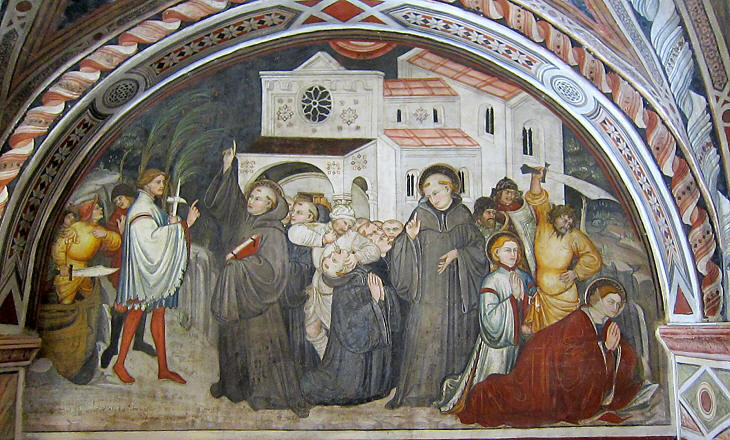
"Placidus, my beloved son, why should I weep for you? You are taken from me, only that you may belong to all men. I will give thanks for this sacrifice of the fruit of my heart, offered to Almighty God." Thus, on hearing of this day's triumph, spoke St. Benedict, his spiritual father, mingling tears with his joy. He did not survive St. Placidus long; yet long enough to complete, of his own accord, the sacrifice of separations, by sending into far-off France the companion of St. Placidus' childhood, St. Maurus, who was destined not to rejoin him in Heaven for many long years. Charity seeks not her own interests; she finds them by forgetting self, and losing self in God. St. Placidus had disappeared; St. Maurus had been sent away; St. Benedict was about to die: human prudence would have believed the holy patriarch's work in danger of perishing; whereas, at this critical moment, it strengthened its roots and extended its branches over the whole world. Unless the grain of wheat falling into the ground die, itself remains alone; but if it die, it brings forth much fruit (John 12: 24-25). As heretofore the blood of martyrs was the seed of Christians, it now produced a rich harvest of monks.
Deus, qui nos concédis sanctórum Mártyrum tuórum Plácidi et Sociórum eius natalícia cólere, da nobis in ætérna beatitúdine de eórum societáte gaudére.
Per Dóminum nostrum Iesum Christum, Fílium tuum: qui tecum vivit et regnat in unitáte Spíritus Sancti, Deus, per ómnia sǽcula sæculórum.Bruno, the founder of the Carthusian Order, was born at Cologne. From his boyhood he excelled in the soberness of his ways and his desire for solitude parents sent him to Paris, and there he made such progress in the study of philosophy and theology that he earned the degree of doctor and master in both faculties. Not long after, because of outstanding virtues he was anointed a Canon of the church of Reims. Having founded the Carthusian Order and having led a hermit's life in this Order for some years, he was summoned to Rome by Urban II, who had been his disciple. In those calamitous times, the Pope made use of Bruno's counsel and learning for several years. Finally the man of God, who had refused the archbishopric of Reims, was allowed to depart. He again sought a place of solitude, and there, full of virtues and merits, he fell asleep in the Lord.
