Tuesday, November 7, 2023

9th November Feast of the Dedication of the Lateran Basilica


9th November Feast of the Dedication of the Lateran Basilica Rome: “Mater et Caput”
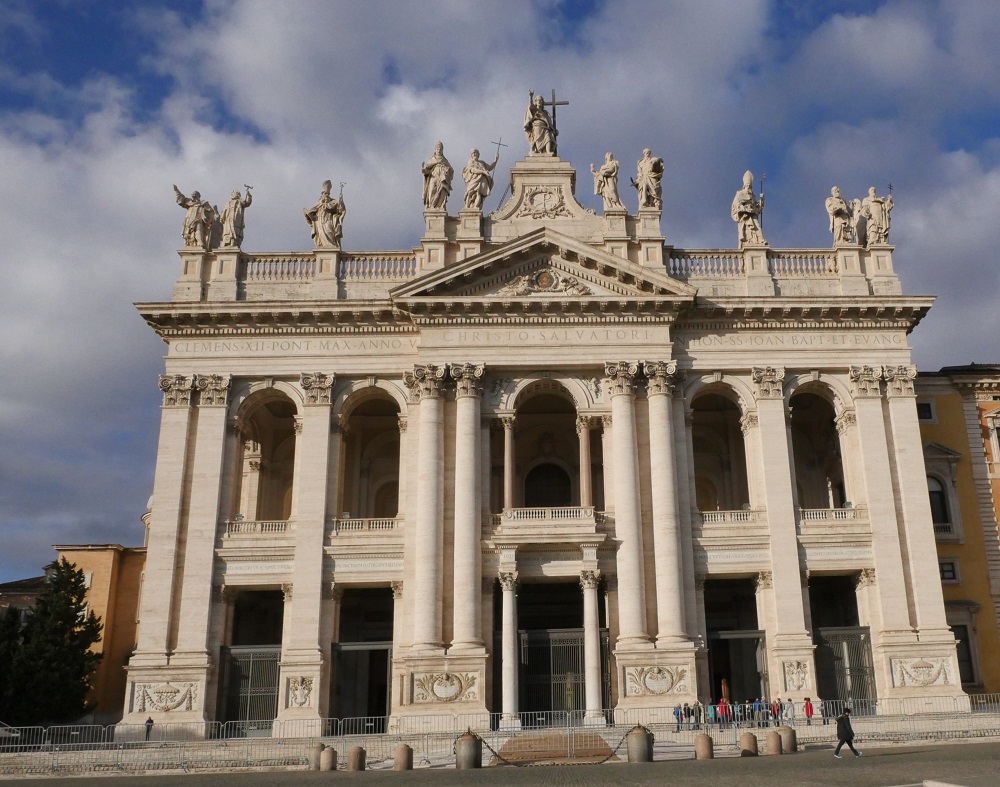
St John Lateran’s Basilica, Rome.

St John Lateran’s Basilica in Rome is the “Mater et Caput”, ‘Mother and head’, of all churches in Rome and the world. This fact is celebrated by the relief that adorns the entrance to the Basilica.
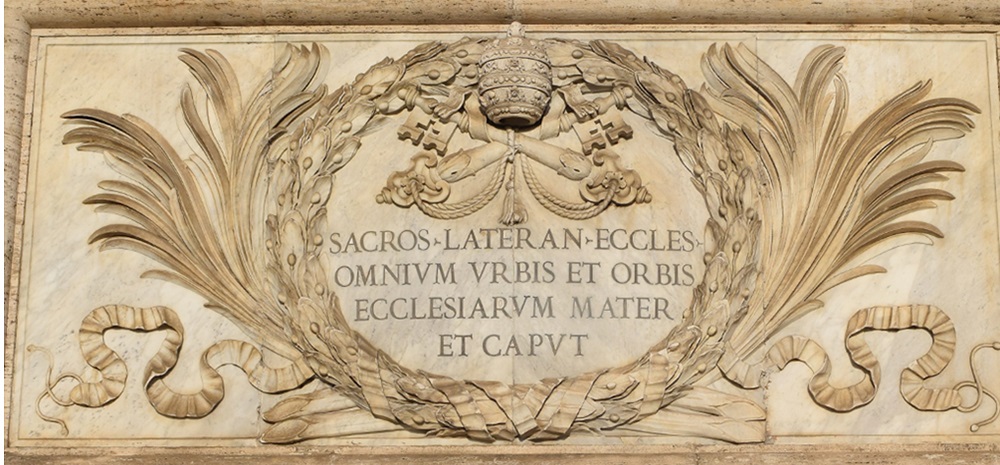
Most Holy Lateran Church, Mother and Head of all churches in this city and the world.

The name “Lateran” is derived from the fact that this Basilica was constructed on the territory that belonged to the Lateran family before it was bequest as an inheritance to Fausta, the wife of the Emperor Constantine. The Basilica was consecrated by Pope Sylvester I on the 9th November 324 and the liturgical feast of the Basilica, which is celebrated on the same day, commemorates this event. This feast has a special importance because the Lateran Basilica was the first church dedicated to the Most Holy Saviour under the express wishes of the Emperor Constantine. The entire Church celebrates this feast as an affirmation of unity with the Pope who is the Bishop of Rome and Head of the Universal Church.

The existence of the Basilica testifies to Constantine’s vision of the cross in the sky which turned out to be a prodigious event that profoundly changed the practice of Christianity during the first centuries.
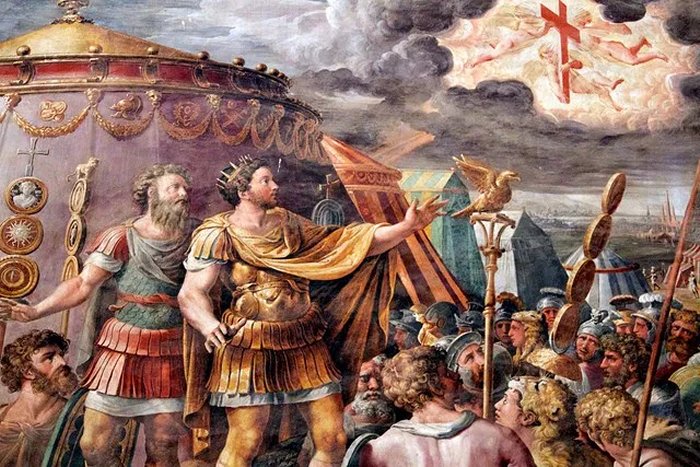
Raphael, Vision of the Cross, Raphael Rooms, Vatican Museums.

Bishop Eusebius of Caesarea, a friend and confident of Constantine, recounts that the night preceding the battle for domination of the Roman Empire against Maxentius, the Emperor considered which god to appeal to for help and protection in the battle. Like his father before him, Constantine had decided to adopt the sun god and he prayed that this god would reveal himself to him. Suddenly, a vision of an illuminous cross appeared in the sky which was visible to the whole army. Beneath the vision were the words, “In hoc signo vinces” which means ‘with this sign you will be victorious’. The following morning the army went into battle bearing the sign of the cross.

The battle took place on the 28th October 312 at Saxa Ruba in Rome and concluded with the Battle of the Milvian Bridge. Maxentius stumbled with his horse and fell into the River Tiber leaving Constantine free to enter Rome victorious.

Thanks to this victory, the Emperor brought an end to three centuries of Christian persecution during which many Christians were martyred. Constantine publicly authorised Christian worship with the proclamation of the celebrated Edict of Milan in 312.
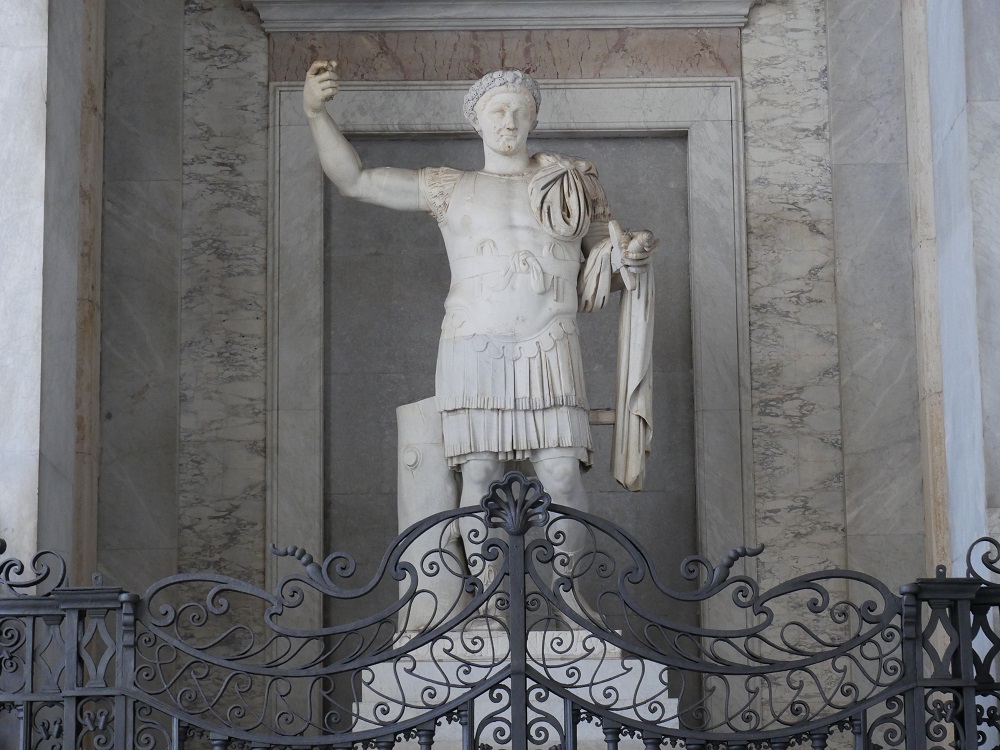
Statue of the Emperor Constantine, Portico of the Lateran Basilica.

The Emperor himself initially dedicated the Basilica to the Most Holy Saviour in gratitude for the victory. Only later, when the Basilica was also dedicated to Saints John the Baptist and the Evangelist, did it become known by its most popular name as St John Lateran.
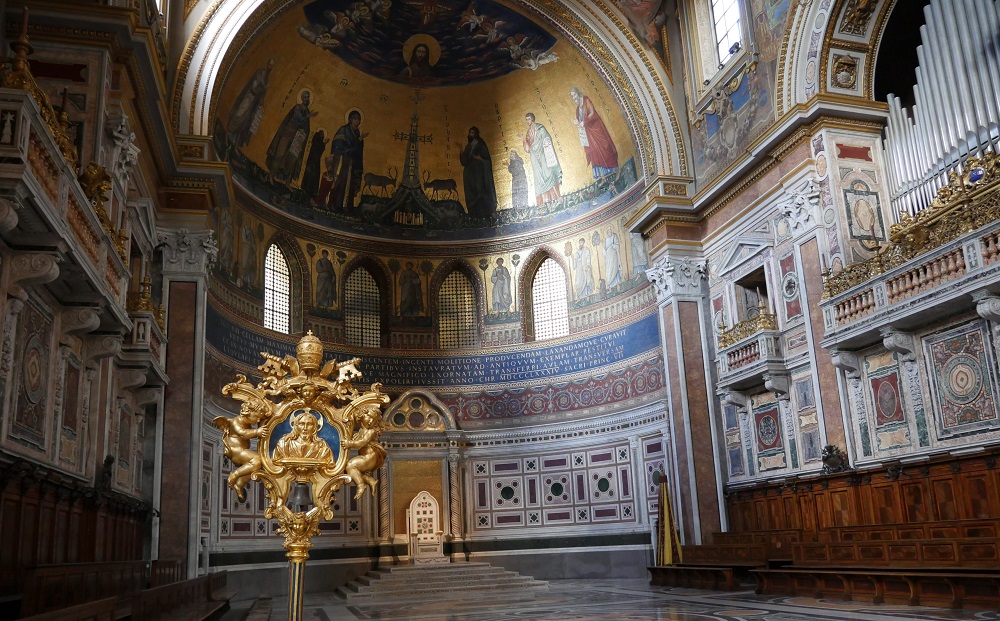
The Chair of the Lateran Basilica which represents the teaching seat of the Holy Father.

The importance of the feast of the ‘dedication of the Lateran Basilica’ celebrates the fact that Christians could freely come together in union with their Bishop to celebrate the liturgy of the Church and receive the teaching of the doctrine of the faith. From antiquity, the Basilica became the Cathedral of Rome and the world. The Pope has his Cathedra or Chair here as a sign of his teaching, his magisterium and his precedence. Therefore, the Petrine ministry is only initiated when the elected Pope has taken possession of the Chair of St John Lateran.

This beautiful edifice represents the Church – the assembly formed of the ‘living stones’ of Christians who today, as in centuries past, continue to testify their faith in Jesus Christ, the Most Holy Saviour.

Saturday, November 4, 2023

Homily by St. Jerome, Priest at Bethlehem. Bk. I Comment. on Matth. IX


Homily by St. Jerome, Priest at Bethlehem.

Bk. I Comment. on Matth. IX


St Jerome’s Homily on Matthew 9:18-26 for the Twenty-Third Sunday After Pentecost


I. This is the eighth miracle wrought by Jesus, when a certain ruler, desiring not to be kept out of the true circumcision, besought Him to recall his daughter to life. The ceremony of circumcision, which usually took place on the eighth day after the birth, seems to be indicated by this miracle. Jairus, the ruler of the synagogue, certainly deserved the preference; but a woman, diseased with an issue of blood, thrust herself in, and her own cure occupies the eighth place, so that the resurrection of the ruler’s daughter is postponed, and made the ninth in the enumeration. Indeed, it seems that by this case our Saviour wished to call our attention to the vocation of the Gentiles; for we read in the Psalms: Ambassadors shall come out of Egypt; Ethiopia shall soon stretch out her hands to God (Ps 68:32). A great mystery, spoken of by the Apostle, saying: Blindness in part has happened to Israel, until the fulness of the Gentiles should come in. And so all Israel should be saved, as it is written: There shall come out of Sion He that shall deliver, and shall turn away ungodliness from Jacob (Rom 11:25-26).

II. And behold a woman who was troubled with an issue of blood twelve years, came behind Him, and touched the hem of His garment. Now, compare these two miracles in this Gospel: the first, a woman troubled with her disease for twelve years; the second, the resurrection of the daughter of Jairus who, according to St. Luke (Lk 8:42), was twelve years old; and you will come to the conclusion that the woman, a type of the Gentiles, had been diseased for the same time that the Jewish nation, typified by the ruler’s daughter, had been living in faith. It is only by comparing good with evil that is, idolatry that we see the hideousness of the latter. Note also that this woman with the issue of blood came to our Lord, not in a house nor in a city, for such as she were by the law banished out of cities (Lev 15:25), but in the way, as He walked. Thus our Lord healed one even whilst He was on the road to heal another. Whence the Apostles said: To you it behooved us first to speak the word of God; but because you reject it, and judge yourselves unworthy of eternal life, behold we turn to the Gentiles. For so the Lord has commanded us: I have set thee to be the light of the Gentiles, that thou mayest be for salvation unto the utmost parts of the earth (Acts 13:46-47).

III. According to the Law, whosoever touched a woman with an issue of blood was declared unclean. Here, how ever, we see a woman touch Jesus to be cured of that issue by which she seemed to be unclean. Be of good heart, daughter, said Jesus; thy faith hath made thee whole. Our Saviour calls her daughter, and justly, on account of her faith, by which she was cured. Note, again, our Lord did not say to the woman that her faith would make her whole that is, clean but thy faith hath made thee whole. It was to give her to understand that, as soon as she believed, she was cured. And when Jesus was come into the house of the ruler, and saw the minstrels and the multitude making a rout, He said. The deceased daughter of Jairus was the type of the Jewish nation, even now, after so many years, in a state of death. The Rabbis, entrusted with the instruction of that nation, may be compared to the minstrels playing a mournful and useless tune. The Jewish leaders, as we know, were only a noisy society of infidels, not of believers; and when Jesus said, Give place, for the girl is not dead, but sleepeth, He wished to teach us that every being, under the dominion of the living God, is alive. And when the multitude was put forth, He went in. Indeed, these people, laughing to scorn the One Who had power to give life, were not worthy to assist at the miraculous resurrection of this maiden.

IV. Finally, consider the last point of likeness between the Jewish nation and the ruler’s daughter who, being dead, received life. He took her by the hand. And the maid arose. And the fame thereof went abroad into all the country. The unbelieving synagogue, typified by this daughter, is dead; for her sinful hands are covered with the prophet’s blood shed by them and their fathers (Matt 23:29-36). To rise from that death her stained hands must be washed in the same innocent Blood of Jesus Christ, the Author of all life.

Saturday, October 28, 2023

SS. Simon and Jude


Sermon of St. Gregory, Pope
Sermon 30 on the Gospels
It is written: By His Spirit the Lord hath adorned the heavens. Job xxvi. 13. Now the ornament of the heavens are the godly powers of preachers, and this ornament, what it is, Paul teaches us thus To one is given by the Spirit the word of wisdom, to another the word of knowledge by the same Spirit; to another faith by the same Spirit; to another the gifts of healing by the same Spirit, to another the working of miracles, to another prophecy, to another discerning of spirits, to another diverse kinds of tongues, to another the interpretation of tongues. But all these worketh that one and the self-same Spirit, dividing to every man severally as He will. 1 Cor. xii. 8.

So much power then as have preachers, so much ornament have the heavens. Wherefore again it is written By the word of the Lord were the heavens made. Ps. xxxii. 6. For the Word of the Lord is the Son of the Father. But, to the end that all the Holy Trinity may be made manifest as the Maker of the heavens, that is, of the Apostles, it is straightway added touching God the Holy Ghost: you and all the host of them by the Breath of His mouth. Therefore, the might of the same heavens is the might of the Spirit, for they had not braved the powers of this world, unless the strength of the Holy Ghost had comforted them. For we know what manner of men the Teachers of the Holy Church were before the coming of this Spirit and since He came we see in Whose strength they are made strong.

Homily by St. Augustine, Bishop of Hippo.
87th Tract on John
In the reading from the Gospel, the last before this, the Lord had said: Ye have not chosen Me, but I have chosen you, and ordained you, that ye should go, and bring forth fruit, and that your fruit should remain; that whatsoever ye shall ask of the Father in My Name, He may give it you. And here He saith: These things I command you, that ye love one another. And by this it is that we must understand what fruit from us it is, whereof He saith: I have chosen, that ye should go, and bring forth fruit, and that your fruit should remain, and so the words added That whatsoever ye shall ask of the Father in My Name, He may give it you. He will give unto us when we love one another, since this (mutual love) is itself the gift of Him Who hath chosen us when as yet we were fruitless, since it hath not been we who have chosen Him, (but He Who hath chosen us,) and ordained us, that we should go, and bring forth fruit, that is to say, should love one another.

Love then, is the fruit which we should bring forth, and the Apostle Paul tells us 1 Tim. i. 5 that this love is love out of a pure heart, and of a good conscience, and of faith unfeigned. This is the love wherewith we love our neighbor, the love wherewith we love God, for we do not really love our neighbor unless we love God. For if any man loves God, he loveth his neighbor as himself, since he that loveth not God loveth not himself. For on these two commandments hangs all the law and the Prophets. Love, then, is the fruit which we should bring forth. And concerning this fruit, the Lord giveth us this commandment: These things (saith He) I command you, that ye love one another. Hence also the Apostle Paul (Gal. v. 22) when he is about praising up the fruits of the Spirit as opposed to the works of the flesh, saith first of all: The fruit of the Spirit is love. And from that as the beginning he draweth out a string of other fruits, as thence begotten and thereto bound, namely, joy, peace, long-suffering, gentleness, goodness, faith, meekness, temperance, chastity.

Monday, October 23, 2023

S. Raphael, Archangel


S. Raphael, Archangel

St. Raphael is one of the seven Archangels who stand before the throne of God. He is known as the healer.  Raphael’s name, in fact, means ‘God’s Healing’.  St. Raphael is helpful in bringing healing to body and soul, charity and deliverance. He is powerful and heals all forms of maladies in both humans and animals.

Most of our knowledge of the Archangel Raphael comes to us from the Book of Tobias. Because of his mission as a wonderful healer and the fellow traveler, guide and counsellor of young Tobias, St. Raphael is invoked for journeys and at any critical moment in life. Tradition also holds that Raphael is the angel that stirred the waters at the healing sheep pool in Bethesda.

Saint Raphael, the healer is recorded as having helped Tobias make balms and ointments from fish to cure Tobit’s (Tobias’s father) blindness.  The Archangel Raphael healed Abraham of the pain of circumcision, an operation the patriarch had avoided until late in his life. He also cured the disjointed thigh Jacob suffered while wrestling with the angel.

Saint Raphael is also called the Angel of Science and Knowledge. He is often referred to as ‘Regent’ or ‘Angel of the Sun’. Because of his bright countenance, his sanguine and companionable treatment of Tobias, St. Raphael is considered the most sociable of the archangels; it is imagined that he has the best sense of humor and the happiest disposition. It is said that Raphael delights in bringing health and happiness everywhere he goes.

Prayers for St. Raphael’s Intercession

Saint Raphael Prayer
Blessed Saint Raphael, Archangel, We beseech thee to help us in all our needs and trials of this life, as thou, through the power of God, didst restore sight and give guidance to young Tobit. We humbly seek thine aid and intercession, that our souls may be healed, our bodies protected from all ills, and that through divine grace we may be made fit to dwell in the eternal Glory of God in heaven.
Amen.

St. Raphael Prayer for Healing
Glorious Archangel St. Raphael, great prince of the heavenly court, you are illustrious for your gifts of wisdom and grace. You are a guide of those who journey by land or sea or air, consoler of the afflicted, and refuge of sinners. I beg you, assist me in all my needs and in all the sufferings of this life, as once you helped the young Tobias on his travels. Because you are the “medicine of God” I humbly pray you to heal the many infirmities of my soul and the ills that afflict my body. I especially ask of you the favor (here mention your special intention), and the great grace of purity to prepare me to be the temple of the Holy Spirit.
Amen.

Monday, October 16, 2023

St. Peter of Alcantara


 St. Peter of Alcantara

St. Peter of Alcantara was born the son of Peter Garavita, governor of the palace.  His mother was a member of the noble family of Sanabia.

As a youth, Peter studied grammar and philosophy at Alcantara, and both civil and canon law at Salamanca University. At the age of 16, St. Peter became a Franciscan at Manjarez.

St. Peter founded the friary at Babajoz at the young age 20, and served as its superior at a remarkably young age. He was ordained a priest in 1524 at age 25 and quickly became a noted preacher.

A recluse by nature, he lived at the convent of Saint Onophrius, a remote location where he could study and pray between missions. In 1538, he became the Franciscan provincial for Saint Gabriel in Estremadura, Spain. He worked in Lisbon, Portugal in 1541 to help reform the Order. Shortly thereafter in 1555 he started the Alcantarine reforms, now known as the Strictest Observance. St. Peter became the Commissioner of his Order in Spain in 1556 and then the Provincial of his reformed Order in 1561.

He was a friend and confessor of Saint Teresa of Avila, and assisted her in 1559 during her work to reform her own Order. St. Peter is known as a mystic and writer whose works were used by Saint Francis de Sales. The traditional last lesson at Matins for his feastday reads:

Admirable was his gift of contemplation. Sometimes, while his spirit was nourished in this heavenly manner, he would pass several days without food or drink. He was often raised in the air, and seen shining with wonderful brilliancy. He passed dry-shod over the most rapid rivers. When his brethren were absolutely destitute, he obtained for them food from heaven. He fixed his staff in the earth, and it suddenly became a flourishing fig-tree. One night when he was journeying in a heavy snow-storm, he entered a ruined house; but the snow, lest he should be suffocated by its dense flakes, hung in the air and formed a roof above him. He was endowed with the gifts of prophecy and discernment of spirits as St. Teresa testifies. At length, in his sixtythird year, he passed to our Lord at the hour he had foretold, fortified by a wonderful vision and the presence of the saints. St. Teresa, who was at a great distance, saw him at that same moment carried to heaven. He afterwards appeared to her, saying: O happy penance, which has won me such great glory! He was rendered famous after death by many miracles, and was enrolled among the saints by Clement IX.

He died on October 18, 1562, of natural causes and was canonized on April 28, 1669, by Pope Clement IX.

Prayer:

Deus, qui beátum Petrum Confessórem tuum admirábilis pœniténtiæ et altíssimæ contemplatiónis múnere illustráre dignátus es: da nobis, quǽsumus; ut, eius suffragántibus méritis, carne mortificáti, facílius cæléstia capiámus.

Per Dóminum nostrum Iesum Christum, Fílium tuum: qui tecum vivit et regnat in unitáte Spíritus Sancti, Deus, per ómnia sǽcula sæculórum.
R. Amen.

O God, Who hast been pleased to set before us in thy blessed Confessor Peter a wondrous example of penance and of a mind unfathomably rapt in thee, let, we beseech thee, the same thy servant pray for us, and him do Thou accept, that we may so die unto earthly things, as to take lively hold on heavenly things.

Through Jesus Christ, thy Son our Lord, Who liveth and reigneth with thee, in the unity of the Holy Ghost, God, world without end.
R. Amen.

Saturday, October 14, 2023

St. Callistus, Pope and Martyr


St. Callistus, Pope and Martyr

The lack of name in the collect might indicate the antiquity of  St. Callistus

Callistus, a Roman, was head of the Church while Antonius Heliogabalus was emperor. He fixed the four periods of the year for the Ember days, on which the custom of fasting, handed down by tradition from the Apostolic times, was to be observed by all. He built the Basilica of St. Mary across the Tiber. Because he enlarged the old cemetery on the Appian Way, where many holy priests and martyrs were buried, it is now called the cemetery of St. Callistus. He reigned for five years one month and twelve days. After long starvation and many scourging he was thrown headforemost into a well, and so won the crown of martyrdom under the emperor Alexander. His body was buried in the cemetery of Calepodius in the Aurelian Way at the third milestone from the city, on October 14. Later it was placed under the high altar of the Basilica of St. Mary across the Tiber, where it is venerated with great honor.

Deus, qui nos cónspicis ex nostra infirmitáte defícere: ad amórem tuum nos misericórditer per Sanctórum tuórum exémpla restáura.
Per Dóminum.

O God, Who seest that in our own weakness we do continually fall, make, in thy mercy, the examples of thy holy children a mean whereby to renew in us the love of thyself.
Through our Lord Jesus Christ.

Friday, October 13, 2023

St. Edward the Confessor

 Edward, called the Confessor, nephew of St. Edward the King and Martyr, was the last of the Saxon Kings. When he was ten tears old the Danes who were devastating England sought to kill him. He was forced to go exile at the court of his uncle, the duke of Normandy. There the innocence of Edward's life was the admiration of all. With the destruction of the tyrants, who had killed his brothers and usurped their kingdom, he was called back to his own country, where he devoted himself to wiping out all traces of the enemy's occupation. He began with the restoration of the churches. Famous for the gift of prophecy, he foresaw in a heavenly way a great deal about the future state of England. He was wonderfully devoted to John the Evangelist, and on the day which the Evangelist predicted to him, January 5, 1066, he died a most holy death. Alexander III enrolled him among the Saints.