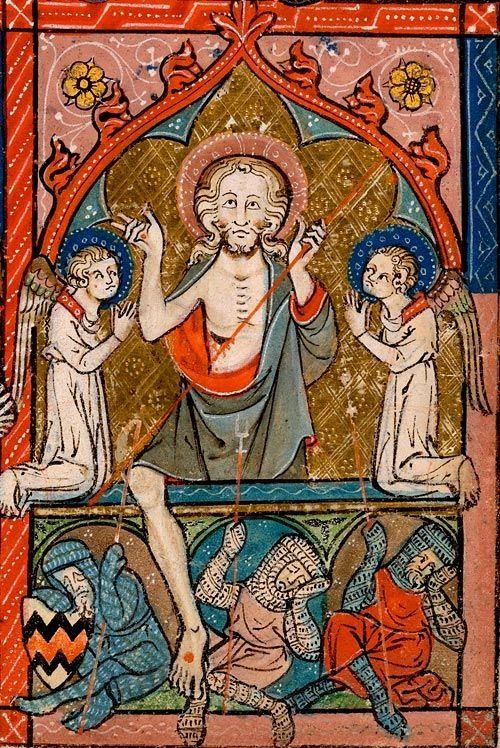
Sunday, April 7, 2024

Annunciation: From the prayers of Saint Catherine of Siena: Proper of the Order of Preachers


Annunciation: From the prayers of Saint Catherine of Siena: Proper of the Order of Preachers


You, O Mary, have been made a book in which our rule is written. In you today is written the eternal Father' s wisdom; in you today our human strength and freedom are revealed.


If I consider your own great counsel, eternal Trinity, I see that in your light you saw the dignity and nobility of the human race. So, just as love compelled you to draw us out of yourself, so that same love compelled you to buy us back when we were lost. In fact, you showed that you loved us before we existed, when you chose to draw us out of yourself only for love. But you have shown us greater love still by giving us yourself, shutting yourself up today in the pouch of our humanity. And what more could you have given us than to give us your very self? So, you can truly ask us, "What should I or could I have done for you that I have not done?"


I see, then, that whatever your wisdom saw, in that great eternal council of yours, as best for our salvation, is what your mercy willed, and what your power has today accomplished.


So, what did you do? What way did your eternal unfathomable wisdom find to fulfill your truth and be merciful, and to satisfy your justice as well? What remedy did you give us? Oh, see what a fitting remedy! You arranged to give us the Word, your only-begotten Son. He would take on the clay of our flesh which had offended you so that when he suffered in that humanity your justice would be satisfied—not by humanity' s power, but by the power of the divinity united with that humanity. And so, your truth was fulfilled, and both justice and mercy were satisfied.


O Mary, I see this Word given to you, living in you yet not separated from the Father—just as the word one has in one's mind does not leave one's heart or become separated from it even though that word is externalized and communicated to others. In these things our human dignity is revealed—that God should have done such and so great things for us.


And even more in you, O Mary, our human strength and freedom are today revealed, for after the deliberation of such and so great a council, the angel was sent to you to announce to you the mystery of the divine counsel and to seek to know your will, and God's Son did not come down into your womb until you had given your will's consent, He waited at the door of' your will for you to open to him; for he wanted to come into you, but he would never have entered unless you had opened to him, saying, "Here I am, God's servant; let it be done to me as you have said."


The eternal Godhead, O Mary, was knocking at your door, but unless you had opened that door of your will God would not have taken flesh in you. Blush, my soul, when you see that today God has become your relative in Mary. Today you have been shown that even though you were made without your help, you will not be saved without your help.


O Mary, my tenderest love! In you is written the Word from whom we have the teaching of life. You are the tablet that sets this teaching before us.

Saturday, April 6, 2024

Friends of the Carthusians

 The following texts written by friends of the monastery, show how Saint Bruno’s charism & spirituality can also touch and transform God seekers who live amidst the challenges and agitations of today’s world.


I consider the Carthusians of both past and present to be a wonderful example of fidelity to Christ and His Church. I first heard of the Order when I was very young, while reading A Silent Life by Merton.


The thought of responding to the Call of Silent Love, to borrow the title of one of the Novice Conference volumes, has for me been a great inspiration. The Carthusian vocation has always reminded me of the Desert Fathers, and thinking of the life helped me reached a place in my heart where my words disappear, and the breath of the Holy Spirit is present. Words are not adequate to describe the fullness of reaching that place, in the depths of the heart, where I find myself united with the Light of His presence, and I can sense the souls that are His are with me, which of course includes St. Bruno and his spiritual family.


Through the years, when my romantic visions of monastic life were replaced by the harsh realities that face both monks and men who live outside the Charterhouse, and through the writings and monastic retreats I was so exposed, I became intimately connected with religious life, and my spiritual growth I feel was enhanced by this exposure.


-Kevin


It is in the midst of the immediate and its surround that the ever-approaching God speaks. It is here, in this present moment, in abiding, in receptive waiting despite the press of goal and schedule and responsibility that I find in each ‘now’ signs of the vast ocean that is the will of God. It is here that I am called to the Father. Finding God in the intimacy of silence and solitude in a manner that reflects the Carthusian spirit gives breadth and focus to this encounter with the Presence that calls to me and that sustains me. Nothing has given me guidance in living aligned with the golden thread that runs through the depth of the self compared to the awakening and homecoming I daily experience in being drawn through the “wound of love” into the portal of the Carthusian mystery.


The silence of the Charterhouse is filled with an unfathomable presence. It is like heart tissue, alive and sentient, vast and deep, austere and pulsating. Through the grace of exposure and intention my life progressively has been shaped around this Carthusian heart of silence and solitude, a shaping that echoes the search for God in the depth of my own heart. I have come to know-through fits and starts and often in the midst of failure–the deep wisdom, the resolute ascesis, the intimate embrace, the hidden silent simplicity of being, the brilliant nothingness, and the whispers of Love that pour forth from the Carthusian heart.


It holds for me contact with a most hidden interiority and with awe at all of creation. It mirrors, as only a sensibility shaped in likeness to the mind of Christ can, the knots of self-absorption and fear and despair that distract me from the path. It infuses me with compassionate attention to the afflicted and hungry and tormented states of being that I encounter in my profession as psychotherapist and in my occasional consulting role at the United Nations.


To follow this path which invites me with insistence is to enter into the desert. This desert of the heart leads me to ever more radical reliance on the guide. Through His counsel I work through struggle toward releasement into the freedom of divine Love. Growth in the desert of contemplation expands through actions of obedience (such as eating one meal a day, periods of fasting, days of recollection, and weeks of reclusion) that are less formally juridical than emergent through the Spirit and under the inspiration of the Carthusian Statutes.


Central to this growth for me is sustenance through devotion to Mary. The contemplative is akin to Mary, said one Carthusian, in that “he receives the Word as a lover’s secret.” I also am fed in this desert that beckons by the fruit of the psalms and by the essence that is the Eucharist.-paschal sacrifice and action of thanksgiving whose interior adoration anchors me in the midst of daily demand. This “Sacramentum Caritas” feeds my soul’s longing and leads me ever more into the silent mystery of the invisible Father’s unapproachable light.


-Elisha


The first image in the amazing documentary “Into Great Silence” is a flame piercing the darkness. Like Christ, that flame keeps alive the monk in whose cell it is burning. While I don’t require a flame from a wood burning stove to keep my body warm like that cloistered monk, I need Christ to keep my soul alive. The Carthusians have provided me with a discipline and an ethos to help me tend that flame, to make it grow and sustain me. There is also great joy in knowing that others, both in the world and in the charterhouses, are daily striving, like me, to tend that vital flame. There is happiness in realizing that those who have persevered before me have reached the point where they have become consumed by the Flame.

Thursday, April 4, 2024

New Liturgical Movement: The Orations of Low Sunday MICHAEL P. FOLEY


New Liturgical Movement: The Orations of Low Sunday


Caravaggio, The Incredulity of St. Thomas, ca. 1602
Lost in Translation #47

Nobody likes it when a good party is over, even when the party stretches out for a remarkable eight days. But all good things (this side of the grave) must come to an end, and so the orations for the Sunday after Easter, which concludes a glorious octave, beg for a way for the joys of the Resurrection to continue even though the main celebration has come to a close.

The Secret for Low Sunday is:
Súscipe múnera, Dómine, quáesumus, exsultantis Ecclesiae: et cui causam tanti gaudii praestitisti, perpétuae fructum concéde laetitiae. Per Dóminum.
Which I translate as:
Receive, we beseech Thee, O Lord, the offerings of Thy exultant Church, and grant to her, to whom Thou hast given cause for such great joy, the fruit of perpetual gladness. Through our Lord.
Similarly, the Postcommunion Prayer is:
Quáesumus, Dómine Deus noster: ut sacrosancta mysteria, quæ pro reparatiónis nostrae munímine contulisti; et praesens nobis remedium esse facias, et futúrum. Per Dóminum.
Which I translate as:
We beseech Thee, O Lord our God, to make the sacrosanct mysteries, which Thou hast bestowed as a fortification of our reparation, a remedy for us both now and in the future. Through our Lord.
“Sacrosanct” is the perfect word for the mysteries (i.e. sacraments) that God has bestowed upon us, for they are both “sacred” – set apart for divine use – and “holy” (sanctus) – infused with the life-giving breath of the Holy Spirit. The sacrament of our reparation is, I suspect, Baptism, which repairs our relationship with God and which the neophytes received last week during the Easter Vigil. But the sacrament that fortifies our repaired life is the Eucharist, which we have just received at this point in the Mass.
It is the Collect that I find particularly fetching:
Praesta, quáesumus, omnípotens Deus: ut, qui paschalia festa perégimus; haec, te largiente, móribus et vita teneámus. Per Dóminum.
Which I translate as:
Grant, we beseech Thee, almighty God, that we who have finished the Paschal feasts may, by Thy bounty, hold onto them in our practices and in our life. Through our Lord.
“Ago” is the Latin verb for doing or making, and “per-ago” (which I have translated as “have finished”) is the verb for thoroughly doing, for carrying an action through to its end. We will, of course, continue to celebrate the Easter season all the way up to Pentecost, but on this Octave Sunday we complete the celebration of Easter Day.
The petition of the Collect subtly traces a movement from outer to inner. The external observance of ritual and ceremony (the “Paschal feasts”) condition our other “practices” or habits outside the liturgy. These habits, in turn, become so internalized that they reconstitute our very “life,” changing our character and our destiny. In some respects, the Collect reflects the moral anthropology of Aristotle’s Nicomachean Ethics but with one key difference: the movement from outer observance to inner transformation cannot succeed without God's bounty. Te largiente literally means “with You giving lavishly.” God not only has to give, but He has to give lavishly, to make the joys of Easter stick to our being and change them forever. So please, God: give lavishly.

Wednesday, April 3, 2024

From an Easter homily by an ancient author


From an Easter homily by an ancient author

Christ the source of resurrection and life

Saint Paul rejoices in the knowledge that spiritual health has been restored to the human race. Just as death entered the world through Adam, so life has been given back to the world through Christ. And again: The first man, being from the earth, is earthly by nature; the second man is from heaven and is heavenly.
  He adds the following: As we have borne the image of the earthly man, (that is, the image of human nature grown old in sin) so let us bear the image of the heavenly man: that is, human nature raised up, redeemed, restored and purified in Christ. We must hold fast to the salvation we have received. As the Apostle himself says: Christ is the beginning (that is, the source of resurrection and life); therefore those who belong to Christ (those who model their lives on his purity) will be secure in the hope of his resurrection and of enjoying with him the glory promised in heaven. As our Lord himself said in the gospel: Whoever follows me will not perish, but will pass from death to life.
  Thus the passion of our Saviour is the salvation of mankind. The reason why he desired to die for us was that he wanted us who believe in him to live for ever. In the fullness of time it was his will to become what we are, so that we might inherit the eternity he promised and live with him for ever.
  Here, then, is the grace conferred by these heavenly mysteries, the gift which Easter brings, the most longed-for feast of the year; here are the beginnings of creatures newly formed: children born from the life-giving font of holy Church, born anew with the simplicity of little ones, and crying out with the evidence of a clean conscience. Chaste fathers and inviolate mothers accompany this new family, countless in number, born to new life through faith. As they emerge from the grace-giving womb of the font, a blaze of candles burns brightly beneath the tree of faith. The Easter festival brings the grace of holiness from heaven to men. Through the repeated celebration of the sacred mysteries they receive the spiritual nourishment of the sacraments. Fostered at the very heart of holy Church, the fellowship of one community worships the one God, adoring the triple name of his essential holiness, and together with the prophet sings the psalm which belongs to this yearly festival: This is the day the Lord has made; let us rejoice and be glad. And what is this day? It is the Lord Jesus Christ himself, the author of light, who brings the sunrise and the beginning of life, saying of himself: I am the light of day; whoever walks in daylight does not stumble. That is to say, whoever follows Christ in all things will come by this path to the throne of eternal light.
  Such was the prayer Christ made to the Father while he was still on earth: Father, I desire that where I am they also may be, those who have come to believe in me; and that as you are in me and I in you, so they may abide in us.

Tuesday, April 2, 2024

Office hymn for Lauds of Eastertide


Office hymn for Lauds of Eastertide. Urban VIII revised it to Aurora caelum purpurat (1632), Aurora lucis rutilat was restored in 1913.


(Lasso and Solesmes 1934)

1  Aurora lucis rutilat,
Coelum laudibus intonat,
Mundus exsultans jubilat,
Gemens infernus ululat.

2  Cum Rex ille fortissimus,
Mortis confractis viribus
Pede conculcans tartara,
Solvit a poena miseros,

3  Ille qui clausus lapide
Custoditur sub milite,
Triumphans pompa nobili,
Victor fugit de funere.

4  Solutis iam gemitibus,
Et infernis doloribus
Quia surrexit Dominus,
Resplendens clamat Angelus,

5  Quae sumus Auctor omnium,
in hoc pascali gaudio,
Ab omni mortis impetu
Tuum defende populum.

6  Gloria tibi Domine,
Qui surrexisti a mortuis,
Cum Patre et Sancto Spiritu,
in sempiterna saecula,
Amen.


1  Light's glittering morn bedecks the sky,
heaven thunders forth its victor cry,
the glad earth shouts its triumph high,
and groaning hell makes wild reply:

2  While he, the King of glorious might,
treads down death's strength in death's despite,
and trampling hell by victor's right,
brings forth his sleeping Saints to light.

3  Fast barred beneath the stone of late
in watch and ward where soldiers wait,
now shining in triumphant state,
He rises Victor from death's gate.

4  Hell's pains are loosed, and tears are fled;
captivity is captive led;
the Angel, crowned with light, hath said,
'The Lord is risen from the dead.'

5  O Christ, the King who lovest to bless,
do thou our hearts and souls possess;
to thee our praise that we may pay,
to whom our laud is due for aye.]

Translation by John Mason Neale

From a discourse by Saint Anastasius of Antioch


From a discourse by Saint Anastasius of Antioch

It was necessary that Christ should suffer and so enter into his glory

Christ, who has shown by his words and actions that he was truly God and Lord of the universe, said to his disciples as he was about to go up to Jerusalem: We are going up to Jerusalem now, and the Son of Man will be handed over to the Gentiles and the chief priests and scribes to be scourged and mocked and crucified.
  These words bore out the predictions of the prophets, who had foretold the death he was to die in Jerusalem. From the beginning holy Scripture had foretold Christ’s death, the sufferings that would precede it, and what would happen to his body afterwards. Scripture also affirmed that these things were going to happen to the God who is immortal and incapable of suffering.
  How could he have been God? We can learn this by reflecting on the true nature of the Incarnation and finding there the reason why we can believe truly and rightly in both his passion and his impassibility: both that he suffered and that it was not in his nature to suffer – the reason, in other words, why the Word of God, otherwise impassible, came to his passion. In fact, man could have been saved in no other way, as Christ alone knew, and those to whom he revealed it; for he knows all the secrets of the Father, even as the Spirit penetrates the depths of all mysteries.
  It was necessary for Christ to suffer: it was impossible for his passion not to have happened. He said so himself when he called his companions dull and slow to believe because they failed to recognise that he had to suffer and so enter into his glory. Leaving behind him the glory that had been his with the Father before the world was made, he had gone forth to save his people. This salvation, however, could be achieved only by the suffering of the author of our life, as Paul taught when he said that the author of life himself was made perfect through suffering. Because of us he was deprived of his glory for a little while, the glory that was his as the Father’s only-begotten Son, but through the cross this glory is seen to have been restored to him in a certain way in the body that he had assumed. Explaining what water the Saviour referred to when he said: He that has faith in me shall have rivers of living water flowing from within him, John says in his gospel that he was speaking of the Holy Spirit which those who believed in him were to receive, for the Spirit had not yet been given because Jesus had not yet been glorified. The glorification he meant was his death upon the cross for which the Lord prayed to the Father before undergoing his passion, asking his Father to give him the glory that he had in his presence before the world began.

Monday, April 1, 2024


An Easter Sermon of St Melito of Sardis

May 6, 2020


From the Easter Sermon of St Melito, Bishop of Sardis, AD 170

“…the Lord Christ arose from the dead and mounted the heights of Heaven. After the Lord had taken our humanity upon Himself, had suffered for the sake of the sufferer, had been bound for the sake of the imprisoned, had been judged for the sake of the condemned, and buried for the sake of the all who were buried, He rose from the dead, and cried aloud with this voice: ‘Who is he who contends with me? Let him stand in opposition to me. I set the condemned man free; I gave the dead man life; I raised up those who had been entombed. 

“ ‘Who is my opponent? I,’ He says, ‘am the Christ. I am the One Who destroyed death, triumphed over the enemy, trampled Hades under foot, bound the strong one, and carried man to the heights of Heaven. I,’ He says, ‘am the Christ. Therefore, come, all families of men, you who have been befouled with sins, and receive forgiveness for your sins. I am your forgiveness, I am the Passover of your salvation, I am the Lamb which was sacrificed for you, I am your ransom, I am your light, I am your Savior, I am your resurrection, I am your king, I am leading you up to the heights of Heaven. I will show you the eternal Father and I will raise you up by my right hand.’ ” 

“This is the one who made the heavens and the earth, and Who in the beginning created man, Who was proclaimed through the law and prophets, Who became human through the Virgin, Who was hanged upon a tree, Who was buried in the earth, Who was resurrected from the dead, and Who ascended to the heights of Heaven. He sits at the right hand of the Father, having authority to judge and to save everything, through Whom the Father created everything from the beginning of the world to the end of the age.

“This is the Alpha and the Omega: the beginning and the end – an indescribable beginning and an incomprehensible end. This is the Christ, the king. This is Jesus, to Whom be the glory and the power world without end. Amen.”