From the Sermons of St. Bernard, Abbot of Clairvaux: The Seven Sorrows of the Holy Virgin
On the twelve stars
The Martyrdom of the Virgin is set before us, not only in the prophecy of Simeon, but also in the story itself of the Lord's Passion. The holy old man said of the Child Jesus, Luke ii. 34, Behold, this Child is set for the fall and the rising again of many in Israel; and for a sign which shall be spoken against; yea, said he unto Mary, a sword shall pierce through thine own soul also Even so, O Blessed Mother! The sword did indeed pierce through thy soul! for nought could pierce the Body of thy Son, nor pierce thy soul likewise. Yea, and when this Jesus of thine had given up the ghost, and the bloody spear could torture Him no more, thy soul winced as it pierced His dead Side His Own Soul might leave Him, but thine could not.
The sword of sorrow pierced through thy soul, so that we may truly call thee more than martyr, in whom the love, that made thee suffer along with thy Son, wrung thy heart more bitterly than any pang of bodily pain could do. Did not that word of His indeed pierce through thy soul, sharper than any two-edged sword, even to the dividing asunder of soul and spirit, Heb. iv. 12, Woman, behold thy son! John xix. 26. O what a change to thee! Thou art given John for Jesus, the servant for his Lord, the disciple for his master, the son of Zebedee for the Son of God, a mere man for Very God. O how keenly must the hearing of those words have pierced through thy most loving soul, when even our hearts, stony, iron, as they are, are wrung at the memory thereof only!
Marvel not, my brethren, that Mary should be called a Martyr in spirit. He indeed may marvel who remembers not what Paul saith, naming the greater sins of the Gentiles, that they were without natural affection, Rom. i. 31. Far other were the bowels of Mary, and far other may those of her servants be! But some man perchance will say Did she not know that He was to die? Yea, without doubt, she knew it. Did she not hope that He was soon to rise again? Yea, she most faithfully hoped it. And did she still mourn because He was crucified? Yea, bitterly. But who art thou, my brother, or whence hast thou such wisdom, to marvel less that the Son of Mary suffered than that Mary suffered with Him? He could die in the Body, and could not she die with Him in her heart? His was the deed of that Love, greater than which hath no man John xv. 13; hers, of a love, like to which hath no man, save He.
Gorgonius was born at Nicomedia. While an officer of the household of Diocletian, he converted to the faith of Christ, with the help of his colleague Dorothy, all the servants of the imperial palace. "To punish them for such audacity, they were hung up and their bodies lacerated by whips; then vinegar and salt were thrown on their uncovered entrails and they were strangled after having been roasted on a gridiron." They were put to death at Nicomedia in A.D. 303. Later, the body of St. Gorgonius was buried at Rome on the Latin Way, whence it was eventually translated to the basilica of St. Peter.
Laetábitur justus in Dómino, et sperábit in eo: et laudabúntur omnes recti corde. * Exáudi, Deus, oratiónem meam, cum déprecor: a timóre inimíci éripe ánimam meam.
The just shall rejoice in the Lord, and shall hope in Him: and all the upright of heart shall be praised. * Hear, O God, my prayer when I make supplications to Thee: deliver my sould from the fear of the enemy.
(Psalm 63:11,2 from the Introit of Mass)
Sanctus tuus, Domine, Gorgonius sua nos intercessione laetificet: et pia faciat solemnitate gaudere.
O Lord, may Thy holy Gorgonius make us glad by his intercession and cause us to rejoice on his holy festival.
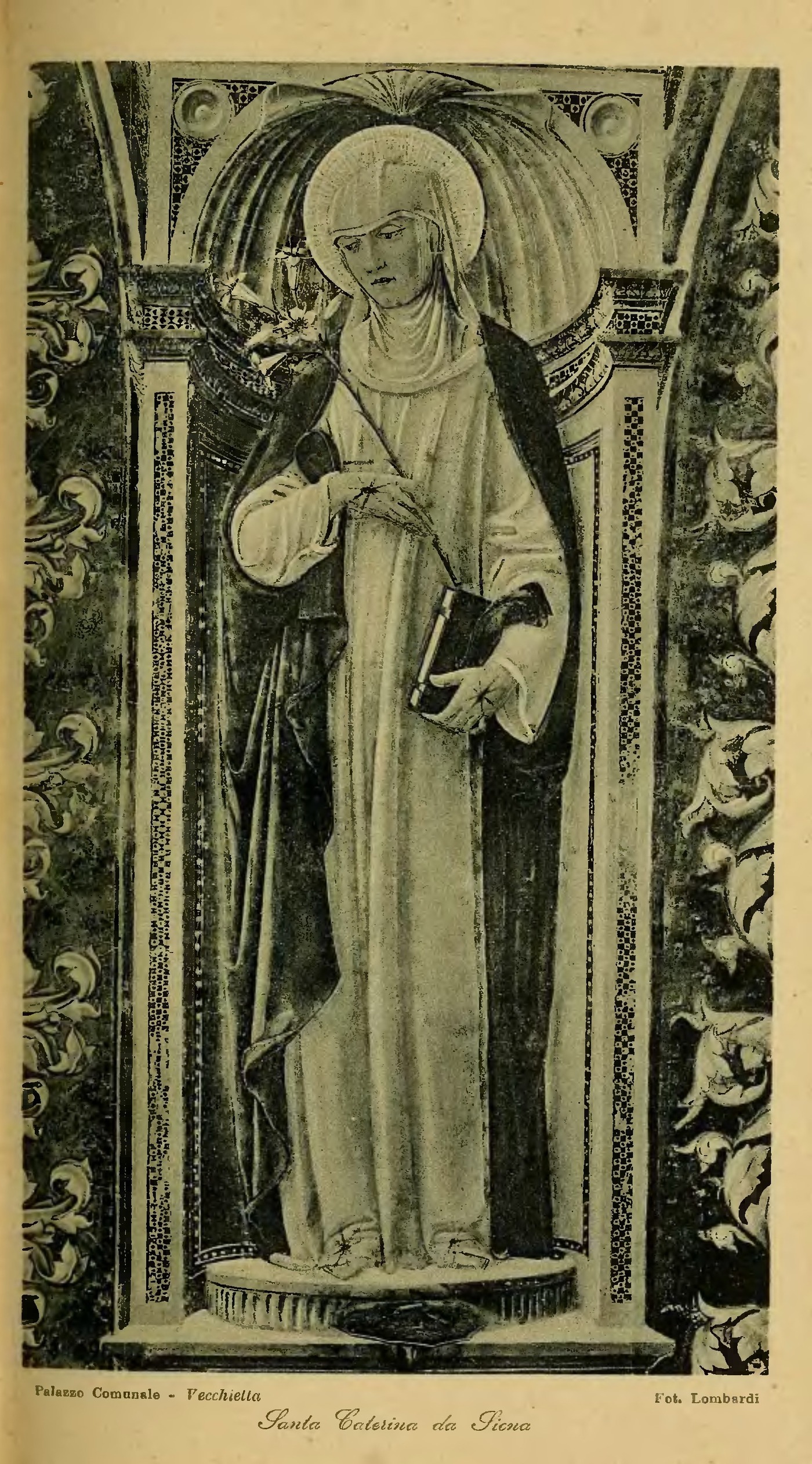
“Dearest brother in Christ gentle Jesus … I long to see you a courageous knight, fighting bravely for the glory and praise of God’s name and the advancement and reform of holy Church.”
“But be aware … that you cannot do this well — you cannot be courageous and come to the help of holy Church — unless you first fight and make war against our three chief enemies, the world, the devil, and our weak flesh. These are the three chief tyrants that kill our soul so far as grace is concerned, no matter what our position, if we use the hand of our free choice to open the gate of our will and let them in.”
“You cannot with a single stroke wipe out all of the sins people in general are committing within the Christian religion, especially within the clerical order, over whom you should be even more watchful. But you certainly can and are obligated to do it, and if you don’t, you would have it on your conscience. At least do what you can. You must cleanse the Church’s womb — that is, see to it that those who surround you closely are wiped clean of filth, and put people there who are attentive to God’s honor and your welfare and the good of holy Church. …”
“Do you know what will happen to you if you don’t set things right by doing what you can? God wants you to reform his bride completely; he doesn’t want her to be leprous any longer. If your holiness does not do all you can about this — because God has appointed you and given you such dignity for no other purposes — God will do it himself by using all sorts of troubles.”
“I see the infernal wolf carrying off your little sheep, and there is no one to rescue them. So I am turning to you, our father and shepherd, begging you in the name of Christ crucified to learn from him who with such blazing love gave himself up to the shameful death of the most holy cross to save this little lost sheep, the human race, from the devil’s hands. Because of its rebellion against God, here are the devils, holding this sheep as their own possession.”
“I tell you in the name of Christ crucified that you must use your authority. ... You are in charge of the garden of the holy Church. So [first of all] uproot from that garden the stinking weeds filled of impurity and avarice, and bloated with pride (I mean the evil pastors and administrators who poison and corrupt the garden). ... Use your authority, you who are in charge of us! Uproot these weeds and throw them out where they will have nothing to administer! Tell them to tend to administering themselves by a good holy life. Plant fragrant flowers in this garden for us, pastors and administrators who will be true servants of Jesus Christ crucified, who will seek only God’s honor and the salvation of souls, who will be fathers to the poor.”
“Where is the purity of the ministers of God’s Son? Reflect that just as you demand that the chalice you carry to the altar be clean and would reject it if it were dirty, so God, supreme eternal Truth, demands that your soul be pure and clean, without stain of deadly sin, especially the sin of impurity. ... These days we are seeing the exact opposite of the purity God requires! Not only are they not God’s temples carrying the fire of God’s word, but they have become stalls, lodging for pigs and other animals! They carry within the house of their souls the fire of anger, hatred, animosity, and ill will. For they harbor pigs, a filthiness that is incessantly rolling about within them like a pig in the mud. ... How bewildering to see Christ’s anointed ones giving themselves over to such wretchedness and immorality!”
“I say you are a pillar to keep this bride’s home safe. So you must be strong, not weak; for weak things topple with the slightest wind — whether that wind is difficulty, or some wrong that may be done to us, or too much of the world’s abundance and prosperity, pleasure and grandeur.”
“Shame, shame, on our human pride, our self-complacency, our self-centeredness, when we see how good God has been to us, how many gifts and graces he has given us — and not because he has to but because he wants to! Obtuse as we are, we seem not to see or feel this love so hot that, if we were made of stone, it would long ago have burst us open! ... I can see no other reason except that the eye of our understanding is not on the tree of the cross. For there is revealed such warm love, such gently persuasive teaching filled with life-giving fruits, such generosity that he has torn open his very body, has shed his life’s blood, and with that blood has baptized and bathed us. We can and should make use of that baptism every day with continual remembrance and great love.”
San Ramón Nonato is associated with secrets and silence. He is the patron saint of both victims of gossip and women in labor. Born in Catalonia in the early 13th century, his mother died in labor and he was surgically removed from her womb.
Raymund was called Nonnatus, or Unborn, because he was brought into life from the side of his dead mother contrary to the common law of nature. He scorned childish games and the temptations of the world and gave himself to works of devotion so that all admired the boy as having the virtues of a mature man. He loved the Mother of God above all and constantly prayed to her. He entered the religious Order called that of Ransom, or of Mercy, for the ransom of captives. He perpetually kept his virginity, which he had already consecrated to the Blessed Virgin, and shone with the other virtues, especially with charity toward the Christians who were living wretched lives under the power of pagans. Gregory IX enrolled him among the Cardinals; but the man of God shrank from all pomp and always held most firmly to the humility proper to a religious. At Cardona, worn out by his last illness and fortified by the Sacraments of the Church, he went to the Lord on the last Sunday of August in the year 1240.
Deus, qui in liberándis fidélibus tuis ab impiórum captivitáte beátum Raymúndum Confessórem tuum mirábilem effecísti: eius nobis intercessióne concéde; ut, a peccatórum vínculis absolúti, quæ tibi sunt plácita, líberis méntibus exsequámur.
Per Dóminum nostrum Iesum Christum, Fílium tuum: qui tecum vivit et regnat in unitáte Spíritus Sancti, Deus, per ómnia sǽcula sæculórum. R. Amen.
O God, Who didst make thy blessed Confessor Raymond to do a wonderful work in delivering thy faithful ones from bondage to the unbelievers, grant unto us at his prayers to be delivered from the chains of sin, and with all willingness of mind to do those things that are pleasing in thy sight.
Through Jesus Christ, thy Son our Lord, Who liveth and reigneth with thee, in the unity of the Holy Ghost, God, world without end. R. Amen.
The first flower of holiness in South America was the maiden Rose. She was born of Christian parents at Lima and in her cradle early gave signs of her future sanctity, for the child's face was wonderfully transformed into the likeness of a rose, and this gave her name. Lest she be compelled by her parents to marry, she secretly cut off her lovely hair. The austerity of her life was most singular. She took the habit of the Third Order of St. Dominic and followed the difficult path of St. Catherine of Siena. For fifteen years, she would suffer terribly for hours at a time from desolation of spirit and from aridity, and bravely bore agonies more bitter than any death. Through frequent apparitions, she enjoyed a wonderful companionship with her Guardian Angel, St. Catherine of Siena, and the Virgin Mother of God, and she was privileged to hear Christ say these words, Rose of my Heart, be thou my bride. Famous for many miracles both before and after her death, she was enrolled in the list of holy Virgins by Pope Clement X.
Bonórum ómnium largítor, omnípotens Deus, qui beátam Rosam, cæléstis grátiæ rore prævéntam, virginitátis et patiéntiæ decóre Indis floréscere voluísti: da nobis fámulis tuis; ut, in odórem suavitátis eius curréntes, Christi bonus odor éffici mereámur:
Almighty God, from Whom cometh down every good and perfect gift, and Who didst cause the dew of thy grace to fall early from heaven upon this blessed Rose, making the same to blossom in the Indies, as a flower whose loveliness was virginity and long-suffering, grant unto thy servants, who do run after the smell of her perfumes, worthily themselves to become a sweet savor unto Christ.
Deus, qui beatam Rosam, tuo amore succensam, mundum relinquere et tibi soli in austeritate paenitentiae vacare fecisti, da nobis, eius intercessione, ut, vias vitae sectantes in terris, torrente deliciarum tuarum perfruamur in caelis.
O God, you set Saint Rose of Lima on fire with your love, so that, secluded from the world in the austerity of a life of penance, she might give herself to you alone; grant, we pray, that through her intercession, we may tread the paths of life on earth and drink at the stream of your delights in heaven.
From the noble family of the Benizi, Philip was called by the most Blessed Virgin, in an extraordinary vision, to enter the recently established Order of her Servants. First he withdrew to a cave on Monte Senario, where he led a life made hard by continual castigation of the body, but sweetened by meditation on the sufferings of Christ the Lord. Then he established sodalities of the Seven Sorrows of the Mother of God throughout almost all Europe and a great part of Asia. He was named General of his Order against his will and, burning eagerly with the ardor of divine love, he traveled about through many of the cities of Italy, settling the disputes which flared up among the citizens, calling back many men to the obedience of the Roman Pontiff and leading even the most abandoned men to repentance. Finally at Todi in the year 1285, embracing the image of Christ the Lord hanging on the Cross, which he used to call his 'book', he died a most holy death. Pope Clement X added him to the number of Saints.
Deus, qui per beátum Philíppum Confessórem tuum, exímium nobis humilitátis exémplum tribuísti: da fámulis tuis próspera mundi ex eius imitatióne despícere, et cæléstia semper inquírere.
Per Dóminum nostrum Iesum Christum, Fílium tuum: qui tecum vivit et regnat in unitáte Spíritus Sancti, Deus, per ómnia sǽcula sæculórum. R. Amen.
O God, Who hast given us in thy blessed Confessor Philip, a wonderful example of lowliness, grant unto thy servants walking in his steps to set little store by the pleasant things of this life, and to seek ever for that glory which Thou hast prepared in heaven.
Through Jesus Christ, thy Son our Lord, Who liveth and reigneth with thee, in the unity of the Holy Ghost, God, world without end. R. Amen.
How soon may I hope for the happy day when I shall irrevocably offer myself to my God? He has so filled me with the thought of being entirely His, and it has come home to me in such a wonderful and powerful manner, that, were my emotion to last as it now is, I could not live under its intensity. Never have I had such a burning love and desire for the evangelical life and for the great perfection to which God calls me. What I feel about it is quite impossible to put into words. But, alas! my resolve to be very faithful to the greatness of the love of this divine Savior is balanced by the feeling of my incapacity to correspond with it. Oh, how painful to love is this barrier of powerlessness! But why do I speak thus? By doing so I degrade, it seems to me, the gift of God which urges me to live in perfect poverty, in humble obedience, and in spotless purity. ~Letter to Saint Francis de Sales, from Saint Jane de Chantal
Born of noble parents at Dijon in Burgundy, Jane Frances Frémiot de Chantal lost her mother while she was still a girl, and commended herself to the care of the Virgin Mother of God. Her father gave her in marriage to the Baron de Chantal, and she shewed herself to be a valiant woman above all others, making herself all things to all persons. When her husband was killed while hunting, she made a vow of continence, and she so mastered herself that she did not hesitate to act as godmother to the son of the man who killed her husband. Lest later on she should be moved from her determination to observe chastity, she renewed her vow and inscribed the most holy Name of Jesus on her breast with a hot iron. With St. Francis de Sales as her spiritual director, who taught her the divine will, she laid the foundations of the religious Institute of the Visitation of Holy Mary, which she spread far and wide. Finally, she bound herself by a vow always to do what she understood to be most perfect. Full of merits, she went to the Lord on the 13th day of December, 1641, at Moulins, and was enrolled among the Saints by Clement XIII.
Omnípotens et miséricors Deus, qui beátam Ioánnam Francíscam, tuo amóre succénsam, admirábili spíritus fortitúdine per omnes vitæ sémitas in via perfectiónis donásti, quique per illam illustráre Ecclésiam tuam nova prole voluísti: eius méritis et précibus concéde; ut, qui infirmitátis nostræ cónscii de tua virtúte confídimus, cæléstis grátiæ auxílio cuncta nobis adversántia vincámus.
Per Dóminum nostrum Iesum Christum, Fílium tuum: qui tecum vivit et regnat in unitáte Spíritus Sancti, Deus, per ómnia sǽcula sæculórum. R. Amen.
O Almighty and merciful God, Who didst enkindle the love of thyself in the blessed Jeanne Frances, Who didst give unto her the grace to make every path of life temporal the straight and narrow way which leadeth unto life eternal, and Who wast pleased to use her as a mean whereby to adorn thy Church with a new sisterhood, grant unto us for that thine handmaid's sake, and at her prayers, that we who know that we have no strength as of ourselves to help ourselves, and therefore do put all our trust in thine Almighty power, may by the assistance of thy heavenly grace, always prevail in all things against whatsoever shall arise to fight against us.
Through Jesus Christ, thy Son our Lord, Who liveth and reigneth with thee, in the unity of the Holy Ghost, God, world without end. R. Amen.