DO YOU THINK THAT a mortal heart grasps the extent
of the Lord's charity towards us? Do you think that a mind burdened by the
weight of an earthly body can understand or realize God's affection towards us?
For whatever sparkles, shines, and gleams with the splendor of heaven, whatever
on earth bursts forth with flowers, whatever pleasant taste there is in fruit,
and whatever joy there is in living beings, have all been made out of love for
us, and have been designed to serve us. But although they are great,
nevertheless, they are small insofar as indicating heavenly love towards us. To
us the principalities of heaven, the heavenly powers, the celestial dominions,
to us the choirs of angels give service with tireless vigilance. But even these
are small and inferior as signs of the intimate bond God has with us, and as
paltry in value as the creature is inferior to his Creator.
2. God, whose face cannot be seen, who is
imperceptible to our sight, who cannot be grasped by our senses, who is
inaccessible to our mind, and not even completely known when his voice is
heard, how often, in how many ways, with how many varieties, and with what
diversity has he adapted himself to human vision! How he has offered and
submitted himself to communion and familiarity with human beings, when he made
Noah a partner in his design! He forewarned him that very shortly the world was
to be purified by a flood, and he carried out his plan for the whole world
under his supervision over the little seed-vessel that was the ark.'
When he came as a guest to Abraham, he very
graciously accepted the invitation, he did not refuse what was offered, he ate
what was served like one who was hungry' and weary, and in this divine exchange
he received and accepted human kindness like one who was in need. Shortly
thereafter the dead members of the old man revive, the sterile womb of the
childless old woman is now awakened, and the nature that had been buried in a
living corpse rises to life to reveal its Author, and although her time had already
passed, she who had believed the one Creator produces very many descendants.
To Moses he comes as a ball of fire in the bush,
then he discusses with his servant what must be done, he is busy in Egypt with
various acts of power, and he is revealed at the will of his servant. He
imposes scourges or he removes them, and in the sea the avenging waves show by
their obedience how great he is and how much he has given to the human being,
when with its swell all dried up the wave yields to the holy ones, and it
provides a wall out of water that solidified, it offers a defense for those to
be freed, and with all its might it crashed down in triumph over the fiercest
of enemies.
In his wondrously intimate bond with the
Israelites God keeps company with them in their camp; at one moment he strikes
a number of pagans with a thunderbolt, at another he pours down hail, at yet
another he levels them with the noisy din of trumpets, so that without a battle
and without a wound, God goes ahead of the battle lines and leads them to
victory. He was present to their needs, he granted individuals their prayers,
he responded quickly to what was asked, he revealed what was hidden, he foretold
the future, he brought to light what was sought, he conferred the kingdom, he
bestowed wealth, he provided rain in due season, he supplied fertile lands, and
with prosperity and honor he endowed his children who kept holy the bond of
marriage.
But he considered this to be still too little, if
he were to show his affection towards us by bestowing blessings on us, but not
also by enduring adversities. After all this he entered his own world in
poverty, he lay in a cradle: thus, as a human being by his crying he implores,
he seeks, he pleads for the loving kindness that he himself has shown to you.
The Parent of a119 has made use of you as a parent, and the One who is higher
than every height lived under your authority; 10 the One whom terrifying things
fear was frightened, the Refuge of all fled, the Ruler of the heavens is a
guest in the homes of sinners, the Judge of the guilty is fed on their bread.
Bridget was born of an aristocratic family in
1303 at Finsta, in the Swedish region of Uppland. She is known above all as a
mystic and the foundress of the Order of the Most Holy Saviour. Yet it must not
be forgotten that the first part of her life was that of a lay woman happily
married to a devout Christian man to whom she bore eight children. In naming
her a Co-Patroness of Europe, I would hope that not only those who have
received a vocation to the consecrated life but also those called to the ordinary
occupations of the life of the laity in the world, and especially to the high
and demanding vocation of forming a Christian family, will feel that she is
close to them. Without abandoning the comfortable condition of her social
status, she and her husband Ulf enjoyed a married life in which conjugal love
was joined to intense prayer, the study of Sacred Scripture, mortification and
charitable works. Together they founded a small hospital, where they often
attended the sick. Bridget was in the habit of serving the poor personally. At
the same time, she was appreciated for her gifts as a teacher, which she was
able to use when she was required to serve at Court in Stockholm. This
experience was the basis of the counsel which she would later give from time to
time to princes and rulers concerning the proper fulfilment of their duties.
But obviously the first to benefit from these counsels were her children, and
it is not by chance that one of her daughters, Catherine, is venerated as a
Saint.
But this period of family life was only a first
step. The pilgrimage which she made with her husband Ulf to Santiago de
Compostela in 1341 symbolically brought this time to a close and prepared her
for the new life which began a few years later at the death of her husband. It
was then that Bridget recognized the voice of Christ entrusting her with a new
mission and guiding her step by step by a series of extraordinary mystical
graces.
Leaving Sweden in 1349, Bridget settled in Rome,
the See of the Successor of Peter. Her move to Italy was a decisive step in
expanding her mind and heart not simply geographically and culturally, but
above all spiritually. In her desire to venerate the relics of saints, she went
on pilgrimage to many places in Italy. She visited Milan, Pavia, Assisi,
Ortona, Bari, Benevento, Pozzuoli, Naples, Salerno, Amalfi and the Shrine of
Saint Michael the Archangel on Mount Gargano. Her last pilgrimage, made between
1371 and 1372, took her across the Mediterranean to the Holy Land, enabling her
to embrace spiritually not only the many holy places of Catholic Europe but
also the wellsprings of Christianity in the places sanctified by the life and
death of the Redeemer.
Even more than these devout pilgrimages, it was a
profound sense of the mystery of Christ and the Church which led Bridget to
take part in building up the ecclesial community at a quite critical period in
the Church's history. Her profound union with Christ was accompanied by special
gifts of revelation, which made her a point of reference for many people in the
Church of her time. Bridget was recognized as having the power of prophecy, and
at times her voice did seem to echo that of the great prophets of old. She
spoke unabashedly to princes and pontiffs, declaring God's plan with regard to
the events of history. She was not afraid to deliver stern admonitions about
the moral reform of the Christian people and the clergy themselves (cf.
Revelations, IV, 49; cf. also IV, 5). Understandably, some aspects of her
remarkable mystical output raised questions at the time; the Church's
discernment constantly referred these back to public revelation alone, which
has its fullness in Christ and its normative expression in Sacred Scripture.
Even the experiences of the great Saints are not free of those limitations
which always accompany the human reception of God's voice.
Yet there is no doubt that the Church, which
recognized Bridget's holiness without ever pronouncing on her individual
revelations, has accepted the overall authenticity of her interior experience.
She stands as an important witness to the place reserved in the Church for a
charism lived in complete docility to the Spirit of God and in full accord with
the demands of ecclesial communion. In a special way too, because the
Scandinavian countries from which Bridget came were separated from full
communion with the See of Rome during the tragic events of the sixteenth
century, the figure of this Swedish Saint remains a precious ecumenical
“bridge”, strengthened by the ecumenical commitment of her Order.
St. Cyril of Alexandria: On the Gospel of John
1.35-42
35, 36Again the next day after John stood, and two of his disciples, and
looking upon Jesus as He walked, he said, Behold the Lamb of God, Which taketh
away the sin of the world.
Already had the blessed Baptist pointed Him out
before; but lo, repeating again the same words, he points Jesus out to his
disciples, and calls Him the Lamb of God, and says that He taketh away the sin
of the world, all but bringing his hearers to remembrance of Him Who said in
the Prophets: I, even I, am He That blotted out thy transgressions, and will
not remember thy sins. But not in vain does the Baptist repeat the same account
of the Savior. For it belongs to skill in teaching, to infix in the souls of
the disciples the not yet received word, not shrinking at repetition, but
rather enduring it for the profit of the pupils. For therefore does the blessed
Paul too say, To write the same things to you, to me indeed is not grievous,
but for you it is safe.
37And the
two disciples heard him speak, and they followed Jesus.
See thou the fruit, handmaid of teaching, yielded
therefrom? See thou how great gain accrued from repetition? Let him then who is
entrusted with teaching learn from this, to shew himself superior to all
indolence, and to esteem silence more hurtful to himself than to his hearers,
and not to bury the Lord's talent in listless sloth, as in the earth, but
rather to give His money to the exchangers. For the Savior will receive His own
with usury, and will quicken as seed the word cast in. You have here a most excellent
proof of |149 what has been said. For the Baptist, not shrinking from pointing
out the Lord to his disciples, and from saying a second time, Behold the Lamb
of God, is seen to have so greatly profited them, as to at length even persuade
them to follow Him and already to desire discipleship under Him.
38 Then Jesus turned and saw them following, and
said unto them, What seek ye?
Fitly does the Lord turn to them that follow Him,
that thou mayest learn in act that which is sung, I sought the Lord, and He
heard me. For while we do not yet seek the Lord by good habits and Tightness in
believing, we are in some sort behind Him: but when, thirsting after His Divine
law, we track the holy and choice way of righteousness, then at length will He
look upon us, crying aloud what is written, Turn ye unto Me, and I will turn
unto you, says the Lord of Hosts. But He said unto them, What seek ye? not as
though ignorant (whence could it be so?), for He knows all things, as God; but
making the question a beginning and root of His discourse.
They said unto Him, Rabbi, where dwellest Thou?
Like people well instructed do they that are asked
reply. For already do they call Him, Master, thereby clearly signifying their
readiness to learn. Then they beg to know His home, as about therein to tell
Him at a fit season of their need. For probably they did not think it right to
make talk on needful subjects the companion of a journey. Be what is said again
to us for a useful pattern.
39 He said unto them, Come and see.
He doth not point out the house, though asked to
do it, but rather bids them come forthwith to it: teaching first, as by
example, that it is not well to cast delays in the way of search after what is
good (for delay in things profitable is altogether hurtful): and this too
besides, that to those who are still ignorant of the holy house of our Savior
|150 Christ, that is, the Church, it will not suffice to salvation that they
should learn where it is, but that they should enter into it by faith, and see the
things mystically wrought therein.
They came and saw where He dwelt, and abode with
Him that day: for it was about the tenth hour.
Assiduously did the disciples apply themselves to
the attainment of the knowledge of the Divine Mysteries. For I do not think
that a fickle mind beseems those who desire to learn, but rather one most
painstaking, and superior to feeble mindedness in good toils, so as during
their whole life time to excel in perfect zeal. For this I think the words,
they abode with Him that day, darkly signify. But when he says, it was about
the tenth hour, we adapting our own discourse to each man's profit, say that in
this very thing, the compiler of Divinity through this so subtle handling again
teaches us, that not in the beginning of the present world was the mighty
mystery of our Savior made known, but when time now draws towards its close.
For in the last days, as it is written, we shall be all taught of God. Take
again I pray as an image of what has been said about the tenth hour, the
disciples cleaving to the Savior, of whom the holy Evangelist says that having
once become His guests they abode with Him: that they who through faith have
entered into the holy house, and have run to Christ, may learn that it needs to
abide with Him, and not to desire to be again estranged, either turning aside
into sin, or again returning to unbelief.
40, 41, 42One of the two which heard John speak and followed Him, was Andrew Simon
Peter's brother. He first finds his own brother Simon, and said unto him, We
have found the Messiah, which is, being interpreted, the Christ. And he brought
him to Jesus.
They who even now received the talent, straightway
make traffic of their talent, and bring it to the Lord. For such are in truth
obedient and docile souls, not needing many words for profit, nor bearing the
fruit of their instruction, |151 after revolutions of years or months, but
attaining the goal of wisdom along with the commencement of their instruction.
Forgive, it says, instruction to a wise man, and he will be yet wiser: teach a
just man, and he will increase in learning. Andrew then saves his brother (this
was Peter), having declared the whole mystery in a brief summary. For we have
found, he says, Jesus, as Treasure hid in a field, or as One Pearl of great
price, according to the parables in the Gospels.
In Praise of Hiddenness: ON THE PARADOX OF
CONCEALMENT: by a Camaldolese Hermit
In Communist countries not so long ago, the media
never reported earthquakes, floods, train wrecks, disasters of all kinds, and
other tragedies. Such occurrences were considered as the negation of the then
prevailing dogma according to which the Soviet man must of necessity control
all the events of the planet. The ideal of such a society being success, and a
today always more glorious than yesterday, all disasters must therefore be
concealed, denied. Catastrophes occur only in capitalist countries.
Now the society in which we live is in fact
dominated by this same idol of success, of perpetual youth, of obligatory
efficiency. Human pride, which tries strenuously to do without God and His
laws, is unable to give meaning to earthly distresses and even simply to admit
them. Among us, it is true that we are informed of our ordeals either by word
of mouth, or by the press, radio, and television, but inevitably with
indignation, protests, and accusations.
In short, the setback should not have occurred,
and that is why we immediately look for the culprits that caused it. If
something goes awry, then certainly somebody did not do his duty and should be
condemned. For instance, it is even difficult to admit that an earthquake could
not be foreseen and avoided. Why did not those responsible arrange everything
so as to exclude all damage of goods and persons? Likewise, regarding the
recent bad floods. A number of mayors and magistrates expect proceedings to
start against them. . . It is certainly true that sometimes one sins by
omission, but it seems that this clumsy search for culprits in all our
misfortunes often has this strange idea as its underlying motive: man must be
the absolute master of all, even of nature itself. To admit that certain
calamities are natural and inevitable would be to agree that the human
condition is fragile and, in the final reckoning, a state of death.
In the past, the faithful Christian accepted
mishaps, seeing in trials a means God makes use of to punish us for our
aberrations or to purify us and to prepare us for eternity. Today, a disaster
is not seen at all as a challenge to faith or as a stimulus to abandon
ourselves into God's hands, but rather just as a provocation to anger. Now
anger supposes an enemy to shoot at, to unload on. Man's failure is a scandal
and unacceptable. From the moment man wants to free himself from God, without
really having the power, he needs to feel himself a victor. Success is for him
more necessary than the air he breathes. He knows well, however, that
"success" is not a name of God — at least not of the God of Christian
revelation. But as in every error there is a grain of truth, so when the hour
arrives that will put an end to history and reveal the Kingdom of God in all
its grandeur, when at last the new heavens and the new earth will appear, it is
then that we will be able to say that God's name is Victory.
The idolatry of success in our wounded humanity
reveals itself in the great illusion that tries to mask the enormous defeat
called death. The human victories of science and technology vanish with this
defeat, this last enemy that will be overcome by the resurrection of Christ.
The desire for success inscribed in the depths of our
being is certainly not at all condemnable in itself, for it is the natural
object of all we undertake, even if it is not always attained. Success in our
existence represents, without a doubt, a true value, a good that we call
"merit" in our Christian tradition. We have “to merit" heaven
even though, in reality, it is a question of a gratuitous gift of God. But
personal success is altogether compatible with material failure; the sick, the
unfortunate, the handicapped can have a greater dignity, merit, and moral worth
than the worth of celebrities written up in widely circulated newspapers. It is
man's lot to live with failure, but likewise to lay hold of suffering and to
use it as raw material for his human and divine success, his merit, his
salvation, and his glory.
Yet the temptation certainly exists among us to
want to establish God's Kingdom already on this earth. This is precisely, mark
well, the temptation that Jesus repulsed in the desert at the beginning of His
public ministry and preaching of the Gospel: "The Kingdom of God will not
be realized through a historic triumph resulting from an ever-increasing
ascendancy, but rather by God's victory over the ultimate unchaining of evil,
which will make His Bride descend from heaven." This is our hope.
The life and message of St. Bonaventure can provide a framework for understanding both the world and your personal calling.
When did “God” become more than a word to you? When, even for just a moment, did you glimpse the meaning of your life and personal vocation? When, in the midst of the challenges and complexities of adult responsibilities, did you regain the joy and passion you felt as a child? Or, in a time of trouble, struggling to find your way, how did God’s amazing grace become real to you and, though the path remained difficult, you knew that God was with you and trusted that you would find your true home? Perhaps it was the birth of your child or grandchild, a starry night in the Rockies, a sunrise at the beach, a time when you hit rock bottom and discovered the Rock, your child received a cancer diagnosis, or you felt Christ come alive in the bread and wine.
At such moments, we are forever changed. Despite our imperfections and struggles, life becomes brighter and more colorful or perhaps more fragile, new energies emerge, and we discover, as did mystic-activist Dorothy Day, that each person we meet is holy, and that we should speak to all people as if they were angels. We know that we are in God’s hands, and God will never abandon us.
These moments of spiritual transformation may not be dramatic but, when they occur, our lives are never the same. The world truly does become charged with God’s grandeur (as the Jesuit poet Gerard Manley Hopkins wrote), the heavens declare the glory of God, and we realize that nothing, not even our greatest fears, can separate us from the love of God.
The Apostle Paul said that without love, “I am a noisy gong or a clanging cymbal” (1 Cor 13:1). The same applies to philosophers and theologians. Without an experience of God’s loving presence, our words are dry, brittle, and unconvincing to ourselves and our readers. This was true for St. Bonaventure, and it has made all the difference in the world to me.
In his early 40s, having been recently appointed as minister general of the Franciscan friars, the philosopher-priest Bonaventure, “under a divine impulse,” retreated to La Verna, Italy, the site of St. Francis’ vision of “the winged Seraph in the form of the Crucified.” Bonaventure had been “seeking peace with a panting spirit” to find a way to face his new responsibilities as the spiritual leader of the Franciscan Order.
At La Verna, as he was reflecting on Francis’ vision, Bonaventure saw “all at once” the meaning of Francis’ vision and his guidance on the soul’s journey to God. Bonaventure felt spiritually uplifted as he meditated on Francis’ experience of the six-winged seraph. Now he knew firsthand the contours of Francis’ mysticism as he received in that moment the outline of The Soul’s Journey into God. His theology came alive, the words and stories of Francis and Jesus became flesh, and he experienced God’s inspiration mediated through the mystical experience of God’s humble servant, Francis of Assisi. Bonaventure the philosopher and administrator truly became a mystic. His words and meditations became electrified by God’s love.
An Inspiring Example
As a writer and theologian, I can easily identify with Bonaventure. He was a holistic theologian who saw theology as a spiritual as well as an intellectual enterprise. Like Bonaventure, I first entered graduate studies to become a scholar, a philosopher of religion, and a theologian. But, as did the 13th-century saint, I felt called to ministry during my graduate studies. In the spirit of Bonaventure, I wanted to join heart, head, and hands. I wanted to live my theological vision intellectually, spiritually, relationally, emotionally, and practically in my daily life as a scholar, pastor, husband, and father. I wanted my writing, preaching, and pastoral care to come alive in ways that inspired others to embody God’s presence in their lives. I found that healthy and life-transforming theology is an act of love, grounded in prayer and the ongoing quest to experience God’s grace coursing through body, mind, spirit, and relationships.
Bonaventure soared to the heavens in speculative theology and spirituality and then returned to earth to face the challenges of organizing a religious order, dealing with institutional controversies and potential schisms, and attempting to reconcile the Eastern and Western branches of Christianity. Following in the footsteps of the crucified Christ and Francis of Assisi, whom he saw as the embodiment of Christ’s mission, Bonaventure crafted a theological vision inspired by the spiritual virtues of grace, devotion, wonder, joy, piety, love, humility, wisdom, and inspiration. Some historians cite Bonaventure as one of the first theologians to craft a text on institutional leadership, unique in his counsel “about how to get the community to live up to its ideal.”
Devoted Follower of St. Francis
Little is known of the details of Bonaventure’s life. Like Francis and Clare, he was born into privilege, most likely in 1217. Like Francis and Clare, he anticipated a life of material comfort, intellectual stimulation, and financial success during a time of great poverty and social unrest.
His father, Giovanni di Fidanza, was a wealthy physician married to Maria di Ritello. He grew up in Bagnoregio, a village in central Italy located between Viterbo and Orvieto, 56 miles northwest of Rome. Bonaventure was baptized as Giovanni, or John, after his father, and he received the name Bonaventure upon entering the Franciscan Order.
At age 17, he began studying theology at the University of Paris, where he encountered Franciscan friars whose integration of mind, heart, and hands transformed his life and mission. Some scholars speculate that Francis of Assisi may have stopped in Bagnoregio on his various pilgrimages, although there is no direct evidence that the child Bonaventure met the saint he came to love and follow.
From his first years, Bonaventure was shaped by the spirit of Francis. Bonaventure places Francis at the heart of his miraculous recovery when he was ill as a child: “God’s numberless favors granted through Francis in various parts of the world do not cease to abound, as I myself who have written this life have verified. For as I lay seriously ill while still a child, I was snatched from the very jaws of death and restored to perfect health owed to a vow made by my mother to the blessed Father Francis.”
“The heavens declare the glory of God, and we realize that nothing, not even our greatest fears, can separate us from the love of God.” —Gerard Manley Hopkins
As Bonaventure grew older, Francis’ teachings saved him theologically and spiritually. Bonaventure couldn’t help but give thanks for Francis’ impact on his life. “When I was a boy, as I vividly remember, I was snatched from the jaws of death by his [Francis’] invocation and merits. So if I remained silent and did not sing his praises, I fear that I would be rightly accused of the crime of ingratitude. I recognize that God saved my life through him, and I realized that I have experienced his power in my very person.” I suspect that that gratitude to Francis characterized his daily prayers. The spirit of Francis that first saved young Giovanni’s life later enlightened and enlivened his soul.
At the University of Paris, Bonaventure studied with the renowned scholar Alexander of Hales (1185–1245), an Englishman who had entered the Franciscan Order later in life, at age 50. Alexander was the right person at the right time to teach young Bonaventure. Alexander spoke to Bonaventure’s spirit, recognized and encouraged his potential to become a spiritual leader, and opened the door to his lifetime integration of spirituality and theology in the Franciscan tradition.
Bonaventure was also at first intellectually and then spiritually captivated by the humble Francis, whom he perceived to be the fullest embodiment of Christ. Bonaventure described Francis as the second Christ and the pinnacle of spiritual evolution. This description may sound intense, but in the simplicity of Francis’ life, Bonaventure experienced what it meant to live out Jesus’ spirit in a way similar to our Savior’s first followers.
A Journey of Faith
Later, during a time of controversy in the Franciscan Order, Bonaventure affirmed the simplicity of the first Franciscans in contrast to those who sought to accommodate the Franciscan movement to the greater comforts and stability of academic and cultural life.
“Do not be upset that in the beginning, friars were simple and unlettered. This ought rather to strengthen your faith in the order. For I acknowledge before God that what made me love the life of the blessed Francis so much was the fact that it resembled the beginning and growth of the Church. As the Church began with simple fishermen and afterward developed to include renowned and skilled doctors, so you will see it to be in the case of the Order of Blessed Francis. In this way, God shows that it was not founded by the prudence of men, but by Christ.”
Bonaventure believed that, regardless of how much we grow intellectually, our faith is incomplete if we are cut off from the wellsprings of the simple Galilean and his apostles. Theology without experiencing God’s presence is harsh and uninspiring. This was true in the 13th century, and it is true for us today. Without love and grace, even our most erudite theological reflections cannot transform our lives and enable us to face life’s challenges and tragedies with hope and faith. Bonaventure shows us that the way of Francis provides a path to live out Christ’s spirituality of simplicity and compassion in our time and place.
Bonaventure entered the Franciscan Order in 1243, in his mid-20s, under the direction of Alexander of Hales. In Franciscanism, the intellectual Bonaventure found a path for the heart. Pope Sixtus IV affirmed that Bonaventure was “great in learning, but no less great in humility and holiness. His innocence and dove-like simplicity were such that Alexander of Hales, the renowned doctor whose disciple Bonaventure became, used to say of him that it seemed as if Adam had never sinned in him.”
Bonaventure progressed in the Franciscan Order and was appointed its chief minister and spiritual leader at age 40. As minister general, Bonaventure sought to maintain the spirit of Francis while ensuring the long-term health and survival of the order. He gracefully accomplished the difficult tasks of any administrator by being open to new ideas and fresh ways of seeing things, promoting changes to suit the demands of the times, and including friars as professors and domestics rather than just wandering preachers, yet honoring and preserving the foundational spirit that gave birth to the tradition.
In my professional life as a seminary and university administrator, I have discovered, like Bonaventure, that healthy institutional life involves the creative synthesis of order and novelty, tradition and transformation, stability and change. A good administrator must preserve the wellsprings of the institution—in this case, the simpli-city of Francis and his mendicant lifestyle, committed to holy poverty—while supporting the growth of academic ministry attached to a particular institution.
In his mid-50s, Bonaventure was appointed cardinal-bishop of Lyons by Pope Gregory X and asked to prepare for the Second Council of Lyons. The year was 1273.
The council intended to reform the Western Church and integrate its various forms of ministry, ranging from the unsettledness and poverty of wandering friars to the relative stability and comfort of the secular clergy.
Bonaventure also tried to heal the divisions between the Roman and Greek Churches. Although he and others nearly reconciled the Catholic and Orthodox communions, the quest for Christian unity eventually failed due to theological disagreements that still exist today.
During the council, Bonaventure passed away. Some suggest that he died as a result of the stress involved in securing Christian unity. Others believe that he died of the plague, while some suspect that he was poisoned, perhaps by those who preferred schism to unity and the love of power to the power of love. He was praised by Orthodox and Catholic leaders, however, and Pope Sixtus IV canonized him in 1482. Bonaventure’s feast day is July 15.
In 1588, Bonaventure was given the title Doctor Seraphicus (the Seraphic Doctor). Christ appeared as a seraph to Francis when he received the stigmata on Mount La Verna. Therefore, it is also fitting to use this term to describe the soaring mysticism of Bonaventure, who believed that Christ was his ever-present companion, healing him as a child through Francis, revealing his glory at La Verna, and guiding him as a spiritual leader and administrator.
A Theologian for Our Time
Theological reflection is not restricted to academic scholars or ordained ministers. Healthy theology, grounded in our concrete experiences of God’s presence in worship, work, and daily life, helps us to experience God’s guidance and provides hope in times of challenge. Bonaventure’s writings give counsel and direction for 21st-century people seeking to follow Christ’s way. The Seraphic Doctor believed that God is a fountain of love flowing through the world—and, therefore, through our lives.
Bonaventure experienced God’s love as revealed in the humility and suffering of Christ, whose cross enables us to experience God’s companionship and the power to change our lives. Bonaventure wanted to share the Franciscan experience of intimacy with God not only with monks and priests but with “ordinary” people who can embody this same love in the spiritual integration of head, heart, and hands.
Saint Bonaventure: Mary as Queen; Queenship of
Mary: Royal Dignity of the Blessed Virgin Mary
The Blessed Virgin Mary is the Mother of the great
King by reason of a noble kind of conception according to the message given her
by the Angel. "Behold," he said, "thou shalt conceive and shall
bring forth a Son"; and again, "The Lord God will give Him the throne
of David His father, and He shall be king over the house of Jacob forever; and
of His kingdom there shall be no end." This is as if to say in so many
words, "Thou shalt conceive and bear a Son who is King, eternally reigning
on the royal throne, and because of this thou wilt reign as the Mother of the
King, and as Queen thou wilt be seated on the royal throne." For if it
becomes a son to give honor to his mother, it is also fitting that he share his
royal throne with her; and so the Virgin Mary, because she conceived Him on
whose thigh was written, "King of kings and Lord of lords," was Queen
not only of earth but also of heaven as soon as she conceived the Son of God.
This is indicated in the Apocalypse where it says, "A great sign appeared
in heaven: a woman clothed with the sun, and the moon was under her feet, and
upon her head a crown of twelve stars."
Mary the Queen outshines all others in glory, as
the Prophet clearly shows in the Psalm which particularly concerns Christ and
the Virgin Mary. It first says of Christ, "Thy throne, O God, stands
forever and ever," and shortly thereafter of the Virgin, "The queen
takes her place at Thy right hand," that is, in the position of highest
blessedness, for it refers to glory of soul. The Psalm continues, "In
garments of gold," by which is meant the clothing of glorious immortality
which was proper to the Virgin in her Assumption. For it could not be that the
garment that clothed Christ, the garment completely sanctified on earth by the
incarnate Word, should be the food of worms. As it was fitting for Christ to
grant the fullness of grace to His Mother at her Conception, so it was fitting
that He grant her the fullness of glory at her Assumption. And so, we are to
hold that the Virgin, glorious in soul and body, is enthroned next to her Son.
Mary the
Queen is also the distributor of grace. This is indicated in the book of Esther
in the passage, "The little spring which grew into a river and was turned
into a light and into the sun." The Virgin Mary, under the type of Esther,
is compared to the out- pouring of a spring and of light, because of the
diffusion of graces for two uses, that is, for action and for contemplation.
For the grace of God, which is a healing for the human race, descends to us
through her as if through an aqueduct, since the dispensing of grace is
attributed to the Virgin not as to its beginning, but because of her position
through merit. By position the Virgin Mary is a most excellent Queen towards
her people: she obtains forgiveness, overcomes strife, distributes grace; and
thereby she leads them to glory.
Beatitude and the reward of the Saints in Heaven consist in the clear, immediate knowledge of the Divinity and the full happiness it brings. In this vision a person sees together the entire Holy Trinity with his sight full of glory because the Father, the Son and the Holy Ghost are one only essence, the one same God, the same sovereign good that the person enjoys.
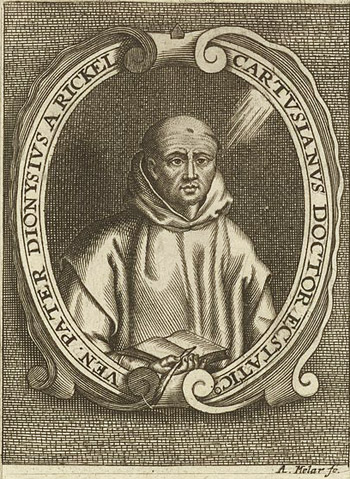
Blessed Denis (1402-1471)
Now then, this beatific vision is ineffable in its joy and sweetness, and it completely fulfills, completes and satisfies all the desires of the Saints. For this reason, the Prophet speaking of God writes: “Only the sight of Thy Face will inebriate me with joy for Thou will make those at Thy right hand enjoy endless delights. I will be satiated for I will be able to contemplate Thy glory.”
In effect, the more a thing is superior in effect and excellence, the more we feel the happiness of clearly possessing it, above all if we love its presence and fervently desire it. Now, God is the infinite beauty. Or, better said: by His essence He is invariable beauty; moreover, He is beauty that never ends, most pure, brilliant, complete and agreeable; the original beauty whence comes all the beauty of the creatures – all infinitely far from His – emanating as from a fountain.
The more a thing is superior to us in beauty and excellence, the more we feel the joy of definitively possessing it.
What is more beautiful than the truth? God is truth itself. What is more pure than sanctity? God is sanctity itself. What is more luminous than wisdom? God is wisdom itself.
God is the first truth that subsists of itself, the eternal sanctity that never ends and the fountain of wisdom that cannot be measured or dimmed in its effusion. He is, therefore, truly, essentially and incomparably beautiful and most amiable in Himself.
We also say that the Saints in the Celestial Kingdom love God most ardently. This is why they contemplate Him, as in a delirium of inexpressible joy, all the greater since they no longer desire anything else.
It is certain that when we see goodness, perfection and sweetness in a person, we appreciate him more. Now, God is the sovereign goodness, the immense sweetness and the complete perfection; He is all treasures, all richness and all delights joined together in an infinite degree.
Then, what delight in possessing this infinite joy, this divine goodness, enjoying them through the clear knowledge of the beatific vision! Doubtless this is the sweetest and most joyous banquet! It is the sacred banquet where the Divinity and the Eternal Trinity become food for men!
Comments of Prof. Plinio:
The Saints know God with all clarity and immediately, that is, not through an image, idea or other intermediary thing, but straightforwardly. This knowledge is delightful; it is a thing that fills the Saints with pleasure.
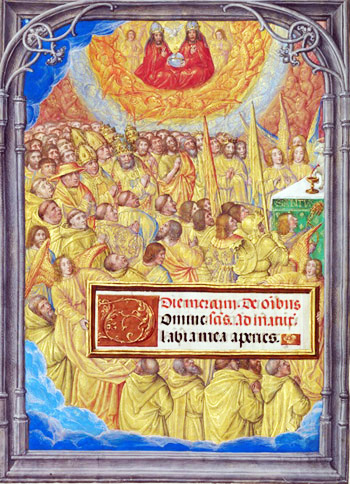
The Saints in Heaven enjoy the Beatific Vision
In the beatific vision they see the very essence of God in a most clear way and without any veil.
He who contemplates the essence of God sees in the same gaze the Father, the Son and the Holy Ghost because They constitute the One and Triune essence of God. This knowledge is the delight of all delights, the joy of all joys.
To explain why the Saints have this enormous joy in the contemplation of God face-to-face, Blessed Denis uses a very profound principle that can be verified by our own immediate experience.
For example, each one of you who sees this table in front of me, considers how beautiful its feet are, how its wood is solid and good, and how it fulfills its final end has a sensation of enjoyment. It is because of the general principle that Blessed Denis enunciates: “The more a thing is superior to us in beauty and excellence, the greater is the joy we feel in possessing it directly.”
If someone comes to us and says: “Look, behind that screen there is a marvelous stone that shines with a unique brilliance, exuding marvelous lights, etc.” When he pauses in his eulogy, we normally would say to him: “Why do you not just remove this screen and let us see the stone directly?”
This is a natural reaction, for the contemplation of something very superior in beauty attracts our curiosity, our desire to know it directly, and when we know it, we are filled with a great sense of well-being in our soul.
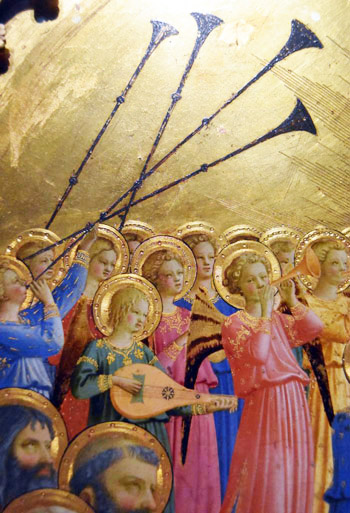
Angels trumpet the glory of the Divine Trinity
Now, God is a Being of a beauty, perfection and excellence that is unmatched by any precious stone. The result is that the direct knowledge of Him is for us extremely delicious and marvelous and gives us an extraordinary happiness.
At a certain point Blessed Denis the Carthusian says that the Saints have a kind of delirium of joy. The delirium he speaks of here is not the earthly state of a man who has a fever, becomes semi-crazy and enters into a delirium saying things that make no sense. There is no disorder in the delirium of which he speaks.
Man has in his nature a tendency toward the plenitude of happiness. He desires a happiness that is, so to speak, greater than himself, that fills him completely with joy and brings him to the very height of his enthusiasm.
This sort of insatiability makes us always desire more, always more, without ever stopping. We shall satisfy this insatiability and have this joy without end when we shall see God face-to-face. It is a kind of apotheosis of admiration and enthusiasm, without tedium and always restful, that we will have for all eternity. What tires in enthusiasm is the stress it brings. What tires in rest is its lack of enthusiasm. This is part of our human weakness.
In this valley of tears what is grand raises our enthusiasm and then tires us. God created the small beautiful things to make us admire them when we are tired of the grand. It is the delight of the small thing that allows us not to lose the taste for the marvelous. So, among the flowers, we have the grandiose and solemn rose and the splendorous and exotic orchid; but then we have the forget-me-not to rest us. “What a beautiful small little thing,” we say.
An excellent exercise: to consider the gaze of Our Lord Jesus Christ
An analogous thing occurs with respect to our rest. A man stops to rest for a while – What a delight! Then, the rest continues, and goes on and on... in the end he can no longer bear it. Its mediocrity and emptiness become unbearable.
In our human state there is an opposition between enthusiasm and rest. But in contemplating God, we will be perpetually at the very height of our enthusiasm and the summit of our rest. Blessed Denis then goes on to describe the infinite goodness, sweetness and perfection that are in God.
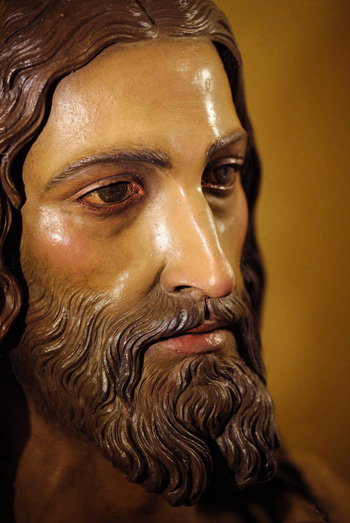
For us to make a good meditation, we should not to think only on God the Father, but also on Our Lord Jesus Christ, and try to imagine, based on the Holy Shroud of Turin, how He had all these qualities. If we could look at Him in His humanity, His divinity would reveal itself. In a certain way, we could see all these qualities in Him.
For example, a thing that I like to imagine is the many gazes of Our Lord. I would like to know His gazes: He returns home after a journey and looks at Our Lady. What would that gaze be? What would be His gaze as a boy looking at Her to express something without speaking? His gaze at St. John when the Apostle rested his head over His chest? His gaze at the Apostles sleeping at the Garden of Gethsemane? His final gaze from the Cross? His gaze after He resurrected? His last gaze at men before His ascension into Heaven.
I have the impression that if Our Lord were to condescend to gaze at us, it would be such a great delight for our souls that we would want to spend all eternity contemplating those eyes. Nothing else would be necessary. If we could know those gazes it would not be the beatific vision, but it would be the most accessible idea of the beatific vision we could have.
I suggest that you think about the gazes of Our Lord.