Showing posts with label Theologie de la Liturgie des Heures. Show all posts

Monday, November 19, 2018

The Presence of Mary in the Mystery of Worship (La presencia de María en el misterio del culto)

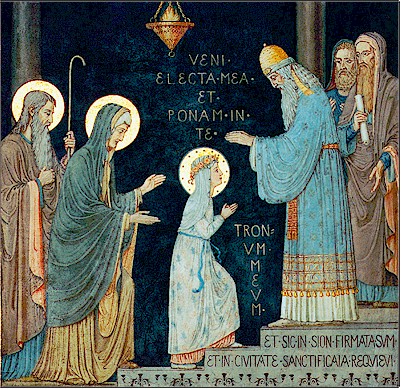
Related image


To the offering of Christ are united not only the members still here on earth, but also those already in the glory of heaven. In communion with and commemorating the Blessed Virgin Mary and all the saints, the Church offers the Eucharistic sacrifice. In the Eucharist the Church is as it were at the foot of the cross with Mary, united with the offering and intercession of Christ (Catechism of the Catholic Church: 1370).

The Blessed Virgin Mary is intimately united both to Christ and to the Church and is inseparable from both. She, therefore, is united in that which constitutes the very essence of the liturgy: the sacramental celebration of Salvation for the glory of God and the sanctification of man. Mary is present at the liturgical action because she was present at the salvific event.

She is next to every baptismal font where the members of the Mystical Body are born to the divine life, in faith and in the Holy Spirit, since it was through faith and the power of the Spirit that their divine Head, Christ, was conceived. She is found next to each altar where the memorial of the Passion and Resurrection is celebrated since she was present, adhering with all her being to the plan of the Father, in the historical-salvific fact of the Death of Christ. She is close to every cenacle where, through the laying on of hands and the holy anointing, the Spirit is granted to the faithful, since with Peter and the other Apostles, with the nascent Church, she was present in the Pentecostal effusion of the Spirit. With Christ, the High Priest, the Church, the liturgical   community, Mary is incessantly united with both, Christ and the Church, in the saving  event and in the liturgical memorial.

So St. John Paul II said: “In the celebration of the annual cycle of the mysteries of Christ, the holy Church venerates with special love the blessed Mother of God, the Virgin Mary, united to her with an indissoluble bond to the saving work of her Son”.

Mary in the liturgy: she is "united with an indissoluble bond to the salvific work of her Son". It is an expression pregnant with meaning that deserves a quiet pause of contemplation and reflection in the light of the theology of the Sacrosanctum Concílium. The text offers a unique appreciation of the association of Mary to the Mystery of the Incarnation, as a principle and foundation of the totality of her association with the saving Economy. Following the thread of the words of the Pope, it can be said that the one who participated in the historical mysteries of his Son intérfuit mystériis is now present in the mysteries made present in the liturgical memorial adest in mystériis.

Hence, the presence of Mary in the saving events of the life of Jesus are the presuppositions for understanding the presence of Mary in the mysteries of the celebrated historical events of the life of her Son, renewed in the liturgy. The mysterious presence of Mary in the liturgy depends on the fact that Christ himself wanted to assume as the constituent element of his salvific action (the theandric act) the action of the Virgin (purely human act). In this case, the act of the Virgin, insofar as assumed by the Word and constitutively inserted in her salvific action, is, therefore, subsistent in Him and, hence, susceptible of being mysteriously re-presented in the liturgical celebration. This hypothesis is based on a double theological intuition.

A)    The first is built on the basis that the saving acts of Christ have been assumed to glory; carried out in history, they remain alive and effective meta-history. It is a theological argument collected in the Catechism of the Catholic Church: "In the Liturgy of the Church, Christ means and performs mainly his paschal mystery. During his earthly life Jesus announced with his teaching and anticipated with his acts the paschal mystery. When his time came (cf. Jn 13, 1; 17, 1), he experienced the only event in history that does not just happen: Jesus dies, is buried, rises from the dead and sits on the right hand of the Father "once for all "(Rm 6, 10; Hb 7, 27; 9, 12). It is a real event, it happened in our history, but absolutely unique: all other events happen once, and then pass and are absorbed by the past. The paschal mystery of Christ, on the contrary, cannot remain only in the past, because by his death he destroyed death, and all that Christ is and all that he did and suffered for men participates in divine eternity and dominates thus all times and in them it remains permanently present. The event of the Cross and of the Resurrection remains and attracts


B)    The second intuition refers to the fact that not only the historical acts of Jesus have been assumed to glory, but also those of his Mother. The latter have been so insofar as they are indissolubly linked to the very acts of Christ (Sacrosanctum Concílium, 103). The historical acts of Mary, inserted in the same economy of the Salvific Event, inseparable from it insofar as the Event had not occurred in its salvific historicity without the presence and cooperation of the Mother of the Lord who always worked in communion with her Son and in the synergy of the Holy Spirit they also remain forever.


It is in this sense that I have just noted where we find a "pre-understanding" of that other important text of the Catechism of the Catholic Church: "The Marian dimension of the Church precedes its Petrine dimension". [CCC, 773.] From the Petrine dimension, certainly, elements as substantial as its fundamental hierarchical structure emerge for the Church ... but, at the same time, the Church is original and constitutively Marian. Mary is present in the consilium salutis from the first moment, as a person actively involved in it. Consilium, project, plan of which She is, at the same time, fruit and cooperatively active with a personal uniqueness, unique and unrepeatable. Thus, the Marian dimension of the Church and, therefore, of its liturgy is not something merely devotional, demanded for affective reasons or sentimental pietism. The Second Vatican Council, confirming the teaching of the whole tradition, recalled that in the hierarchy of holiness, precisely the woman, Mary of Nazareth, is a figure of the Church. She "precedes" everyone on the path of holiness; in her person the Church has already reached the perfection with which she exists immaculate and without blemish. "[ Eph 5, 27.  In this sense affirms John Paul II in an Apostolic Letter it can be said that the Church is, at the same time, "Marian" and "apostolic-petrine". Carta Apostólica Mulieris dignitatem, 27]

But le us return to our theme: Mary's mystic presence in the liturgy. In the Roman Canon, Mary Most Holy is preceded by the significant adverb imprimis, (especially, in a particular way ...) which refers to the singularity of the presence of the Virgin, unparalleled with the angelic presence or with others in the communion of the Saints, because of the glorious and celestial condition of the person of Mary in body and soul.


The questions that we proposed at the beginning of our reflection were of this tenor: can we speak of a presence of Mary in the celebration of Christian worship? In what sense? On what theological bases can we dispose? How much of analogy and distinction? The answers must necessarily be sober. Answers that illustrate but do not exhaust all that the questions they intend to cover. Mary is present in the liturgy in a way "analogous" to how her Son is present. This word "analogous" is taken from the analogy fidei, from the analogy mysteriorum, and points to the nexus of unity of all the mysteries in relation to the unique Mystery of Christ.

In line with these final paragraphs, I take the opportunity to highlight two liturgical testimonies, the one patristic and the other offered by J. Castellano, which could corroborate, each from their own angle, the question we are dealing with: the mysterious presence of Mary Most Holy in the liturgy. They are two different witnesses who, in their respective fields, point to the same feeling:

The first consists in the very significant Byzantine liturgical use, according to which, during the preparation of the gifts, the priest takes a particle of bread not consecrated and says: "In honor and memory of the most blessed, glorious and sovereign Mother of God and ever Virgin Mary and through her intercession, welcome, Lord, this sacrifice that we present on your altar. " The priest then takes that particle of unsacred bread, places it on the right of the consecrated Bread and says: "Standing at your right is the Queen, bejeweled with gold from Ophir, dressed in pearls and brocade (Ps 44)" [ ] M.B. ARTIOLI, Liturgia eucaristica bizantina, Torino, 1988, p. 40-41].

The second testimony is the confession of faith of St. Germain of Constantinople who, through a theology that is simultaneously prayer, during a homily on the Dormition of the Blessed Virgin and while conversing with her, confesses and interprets the faith of the Church in the presence of Mary in the liturgy and, beyond the liturgy, in the life of the People of God:

"O Most Holy Mother of God ... just as when you lived on earth, you were no stranger to the life of Heaven, so you are no stranger either, after your Assumption, to the life of men, rather you are spiritually present to them. .. As in the time you lived bodily with those who were your contemporaries, so now your spirit lives next to us. The protection with which you assist us is a clear sign of your presence in our midst. We all hear your voice and the voice of all of us also reaches your ears ... You watch over us. Even though our eyes are not able to contemplate you, or very happy, You yourself are gladly with us and manifest in different ways to those who are worthy of you”[ S. GERMÁN DE CONSTANTINOPLA, Homilia I de Dormitione, 4; PG 98, 341-348.].


Sunday, November 11, 2018

Félix María Arocena Solano: The Day and the Night in the Hymns of the Liturgy of the Hours


Félix María Arocena Solano:  The Day and the Night in the Hymns of the Liturgy of the Hours  


LAUDES - LA AURORA»

“Light is the shadow of God”. (Plato)

Often the formal architecture of the hymns of Laudes appears to reproduce an almost identical pattern throughout them. This provision is constituted, with rare exceptions, by a doublet of the following type: the two - and even, in some cases, up to three - first stanzas are written on the idea of light and then, following this idea is connected initially with other more varied subjects, but of an eminently ascetic nature, such as:

-that Christ should give us charity, (1) Fulgentis auctor, verse 5, Lauds II and IV Wednesday.

- that the theological virtues are rooted in the soul, (2) Æterna cæli, verse 5, Lauds I and III Friday

-to live the day in fidelity to Christ, (3) Aeterne lucis, verse 6 Lauds II and IV Tuesday

-the promotion of virtues through the struggle against vices: anger:  Aeterne lucis, verse 5, Lauds II and IV Tuesday; sensuality, (5); Aeterne lucis, verse 6 Lauds II and IV Tuesday gluttony (6): Aeterne lucis, verse 6 Lauds II and IV Tuesday

-avoid the sins of the tongue, (7) Sol ecce lentus, verse 3 Lauds II and IV Wednesday; Iam lucis, verse 6 Lauds II and IV Thursday

-be guarded from all adversity, (8) Iam lucis, verse 1 Lauds II and IV Thursday

Now the operative mechanism that has been used to amalgamate the first stanzas of light with ascetic themes is the idea of purity, of which light is, as we know, a classical symbol. Here are some examples:

-keep the heart clean until the end of time, (9) Æterna cæli, verse 4 Lauds I and III Friday

- to be pure to the bottom of our soul, (10) Iam lucis, verse 3 Lauds II and IV Thursday

-the light brings us the serenity and renders us pure, (11) Sol ecce Surgit, verse 3 Lauds I and III Thursday

-to our dark heart, with God filling it, the day is opened and ennobled (12) Nox et Tenebrae, verse 3 Lauds I and III Wednesday

-that the Paraclete should keep holy the temple of our body, (13) Lucis largitor, verse 4 Lauds II and IV Monday

-that the purity of the soul should overcome the claims of the arrogant body (14) Lucis largitor, verse 4 Lauds II and IV Monday

We can extract another typical characteristic of the hymns of Laudes from the prism of the vocabulary and the verbs that the poets use. In stanzas whose content alludes to the auroral moment of the day, it is very common to use expressions and verbs of an inchoative type. It is a literary technique that instills in the mind of the reader a feeling of renewal that accompanies the moment of the morning, when, out of the world of night dreams, awakens a new day, capable of being filled with love for God and service to men.

Saturday, January 14, 2017

Theologie de la Liturgie des Heures: None

NONE

At the hour of none, we remember the death of Christ, whose hymns see above all the results of salvation.  Thus, the hymn "Ternis ter horis numerus", invites us to ask for the grace of forgiveness which was granted to the good thief. Death is destroyed by the death of the Savior and after the darkness that has dwarfed " all the earth" from the sixth to the ninth hour (Lk 23:44), the light finally returns, and we find an allusion to the resurrection of the many holy departed referred to in Mt. 27, 52-53 (184).  In the second stanza of the hymn: "Rerum, Deus, tenax vigor", for ordinary time, we have a daily memorial of the mystery of the ninth hour: "In her, through the death of Christ and his descent into  the underworld, the redemption of mankind has been completed; In it, is broken, every day once again the captivity of  those who return, the unwise, to their former slavery (185). In the last days of Holy Week, the hymn of None endeavors to highlight the mystery of the cross by which man is freed from the bondage to Satan and has access to the true life (186). We also find the "cycle" of Peter in the same way at None, since at this ninth hour devoted to prayer among the Jews, a hymn commemorates the miracle done by St. Peter when he healed a lame man at the  Gate called Beautiful of the temple where he was going to pray (Acts 3: 1). Recalling this important event presents it as a striking example of the power of the prayer of  faith professed in the name of Jesus (187). Another concluding prayer, that of Tuesday, evokes the prayer of the centurion Cornelius, which  was answered in a wondrous way when Peter was sent to reveal the way of salvation. The grace requested is precisely that we become good cooperators in the work of salvation. The prayer of the following three days asks God to make efficacious this memory of the Savior's death.  Three particular points of unequal importance are made. On Wednesday, we ask the Lord Jesus "who extended his arms  upon the cross to save men ", to make  the actions of the Christians worthy of him and that they manifest to the world the work of redemption (189). On Thursday, we ask the Father of our Lord Jesus Christ that we may imitate the patience of Jesus,  while on Friday we address Christ Himself who forgave the converted thief, to grant us like the thief to go to heaven (190). Finally, on Saturday, we pray for the consummation of  peace, after having lived for the Lord, through the intercession of the Blessed Virgin Mary (191). The time of none is thus characterized more clearly than the other two little hours by the mystery of Christ, the mystery of his blessed death and the fruits that flow from it for us. The traditional attachment of the prayer of the Hours to the mystery of Christ is well observed  in the Liturgy of the Hours but could be more explicit still especially in the adaptations to other  languages. It would be desirable for small hours or median hours to be conceived as private prayers or devotion in accordance with tradition, Lauds  and Vespers remaining the two principal moments of ecclesial prayer.

184.     T. Quadrag, ad non, hymn. Ternis ter horis numerus, str. 2; 3. Cf. : Ordin. T.P. ad non. hymn. Haec hora,
quae resplenduit str. I, str, 2.
185.     A. LOHR, II y eut un soir, it y eut un matin, op. cit., p. 284; T.O. ad non, hymn. Rerum, Deus, tenax vigor, str. 2.
186.     Fer. VI in Pass. Dom er Sabb. Sancto, ad non. hymn. Per crucem, Christe quaesumus, str. 2; T.P. ad non. hymn.
Haec hora, quae resplenduit, str. 3. In Exalt. S. Crucis, 14 sept. ad laud. hymn. Signum crucis mirabile, str. 3.
187.     T.O. ad non. hymn (ad lib.). Ternis horarum terminis, str. 2 ; Fer. II T.O. I ad non., orat. conclus.
188.     Fer. III T.O, I 'ad non., orat. conclus.
189.     Fer. IV T.O. I ad non., orat. conclus.
190. Fer. V T.O. I ad non., orat. conclus.; Fer. VI T.O. I ad non., orat. coriclus.; T. Quadrag. ad non. hymn. Ternis ter
horis numerus, str. 2'; Fer. IV T.O. I ad off. leer. hymn. (noct.) Rerum creator optime, str. 2.
191. Sabb. T.O. I ad non., orat. conclus.

Theologie de la Liturgie des Heures: Sext


Sext

The hour of noon commemorates the crucifixion of Jesus: "At this hour the glory of the true salvation is rendered to the faithful through the sacrifice of the blessed Lamb and the power of the cross, "as the hymn sings: "Dicamus laudes Domino" 175. This same hymn compares the splendor of the sun from noon to night in relation to that radiant light which floods the world when the Savior is fixed on the wood. 176. The hymn of Sext in Lent recalls the thirst of Jesus, (Jn 19, 28). This is an opportunity for those who say the psalms to ask for (especially if they do!) the grace of hunger and thirst for holiness (177).  On Good Friday, the second stanza of the  hymn "Crux mundi, benedictio", illustrates the text of Jn 12:32: "When I am lifted up from the earth, I will draw all men unto me.”  Another passage from the Fourth Gospel: "The prince of this world comes. Certainly, it has no hold on me:  Jn 14:30). We  recalls an essential element of the mystery of the Passion: Jesus has assumed everything freely in a movement of love, filial and perfect obedience (178).  But in ordinary time, the liturgy of the hours has kept the hymn: "Rector Potens, verax Deus, "which addresses the Creator God whose Providence governs the cosmos and whose salutary grace brings supernatural peace to the human heart (179).  The Sext  hymn in Easter time has the form of an "Invitatory" addressed to all the redeemed so that they sing the praise of the Lord at that  time, It reminds us that The judgment of mortals has given an unjust death to the judge of the ages (180) . How do the concluding prayers of the hour of Sext express the mystery of the sixth hour? They are oriented in three distinct directions. The first concerns the concrete reality of work, in the bright light of the day to ask God for spiritual benefits: accepting the weight of the day and not challenging his will (Monday); to ask for the blessing of God on the work initiated by us so that it leads to perfection (Wednesday), and finally to be able to walk, with an open heart, in the way of the commandments to the splendid light that can only be Christ Himself (Thursday and Saturday) (181). The second orientation, we find on Tuesday,  recall an event in the history of Salvation which had a great importance for the Church: the prayer of Peter on the terrace of a house of Jaffa, the revelation of the saving plan extended to the Gentiles. This is the announcement of the conversion of the Centurion Cornelius Hence the missionary orientation of the concluding prayer (182) . On Friday, we have the third orientation: prayer addressed to Christ, as at Terce and None; We mention the darkness that reigned at the hour when Jesuswas crucified to save the world and ask for the light we need to achieve life eternal (183). The mystery of midday or of the sixth hour is clearly connected with the event of Calvary on the cross, Good Friday and every Friday. The other days, with the exception of Tuesday, Saint Peter, the hour of Sext invites us to sanctify this moment of the day by turning our eyes towards the God the  providential Creator who leads to salvation all those whom he has called to existence.

175.     A sext, T.O. I hymn. (ad. lib.) Dicamus laudes Domino, str. 2.
176.     id. ibid. str. 3.'             .           .
177.     Ad sext, T. Quadrag. hymn. Qua Chrisms hora sitiit str. 1.
178.     Fer. VI in Pass. Domini, ad sext. hymn. Crux, mundi benedictio, str. 2.
179.     Ad sext. T.O.hymn. Rector potens, verax Deus str. 1 et 2.
180.     Ad sext. T.P. hymn. Venire, servi, supplices, str. 1 er 2.
181. Fer. II T.O. I, orat. conclus.j Fer. IV T.O. I, orat. conclus.; Fer. V TO. I, orat. conclus.; Sabb. T.O. I, orat,
conclus.
182.     Fer. III T.O. I ad sext. orat. conclus.
183.     Fer. VI T.O. I ad sext., orat. conclus.