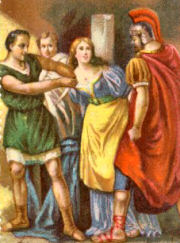
Friday, February 5, 2021

Saints Paul Miki and his Companions, Martyrs


Saints Paul Miki and his Companions, Martyrs  


The Office of Readings: 6th Century


W&H: This hymn point(s) to the contrast between the heroism of martyrs of the past and the deficiencies of the confessors of the present, who acknowledge their sins and plead for pardon for them.


Rex glorióse mártyrum, (1)

coróna confiténtium,

qui respuéntes térrea

perdúcis ad cæléstia,


Aurem benígnam prótinus

appóne nostris vócibus;

tropæa sacra pángimus, (2)

ignósce quod delíquimus.


Tu vincis in martýribus

parcéndo confessóribus; (3)

tu vince nostra crímina

donándo indulgéntiam.


(1)  martyrum . . . confitentium: In this stanza martyrs of the past are grouped with confessors of the present (both are witnesses to the faith), as the tense of perducis in line 4 indicates.

(2)  tropaea sacra: The "sacred trophies" are the butchered bodies of the martyrs. Just as Christ's body was a trophy commemorating his victory over Satan and death so the bodies of those who died to witness to him are a further mark of that victory.

(3)  parcendo confitentibus: This line is better taken with what follows than with what precedes. Those who sing this hymn emulate the martyrs by confessing Christ, but without manifesting a similar heroism.


O glorious King of martyrs, Crown of those who praise you, those who repudiate earthly things you lead to the things of heaven. Quickly in your generosity lend your ear to our voices; we sing of holy triumphs, forgive us the sins we have done. You are victorious in the martyrs by sparing those who confess you; triumph over our offenses by granting pardon.


Lauds: 10th Century: attributed to St. Ambrose


W&H: Citation by Maximus of Turin (Serm. 66) indicates that this hymn goes back to the time of Ambrose. Bede, De arte metrica 11, cautiously attributes it to "the Ambrosians." Thus, the possible attribution to Ambrose himself must rest on correspondences with his prose works. Doubts have been raised against his authorship on the grounds of allegedly non-Ambrosian metrical features, but as Fontaine demonstrates, these are not decisive. However, the impersonal treatment, without mention of specific martyrs, is not characteristic of other hymns of Ambrose, and lends itself to easier imitation, so that the ascription must remain doubtful. The current version eliminates some of the more gruesome lines: e.g.  armata . . . ungulis manus: 'The hand of the maddened torturer, armed with claws:  “The ungula, a metal claw, tore the flesh”.


Ætérna Christi múnera (1)

et mártyrum victórias,

laudes feréntes débitas,

lætis canámus méntibus.


Ecclesiárum príncipes, (2)

belli triumpháles duces,

cæléstis aulæ mílites

et vera mundi lúmina.


Terróre victo sæculi

pœnísque spretis córporis,

mortis sacræ compéndio (3)

lucem beátam póssident.


Tortóris insáni manu

sanguis sacrátus fúnditur,

sed pérmanent immóbiles

vitæ perénnis grátia. (4)


Devóta sanctórum fides,

invícta spes credéntium,

perfécta Christi caritas (5)

mundi triúmphat príncipem. (6)


In his patérna glória,(7)

in his volúntas Spíritus,

exsúltat in his Fílius,

cælum replétur gáudio.


Te nunc, Redémptor, quæsumus,

ut mártyrum consórtio

iungas precántes sérvulos

in sempitérna sæcula. Amen.


(1)  Aeterna . , . munera: The gifts are the martyrs themselves. The phrase here means "gifts bestowed by Christ" in the spirit of Ephesians 4:8, 11

(2) Ecclesiarum Principes: Not necessarily bishops, but martyrs who led by example.  communities.

(3)       compendio: In the sense of "shortcut: martyrdom is the "shortcut" to salvation.

(4) gratia: "for the sake of" rather than (literally) "by the grace of".

(5) perfecta Christi caritas: "The perfect love of Christ for them";

(6) mundi . . . principem: Satan as lord of the world is a persistent theme in John's Gospel. See 12:31, 14:30, 16:11.

(7) paterna gloria . . . voluntas Spiritus: At Hbr 1:3, Christ is the splendor gloriae of the Father; here the martyrs are allotted this distinction. At 1 Cor 12:11 the Spirit bestows his gifts on individuals "prout vult" (as he will).


 The eternal gifts of Christ and victories of the martyrs, bringing the praise we owe, let us sing with joyful minds.  Princes of the churches, triumphant commanders in the war, soldiers of the court of heaven and true lights of the world.  Conquering over the fear of the world, spurning the punishments of the body, profiting from a holy death, they possess the blessed light. By the hand of the mad executioner holy blood was spilled, but they remained unmoved through the grace of eternal life. The devoted faith of the saints, the invincible hope of those who believe, the charity of Christ perfected triumphs over the prince of this world. In them the Father’s glory, in them the will of the Spirit, in them the Son endlessly rejoices, and heaven is filled with joy. To you now, O Redeemer, we beseech you that the company of martyrs might be joined to your servants as we pray through eternal ages. Amen.


Vespers: Rabanus Maurus


Magentius Rabanus Maurus is the commanding figure among the ecclesiastics of his age, a great Churchman and the first German theologian….In a world of change, it appeared to him that the written word alone had a chance of survival, and that knowledge had an abiding value not subect to vanity….His pupil Rudolf at any rate was admirer of Raban’s verses for he describes him as ‘sui temporis poetarum nulli secundus’” F.J.E. Rabus;  Milfull says the hymn is conceived along  the lines of Aeterne Christi Munera: praise, victory of martyrs, bravery in punishment, hope.


Sanctórum méritis ínclita gáudia

pangámus, sócii, géstaque fórtia;

nam gliscit ánimus prómere cántibus

  victórum genus óptimum.


Hi sunt quos rétinens mundus inhórruit,

ipsum nam stérili flore peráridum

sprevére pénitus teque secúti sunt,

  rex, Christe, bone cælitum.


Hi pro te fúrias sævaque sústinent;

non murmur résonat, non querimónia,

sed corde tácito mens bene cónscia

  consérvat patiéntiam.


Quæ vox, quæ póterit lingua retéxere

quæ tu martýribus múnera præparas?

Rubri nam flúido sánguine láureis

  ditántur bene fúlgidis.


Te, trina Déitas únaque, póscimus,

ut culpas ábluas, nóxia súbtrahas,

des pacem fámulis, nos quoque glóriam

 per cuncta tibi sæcula. Amen.


May we sing of the great happiness of the merits of the saints, O friends, and of their brave deeds; for the soul is raised up when we proclaim in song this model of the greatest victory. These are those whom the world rejected and abhorred, for they wholly despised the dry soil of the world with its sterile flower, and followed you, O Christ the good King of the citizens of heaven. These are those who for your sake endured anger and savage punishments but they did not grumble or sound a complaint, but with a quiet heart and a good conscience persevered in patience. What voice, what tongue can tell, Christ, the gifts you have prepared for the martyrs.  for the flow of red blood is well enriched with glimmering laurels. We pray you, O Godhead three and one, that you wash away our faults, lead us away from all that is dangerous, grant peace to your servants, and also that we give glory to you through all ages. Amen. 

Wednesday, February 3, 2021

“Vatican II is Magisterium” So put more Latin in the Liturgy


Questions and Answers about Latin in the Modern Roman Liturgy


Q. Didn’t Vatican II abolish Latin?


The first document of the Second Vatican Council, Sacrosanctum Concilium, states

“The use of the Latin language is to be preserved in the Latin rite” (para. 36). The

postconciliar document on sacred music, Musicam sacram, states, “Care must be

taken that the faithful may also be able to say or sing together in Latin those parts of

the Ordinary of the Mass which pertains them.” The liturgy document stated, “since

the use of the mother tongue, whether in the Mass, the administration of the

sacraments or other parts of the liturgy, frequently may be of great advantage to the

people, the limits of its employment may be extended. This will apply in the first

place to the readings and directives, and to some of the prayers and chants” (para.

36). The Council is clear that Latin is to be continued to be used in the liturgy, while

the vernacular is an option. Therefore, even if we have vernacular in the Mass, we

should still also have Latin in the Mass as well.


Q. But isn’t going back to Latin a bad thing? Shouldn’t we be moving

forward?


The Mass is actually still in Latin; we just experience in many of our parishes the full

extent of permission to use English. The Church never abandoned the Latin,

although in many places parishes did not fulfill the express will of the Council

Fathers. There is no question of going back; we are actually just now beginning to

do what the Council asked.


Q. Isn’t Latin exclusive, though? Won’t it split us up as Catholics?


Latin belongs to all Catholics. The Catholic Church is a universal Church, open to

everyone. The use of a common language in worship is more inclusive, because it

does not assume that everyone has to worship according to any one language or

culture. Using only vernacular languages actually “ghettoizes” divine worship

according to national and ethnic boundaries. Latin transcends borders and

emphasizes the international and multicultural character of the Church.


Q. Isn’t the use of Latin just an historical anomaly that lasted way too long

anyway?


Almost all world religions have a sacred language for worship. Muslims always read

the Qu’ran in Arabic. Jews say all of their prayers in Hebrew. Hindus use Sanskrit

or Pali, which no one speaks colloquially. Until the nineteenth century, Hebrew was

virtually lost even among Jews. The Zionist movement made it a badge of religious

identity, and a century later, an entire country has what was once a dead language as

its official tongue and Jews throughout the world can all communicate in one

language. Dead languages do come back to life because of religious reasons.


Q. Doesn’t 1 Corinthians 14.14 not say, “If I pray in an unknown tongue, my spirit prayeth, but my understanding is unfruitful”?


Saint Paul is not speaking on liturgical language, but makes reference to the

Corinthians who were trying to speak in tongues without having that gift, who were

essentially falsifying a gift of the Holy Spirit. Catholics should learn the basic prayers

of the Mass in Latin as part of their normal religious education, so it is not unknown.

That is why translations are provided, so that they can learn them.


Q. How can I get anything out of Mass if I can’t even understand every

word?


Remember that God is a mystery beyond our intelligence. In the Eastern tradition,

the mystery of God’s Otherness is expressed by a large part of the service being

done behind a wall of icons and a series of veils. The people still actively participate,

but they do so fully aware that the God they are worshipping is not immediately

accessible to them. In the West, the function of icons and veils is taken in part by

language. It emphasizes the mystery and the transcendence of a God who, despite

His closeness to us, is still always beyond our reach.


That said, people shouldn't underestimate just how much one can come to

understand the Latin prayers. By the faithful praying these same Latin prayers over

and over, Sunday after Sunday (often with the benefit of a Missal which also

translates those prayers) they do become very familiar with them and know,

intensely, that which they pray. In fact, because Latin is not our first language, it can

actually help us to be more conscientious about what we are praying as we focus

even more upon how that prayer translates and thereby more potentially ponder the

spiritual depths of its meaning.


Q. Are there any advantages to using both Latin and the vernacular in the

Mass?


Yes! With the readings, the homily and certain prayers in the vernacular, the faithful

can feel God calling to them in words that are familiar; the nearness of God is made

present by the immediate comprehension of certain prayers and rites. We can foster

a community spirit with a language which is used by some if not all of the

worshippers in our parish church. But the Latin reminds us that the Church is not just our parish, and exists not just in one nation; that she is for all people and all times.  The Latin also reminds us that we cannot “own” God; that He is a mystery not to be figured out, but to be adored.


Q. Is it wrong if I don’t feel the same when parts or the whole of Mass is in

Latin?


The Mass is not about us. It is about the worship of God. If it were about us, then

we would be adoring ourselves, and putting ourselves in the place of God. The

Mass is the re-presentation of the Sacrifice of Christ in obedience to His Father on

Calvary for the salvation of the world. It is not entertainment. Worship is not having

an attractive emotional experience that I design according to my likes and dislikes. It

is receiving the gifts of that Holy Sacrifice and uniting my whole being with the great

hymn of praise offered by the whole Church. Religion is not about us and our

feelings; it is about offering to God the praise which is His due. And He asks us to

praise Him according to the ritual forms as celebrated by His Church.


Q. How can I learn more about my Catholic faith and its rich liturgical

heritage?


In Matthew 13.52 we read, Every scribe who has become a disciple of the

Kingdom of Heaven is like the head of a household, who brings out of his treasure

things new and old. Veneration steeped in the Tradition should make us even more

aware of new and creative ways to live our faith. If we are open to studying our

Catholic faith, the documents of the Church, and cooperating with our priests in

living out the liturgical riches of our Church, we have so much to gain!


Tuesday, February 2, 2021

St. Agatha: —The Church's Year of Grace, Pius Parsch


It is impossible to write a historically reliable account of St. Agatha's life. The "Acts" of her martyrdom are legendary, dating from the sixth century.

According to these sources Agatha was a Sicilian virgin of noble extraction. Quintianus, governor of Sicily, became deeply enamored of her; but she rejected his advances. As a result she was charged with being a Christian and brought before his tribunal. To the question concerning her origin she replied: "I am noble-born, of a distinguished family, as all my relatives will attest." When asked why she lived the servile life of a Christian, she answered: "I am a handmaid of Christ, and that is why I bear the outward appearance of a slave; yet this is the highest nobility, to be a slave to Christ." The governor threatened her with the most dreadful tortures if she did not renounce Christ. Agatha countered: "If you threaten me with wild beasts, know that at the Name of Christ they grow tame; if you use fire, from heaven angels will drop healing dew on me."

After being tortured, "Agatha went to prison radiant with joy and with head held high as though invited to a festive banquet. And she commended her agony to the Lord in prayer." The next day, as she again stood before the judge, she declared: "If you do not cause my body to be torn to pieces by the hangmen, my soul cannot enter the Lord's paradise with the martyrs. She was then stretched on the rack, burned with red-hot irons, and despoiled of her breasts. During these tortures she prayed: "For love of chastity I am made to hang from a rack. Help me, O Lord my God, as they knife my breasts. Agatha rebuked the governor for his barbarity: "Godless, cruel, infamous tyrant, are you not ashamed to despoil a woman of that by which your own mother nursed you?"

Returning to prison, she prayed: "You have seen, O Lord, my struggle, how I fought in the place of combat; but because I would not obey the commands of rulers, my breasts were lacerated." In the night there appeared to her a venerable old man, the apostle Peter, with healing remedies. Agatha, ever delicately modest, hesitated to show him her wounds. "I am the apostle of Christ; distrust me not, my daughter." To which she replied: "I have never used earthly medicines on my body. I cling to the Lord Jesus Christ, who renews all things by His word." She was miraculously healed by St. Peter: "Father of my Lord Jesus Christ, I give you praise because by Your apostle You have restored my breasts." Throughout the night a light illumined the dungeon. When the guards fled in terror, her fellow prisoners urged her to escape but she refused: "Having received help from the Lord, I will persevere in confessing Him who healed me and comforted me."

Four days later she was again led before the judge. He, of course, was amazed over her cure. Nevertheless, he insisted that she worship the gods; which prompted another confession of faith in Christ. Then by order of the governor, Agatha was rolled over pieces of sharp glass and burning coals. At that moment the whole city was rocked by a violent earthquake. Two walls collapsed, burying two of the governor's friends in the debris. Fearing a popular uprising, he ordered Agatha, half dead, to be returned to prison. Here she offered her dying prayer: "Blessed Agatha stood in the midst of the prison and with outstretched arms prayed to the Lord: O Lord Jesus Christ, good Master, I give You thanks that You granted me victory over the executioners' tortures. Grant now that I may happily dwell in Your never-ending glory." Thereupon she died.

A year after her death the city of Catania was in great peril from an eruption on Mount Etna. Pagans, too, were numbered among those who fled in terror to the saint's grave. Her veil was taken and held against the onrushing flames, and suddenly the danger ceased. Her grave is venerated at Catania in Sicily.


S. Agatha, Virgin Martyr


The Liturgica Horarum relies on the Common of a Virgin Martyr for the hymns of this memorial. However, this hymn is attributed to St. Damasus, Pope, and was found in the Ambrosian Liturgy.


Martyris ecce dies Agathae

Virginis emicat eximiae,

Christus eam sibi qua sociat,

Et diadema duplex decorat.


Stirpe decens, elegans specie,

Sed magis actibus atque fide,

Terrea prospera nil reputans,

Jussa Dei sibi corde ligans;


Fortior haec trucibusque viris,

Exposuit sua membra flagris.

Pectore quam fuerit valido,

Torta mamilla docet patulo.


Deliciae cui carcer erat;

Pastor ovem Petrus hanc recreat.

Laetior inde, magisque flagrans,

Cuncta flagella cucurrit ovans.


Ethnica turba, rogem fugiens,

Hujus et ipsa meretur opem;

Quos fidei titulus decorat,

His Venerem magis ipsa premat.


Jam renitens, quasi sponsa, polo,

Pro misero rogita Damaso.

Sic sua festa coli faciat,

Se celebrantibus ut faveat.


Gloria cum Patre sit Genito,

Spirituique proinde sacro,

Qui Deus unus et omnipotens

Hanc nostri faciat memorem. Amen.


Lo! is come the bright festal day of the glorious Martyr and Virgin Agatha, when Christ took her to himself, and a double crown wreathed her brow.

Though noble by birth and blessed with beauty, her grandest riches were her deeds and her faith. Earthly prosperity was nothing in her eyes, but her whole heart was on the precepts of her God.

Her bravery tired out the men that tortured her; she flinched not as they lashed her limbs; and her wounded breast reveals a dauntless heart.

Her prison was her paradise, where the Pastor Peter heals his bleeding lamb; and thence once more she runs to suffer, gladder and braver at every wound.

A Pagan city, once in flames, was saved by Agatha’s prayer. The same can check, in Christian hears, the threatening fire of lust.

Now that though are in Heaven, clad as a bride of Christ, intercede with him for us miserable sinners, that He may us so to spend thy Feast, that our celebration may draw down His Grace.

Glory be to the Son, together with the Father and the Holy Ghost. May the One Almighty God grant that this his Saint be mindful of us. Amen


Translation From Gueranger, Liturgical Year, Vol. 4 pg. 248


Common of a virgin martyr


Lauds: 15th Century: Ambrosian Breviary


O castitátis sígnifer (1)

et fortitúdo mártyrum,

utrísque reddens præmia,(2)

audi benígnus súpplices.


Hæc virgo magni péctoris,

beáta sorte dúplici

bináque palma nóbilis,

hic tóllitur præcóniis.


Hæc te fatéri pértinax,

tortóris acre brácchium

armávit in se strénue

tibíque fudit spíritum.


Sic sæviéntis vúlnera

et blandiéntis víncere

mundi docens illécebram,

fidem docet nos íntegram.


Huius favóre débita

nobis remíttas ómnia,

foménta tollens críminum

tuámque subdens grátiam.


1.       O castitátis sígnifer /et fortitúdo mártyrum=Christ; 2. Everything is double for the Virgin Martyr: chastity and fortitude, bearing the rewards of both, blessed by a double portion, ennobled with a twofold palm, teaching us to conquer both the wounds of the cruel and the alluring flattery of the world.


O Standard Bearer of chastity and Strength of martyrs, bearing the rewards of both, kindly hear our prayers.  This virgin great in heart and blessed by a double portion, ennobled with a twofold palm, extolled by proclamations.  This woman resolute in confessing you, obstinately provoked the bitter arm of the torturer and poured out her spirit for you. In this way teaching us to conquer both the wounds of the cruel and the alluring flattery of the world, taught us integrity. By her merit forgive us all our sins, taking away the attraction of sin and giving us your grace.


The Office of Readings: before 9th Century


O Christe, flos convállium,

te láudibus extóllimus,

quod hanc ornásti vírginem

palmis quoque martýrii.


Hæc prudens, fortis, sápiens, (1)

fidem proféssa líbere,

pro te dira supplícia

excépit impertérrita.


Sic spreto mundi príncipe,

tuo ditáta múnere,

cruénto parta prœlio  (2)

ætérna tulit præmia.


Huius, Redémptor, méritis

nos pius adde sócios,

ut, mente pura, frúctibus

tui fruámur sánguinis. (3)


1.       These manly virtues, we might say, military values, belong to the virgin martyrs, indeed, they are the virtues of every martyr, male or female; 2. Indeed the virgin martyr dies cruénto parta prœlio: 3. The virgin martyr imitates Christ and so her blood too is to be enjoyed.


O Christ, flower of the valleys, we raise our praises to you, because you have adorned this virgin also with the palms of martyrdom.  Prudent, strong and wise, professing openly the faith, she fearlessly endured severe punishments for your sake.  In this way, spurning the prince of this world, enriched by your gifts, dying in the bloody battle, she attained eternal rewards. By her merits, O holy Redeemer, make us her companions, that with pure minds we may enjoy the fruits of our blood.


Vespers: 9th Century


Vírginis Proles opiféxque Matris, (1)

Virgo quem gessit peperítque Virgo,

vírginis festum cánimus tropæum:

  áccipe votum.


Hæc tua virgo, dúplici beáta

sorte dum gestit frágilem domáre

córporis sexum, dómuit cruéntum

  córpore sæclum.


Inde nec mortem nec amíca mortis

sæva pœnárum génera pavéscens,

sánguine fuso méruit sacrátum

  scándere cælum.


Huius obténtu, Deus alme, nostris

parce iam culpis, vítiis revúlsis,

quo tibi puri résonet per ævum

  péctoris hymnus. Amen.


1.       The virginity of the Virgin is the source of  the holy virgin’s virginity; 2. dúplici beáta: again doubly blessed by conquering herself and the cruelty of the world;


Off spring of the Virgin and Mother of the Creator, the Virgin who gave birth and remained a Virgin, we sing the festal triumph of a virgin: receive our prayer. This your virgin was twice blessed by lot: while she fought to conquer the bodily fragility of her sex, she triumphed also with her body the cruelty of the world.   Therefore fearing not death, nor the savage punishments that come with death, she was found worthy through the shedding of her blood to scale up to holy heaven. By her intercession, O gracious God, now forgive us our sins, uproot our vices, that this hymn from a pure heart may resound through the ages. Amen.


Monday, February 1, 2021

Presentation/Purification: Roman Breviary: From the Sermons of St. Augustine, Bishop of Hippo. 13th on the Season


In old time it was written: And of Zion shall it not be said This and that man was born in her, and the Highest Himself shall establish her? Blessed be the omnipotence of Him That was born! Blessed the glory of Him That came from heaven to earth! While yet He was borne in His Mother's womb, He was saluted by John the Baptist; He was presented in the temple, and recognized by that famous, ancient, and glorious worthy, the old man Simeon. As soon as he knew Him he worshipped Him, and said Lord, now lettest Thou thy servant depart in peace for mine eyes have seen thy Salvation

He lingered in the world to see the birth of Him Who made the world. The old man knew the Child, and in that Child became a child himself, for in the love wherewith he regarded the Father of all, he felt his own years to be but as of yesterday. The old man Simeon bore the new-born Christ, and all the while, Christ was the old man's Lord. It had been told him by the Lord that he should not taste of death before he had seen the birth of the Lord's Christ. Now Christ is born, and all the old man's wishes on earth are fulfilled. He That came to a decrepit world came to an old man.

He wished not to remain long in the world, but he longed to see Christ in the world, singing with the Prophet, and saying: Show us thy mercy, O Lord, and grant us thy salvation. Ps. lxxxiv. 8. And now at last, that ye may know that the cause of his joy was that this prayer was granted, he saith: Now lettest Thou thy servant depart in peace, for mine eyes have seen thy salvation. The Prophets have sung that the Maker of heaven and earth would converse on earth with men an angel hath declared that the Creator of flesh and spirit would come in the flesh, the unborn John, yet in the womb, hath saluted the unborn Savior yet in the womb. The old man Simeon hath seen God, a little Child. 

Saturday, January 30, 2021

Inviolata, integra, et casta es Maria


Author unknown, not later than the 15th Century, sung by the Dominicans before the Vesper hymn on the Purification; also used by the Dominicans at Compline (Byrne).Inviolata, integra, et casta es Maria,

quae es effecta fulgida caeli porta.

O Mater alma Christi carissima,

suscipe pia laudum praeconia.

Te nunc flagitant devota corda et ora,

nostra ut pura pectora sint et corpora.

Tu per precata dulcisona,

nobis concedas veniam per saecula.

O benigna! O Regina! O Maria,

quae sola inviolata permansisti.


Inviolate, whole, and chaste art Thou, Mary,

who art become the gleaming gate of heaven.

O dearest nurturing Mother of Christ,

accept our pious prayers of praise.


That our hearts and bodies might be pure

our devout hearts and mouths now entreat.

By Your sweet-sounding prayers,

grant us forgiveness forever.


O blessed, O Queen, O Mary,

You alone have remained inviolate.