Saturday, August 14, 2021

Various Hymns for the Assumption


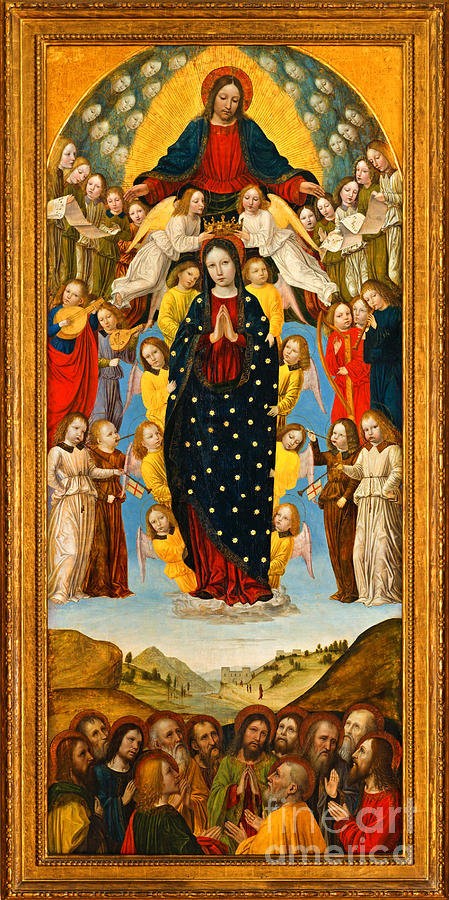
Assumption of the Virgin Painting by Peter Ogden Gallery


Vespers: Fr. Vittorio Genovesi, S.J.


O prima, Virgo, pródita

E Conditóris spíritu,

Prædestináta Altíssimi

Gestáre in alvo Fílium;


Tu perpes hostis fémina

Prænuntiáta dæmonis,

Oppléris una grátia

Intamináta orígine.


Tu ventre Vitam cóncipis,

Vitámque ab Adam pérditam,

Diæ litándæ Víctimæ

Carnem minístrans, íntegras.


Merces piáclo débita

Devícta mors te déserit,

Almíque consors Fílii

Ad astra ferris córpore.


Tanta corúscans glória,

Natúra cuncta extóllitur,

In te vocáta vérticem

Decóris omnis tángere.


Ad nos, triúmphans, éxsules,

Regína, verte lúmina,

Cæli ut beátam pátriam,

Te, consequámur áuspice.


Jesu, tibi sit glória,

Qui natus es de Vírgine,

Cum Patre et almo Spíritu,

In sempitérna sæcula.

Amen.


O Virgin thou, the spirit's fair’st,

Predestined by the will divine,

Within thy sacred womb thou bear’st

His only Son, and also thine.


O thou in whom rich grace abounds,

Foretold thou wast to be the foe

Who in her origin confounds

The wicked demon here below.


Within thy womb anew Life's made,

The very life by Adam lost

Hath been renewed by thee, sweet maid,

Who didst provide the holocaust.


Thy will immersed in Jesu's own,

Atoning for the sins of all,

He raiseth thee to Heaven's throne,

In victory o'er death's dread thrall.


In thy great glory burning bright

Exalted nature sings the praise,

And unto beauty's very height,

Dost honour and all glory raise.


Triumphant Queen to Heaven borne,

Upon us exiles turn thy sight,

That to the ever-blessed morn

We may be guided by thy light.


All honor, laud, and glory be,

O Jesu, Virgin-Born, to thee;

Whom with the Father we adore,

And Holy Ghost, for evermore.

Amen.


Matins: Fr. Vittorio Genovesi, S.J.


Surge! Iam terris fera bruma cessit,

Ridet in pratis decus omne florum,

Alma quæ Vitæ Genitrix fuisti,

Surge, Maria!


Lilium fulgens velut in rubeto,

Mortis auctorem teris una, carpens

Sontibus fructum patribus negatum

Arbore vitæ.


Arca non putri fabricata ligno

Manna tu servas, fluit unde virtus,

Ipsa qua surgent animata rursus

Ossa sepulcris.


Præsidis mentis docilis ministra,

Haud caro tabo patitur resolvi;

Spiritus imo sine fine consors

Tendit ad astra.


Surge! Dilecto pete nixa cælum,

Sume consertum diadema stellis,

Teque natorum recinens beatam

Excipe carmen.


Laus sit excelsæ Triadi perennis,

Quæ tibi, Virgo, tribuit coronam,

Atque reginam statuitque nostram

Provida matrem. Amen.


Rise up! the misty chill has left the meadows;

Now, as they put their liveliest blossoms forward,

Thou, who hast been to Life himself a mother,

Rise up, O Mary.


Fair, as a lily blooming among brambles,

Thou, though unaided, crushing death's inventor,

Fruit from the tree of life denied our fathers

Gatherest for us.


Ark built of wood not subject to corruption,

Thine to conserve the Manna by whose virtue

Dry bones re-edified in living sinew

Rise from their graveyards.


Thy flesh, in all things docile to thy ruling

Spirit, defying final dissolution,

Now as thy soul's inseparable consort

Rises to heaven.


Rise up! and seek the arms of thy Belovéd,

Take thou thy crown of stars at his awarding

And when thy children sing thy benedictions

Hear us with favor.


Christ's in the height be glory never ending,

Offspring of holy Mary ever virgin,

Who with the Father and Spirit co-equal

Reigns to all ages. Amen.


Lauds/Vespers : Jean-Baptiste de Santeul , 17th C: Jean-Baptiste de Santeul entered the Abbey of St. Victor, Paris, in 1653, and made his profession the next year. He was a respected poet in the Latin language, writing under the name of Santolius Victorinus. Santeul also wrote hymns, many of which were published in the Cluniac Breviary of 1686, and the Paris Breviaries of 1680 and 1736. His Hymni Sacri et Novi were published at Paris in 1689. An enlarged version was published in 1698. A number of his hymns were translated into English. De Santeul was the author of the Latin phrase castigat ridendo mores, meaning "laughter corrects customs".


O vos, ætherei plaudite cives,

Hæc est illa dies clara triumpho,

Qua matrem placida morte solutam

Natus siderea suscipit aula.


Quæ non, Virgo, tibi dona rependit!

Cæli divitias explicat omnes,

Verbum vestieras carne; vicissim

Te Verbum proprio lumine vestit.


Qui velo latuit carnis, aperti

Pleno te satiat Numinis haustu:

Et quem virgineo lacte cibasti,

In iugem tibi dat se Deus escam.


O concessa tibi quanta potestas!

Per te quanta venit gratia terris!

Cunctis cœlitibus celsior una,

Solo facta minor, Virgo, Tonante.


Quæ Regina sedes proxima Christo,

Alto de solio vota tuorum

Audi; namque potes flectere Natum,

Virgo Mater: amas nos quoque natos.


Divinæ Soboli, qui dare matrem

In terris voluit, gloria Patri:

Cuius virgo parens, gloria Nato;

Quo fœcunda, tibi gloria, Flamen. Amen.


Sing, you who dwell in the kingdom of heaven!

This anniversary marks a great triumph:

Death's gentle transit accomplished, a mother

Hears her son welcome her into his kingdom.


Virgin, what gifts shall he not lavish on thee?

He deploys all the resources of heaven.

Thine was to clothe God in flesh; and now likewise

God in his own divine splendor shall clothe thee.


Formerly veiled in the flesh, God the Word now

Satisfies thee with full vision of Godhead;

He who once fed on thy virginal milk now

Feeds thee with bread of himself God of heaven.


What immense power is conferred on thee by him!

What immense grace is conferred on earth by thee!

Higher preferred than all dwellers in heaven,

Less than the Thunderer only, O Virgin.


Queen enthroned next to the Lord, hear thy people

Praying to thee where thou reignest in heaven;

Thou canst prevail on thy First-born, O Virgin

Mother, and lovest us also thy children.


Hail to the Father Who willed his divine Son

Take flesh on earth and assigned him a mother,

Hail to the Son who was born of a virgin,

Hail to the Spirit who caused her conception. Amen.

IN ASSUMPTIONE BEATÆ MARIÆ VIRGINIS


Ad I  &  II  Vesperas: Petrus Damianus

Gáudium mundi, nova stella cæli,
prócreans solem, páriens paréntem,
da manum lapsis, fer opem cadúcis,
  virgo María.

Te Deo factam liquet esse scalam
qua tenens summa petit Altus ima;
nos ad excélsi remeáre cæli
  cúlmina dona.

Te beatórum chorus angelórum,
te prophetárum et apostolórum
ordo prælátam sibi cernit unam
  post Deitátem.

Laus sit excélsæ Tríadi perénnis,
quæ tibi, Virgo, tríbuit corónam,
atque regínam statuítque nostram
  próvida matrem. Amen.

Joy of the world, new star of heaven, giving birth to the sun, bearing the parent, give your hand to those slipping, help the fallen, O Virgin Mary. God made you to be the certain ladder, by which the Highest keeping its height could seek the lowest; grant that we may return to the summit of highest heaven.  The choir of Blessed angels, the order of prophets and apostles acknowledge you singularly favored before themselves, after God.  Everlasting praise to the Trinity on high, who granted you, O Virgin, a crown, and established you as our queen and watchful mother. Amen.

Ad Officium lectionis: Petrus Damianus

Auróra velut fúlgida,
ad cæli meat cúlmina
ut sol María spléndida,
tamquam luna pulchérrima.

Regína mundi hódie
thronum conscéndit glóriæ,
illum eníxa Fílium
qui est ante lucíferum.

Assúmpta super ángelos
omnésque choros cælitum,
cuncta sanctórum mérita
transcéndit una fémina.

Quem fóverat in grémio,
locárat in præsépio,
nunc regem super ómnia
Patris videt in glória.

Pro nobis, Virgo vírginum,
tuum depósce Fílium,
per quam nostra suscéperat,
ut sua nobis præbeat.

Sit laus Patri cum Fílio
et Spíritu Paráclito,
qui te præ cunctis cælica
exornavérunt glória. Amen.


As the glittering dawn Mary arises to the height of heaven, sparkling like the sun, most beautiful like the moon.  Today the Queen of the world ascends to her throne of glory, she who gave birth to that Son, who was before the daystar. This one women is taken above the angels and over all the heavenly hosts; she surpasses the merits of all of the saints. Him, whom she has cherished at her bosom, she puts in a manger; now she sees him King over all in the glory of the Father. O Virgin of virgins, pray to your Son for us, through you he received what is ours that he might give to us what is his.  Praise to the Father with the Son and Comforter Spirit, who before all adorned you with heavenly glory. Amen.

Ad Laudes matutinas: Victorius Genovesi

Solis, O Virgo, rádiis amícta,
bis caput senis redimíta stellis,
luna cui præbet pédibus scabéllum,
  ínclita fulges.

Mortis, inférni domitríxque culpæ,
ássides Christo studiósa nostri,
teque regínam célebrat poténtem
  terra polúsque.

Asseclas diæ fídei tuére;
díssitos adduc ad ovíle sacrum;
quas diu gentes tegit umbra mortis
  úndique coge.

Sóntibus mitis véniam precáre,
ádiuva flentes, ínopes et ægros,
spes mica cunctis per acúta vitæ
  certa salútis.

Laus sit excélsæ Tríadi perénnis,
quæ tibi, Virgo, tríbuit corónam,
atque regínam statuítque nostram
  próvida matrem. Amen.

O Virgin, clothed with the radiant sun, her head garlanded with twice six stars, the moon serving her as a footstool, you gloriously shine.  Ruling over death and guilty hell, anxious for our good you are enthroned next to Christ, earth and heaven celebrate you as their mighty queen.  Watch over your children by godly faith, bring back the scattered to the holy fold; gather from all the nations those so long covered by the shadow of death. With gentle prayers implore pardon for the guilty, help those who weep, the needy and the sick, shine on all in the difficulties of life the sure hope of salvation. Everlasting praise to the Trinity on high, who granted you, O Virgin, a crown, and established you as our queen and watchful mother. Amen.

Saturday, August 7, 2021

S. Laurence, Deacon & Martyr


Collects

1962

Da nobis, quǽsumus, omnípotens Deus: vitiórum nostrórum flammas exstínguere; qui beáto Lauréntio tribuísti tormentórum suórum incéndia superáre.

Grant us, we beseech thee, Almighty God, grace to quench the flames of our sins: as thou didst endue blessed Laurence with power to overcome the fire of his torments.

 2002

Deus, cuius caritátis ardóre beátus Lauréntius servítio cláruit fidélis et martýrio gloriósus, fac nos amáre quod amávit et ópere exercére quod dócuit.

 O God, by whose charity blessed Laurence shined forth in faithful service and was glorious in martyrdom: grant that we may love what he loved and do the works which he taught.

Both these prayers are commendable but in quite different ways: 1962 we need grace to quench sin; in 2002 we are encouraged to practice charity, as St. Laurence did. Probably the collects should trade places: the new collect for the Extra-ordinary Form and the old collect for the Novus Ordo.

Sermon by S. Leo the Great: Sermon 85: On the Birthday of S. Laurence

 THEN the power of the  heathen was raging  against Christ's chosen members, and was especially seeking out those in priestly orders, the wicked persecutor bore down on the Levite Laurence, who was pre-eminent in distributing the Church's substance, as well as in ministering the sacraments; the persecutor promised himself a two-fold booty from one man, for if he could make him hand over the holy funds, he would also make him an apostate from the true religion.

THIS man, then, was furnished with a double motive, greed for money, and hatred of the truth: avarice, for he would seize the treasure, wickedness for he would rob Christ. He orders the spotless minister of the sanctuary to bring him the Church's wealth, which he so greedily desires. The most chaste Levite, to show him where that treasure lay, brought him a great crowd of the holy poor, on whose food and clothing he had invested those resources so that they could never be lost; for they were all the more safe, for the holy way in which they had been spent.

THUS frustrated, the robber rages, and seething with hatred for a religion which had appointed such use for wealth, he tries to steal a higher treasure from him in whose hands he found no money; he attempts to rob him of that wealth which made him rich in holiness. He orders Laurence to renounce Christ, and prepares fearful tortures to overcome the Levite's most steadfast strength of soul; when the first tortures are of no avail worse ones follow. He orders his lacerated limbs, cut by many stripes, to be roasted over a fire; so that the torture should be more severe and the suffering prolonged, his body was to be turned from side to side on the gridiron, the bars Of which were themselves burning hot by reason of the slow fire beneath

O RAGING cruelty, gaining nothing, obtaining nothing! That which can die is withdrawn from thy tortures, and Laurence goes forth to heaven, while thou failest with thy flames. The love of Christ could not be overcome by flames. The fire which licked around him was slower than that which burned within. Thou didst rage, O persecutor of a martyr; thou didst rage, and by increasing his tortures thou didst help him to his palm. For what could thy imagination find that was not conducive to the victor's glory, when the very instruments of torture turned to the honor of his triumph? Let us rejoice, therefore, with spiritual joy, beloved brethren, and in the most happy end of this illustrious man let us glory in the Lord, who is wonderful in his Saints, in whom he hath given us both help and example. He hath thus made his glory to shine throughout the world, that from the rising up of the sun unto the going down of the same, amidst the shining brightness of the Levitical lights, as Jerusalem is made glorious by Stephen, so Rome is made illustrious by Laurence.


 Ad Laudes matutinas: Prudentius

 To give Prudentius credit for this hymn is no great favor to such an accomplished, learned and skillful poet. This hymn is pieced together from various lines from Prudentius’ Peristephanon II with, one suspects, some tinkering from Dom Anselmo’s team. The result is a very obscure and difficult to translate hymn. However, Walpole’s suggestion (noted on a somewhat different centoization)  is helpful: The first two lines are explained by the preceding passage of the original, the sense of which is: the one glory formerly lacking to Rome, now given up to Christ, was the final subjugation of foul Jove, not by the turbulent might of Cossus, Camillus, or Caesar, but by the not bloodless strife of the martyr Lawrence”  (Early Latin Hymns p. 138).  Would that this notion were more clearly expressed in the office hymn.


In mártyris Lauréntii

non incruénto prœlio,

armáta pugnávit Fides

próprii cruóris pródiga.


Hic primus e septem viris

qui stant ad aram próximi,

levíta sublímis gradu

et céteris præstántior.


Hic dímicans fortíssimus

non ense præcínxit latus,

hostíle sed ferrum retro

torquens in auctórem tulit.


Sic, sancte Laurénti, tuam

nos passiónem quærimus;

quod quisque supplex póstulat,

fert impetrátum próspere,


Dum cæli inenarrábili

alléctus urbi múniceps,

ætérnæ in arce cúriæ

gestas corónam cívicam.


Honor Patri cum Fílio

et Spíritu Paráclito,

qui nos tuis suffrágiis

ditent perénni láurea. Amen.


In the not bloodless strife of the martyr Laurence, armed with faith he fought, his own blood prodigally shed.  He was the first of seven men, standing next to the altar, a lofty deacon by rank, surpassing all the others. This most courageous fighter girded no sword at his side, but taking the enemy’s sword in  his back, bore the torture with calm authority.  Thus, O holy Laurence, we seek a passion like yours; may, what each humble soul asks of you, succeed and prosper.  Chosen a fellow-citizen of the city of ineffable heaven,  in height of the eternal court you wear a civic crown. Honor to the Father with the Son and Spirit Paraclete, who by your prayers, O Laurence, enriches us with eternal laurels.  Amen.


Ad Officium lectionis & Vesperas: Petrus Damianus


Mártyris Christi cólimus triúmphum,

dona qui mundi peritúra spernit,

fert opem nudis, aliménta, nummos

  tradit egénis.


Igne torquétur, stábili tenóre

cordis accénsus súperat mináces

ígnium flammas in amóre vitæ

  semper opímæ.


Spíritum sumpsit chorus angelórum,

íntulit cælo bene laureándum,

ut scelus laxet hóminum, precándo

  omnipoténtem.


Súpplici voto rogitámus ergo

ómnibus, martyr, véniam precéris,

cordis ardóres, fídei tenácem

  usque vigórem.


Glóriam Patri resonémus omnes,

eius et Nato modulémur apte,

cum quibus regnat simul et creátor

  Spíritus almus. Amen.


We celebrate the triumph of a martyr of Christ, who spurned the passing gifts of the world, brought help to the naked, handed over to the needy food and money.  Tortured by fire, he stood strong, his heart enkindled, overcoming the menacing flames of fire, for the sake of his love for abundant life. The choir of angels receives his spirit, he wears well the victory laurels rightly given by heaven to loosen the sins of men by praying to God almighty. Therefore, O martyr, we humbly ask that you pray pardon for all, for fervent hearts, tenacious faith, and strength. Let us all resound glory to the Father and sing rightly of his Son, with whom the Spirit Creator rules. Amen.

Friday, August 6, 2021

IN TRANSFIGURATIONE DOMINI


The Transfiguration: Homily by S. John Chrysostom   Hom. 56 on Matt. 


THE Lord had said much about dangers, much about his Passion, about the death and slaying of his disciples, and had laid many hard and grievous things upon them; and all these things concerned this present life and were nigh at hand; but the good things were to be expected and awaited: as, for example, that they should save their life if they had lost it; that he would come in the glory of his Father, and render the rewards. Now, in order to reassure them by sight, and to show them what that glory would be when he would come (at least, as much as they could comprehend in this present life) he showed it and unveiled it to them, to prevent any of them, especially Peter, from grieving over their own deaths, or that of the Lord.


AND see what he did when he discoursed on heaven and hell. For when he said, whosoever will save his life shall lose it, and whosoever will lose his life for my sake shall find it, and when he said, He will reward every man according to his works, he indicated heaven and hell.


ALTHOUGH he discoursed on both, he allowed heaven to be seen by the eyes, but not hell; for although it would have been needful for men• who were unlearned and dull; these men were proved and instructed, and it was enough for them to be strengthened by better things. And this is much more becoming to him. But he did not leave out the other altogether, for sometimes he laid all the atrocity of hell as it were before their eyes, as in the parable of Lazarus, and in the account of the man who demanded back the hundred pence.


CONSIDER Matthew's wisdom in not concealing the names of those who had the first places. And John very often does the same, as when he truly and diligently describes Peter's excellency. For neither envy nor vainglory had any place in this company of the Apostles. Why did he take only these? Because they excelled the others. Why did he do it, not straightway, but after six days? Lest it should upset others among his disciples and followers; therefore, he made no mention beforehand of those whom he was going to take with him.


Deus, qui fídei sacraménta in Unigéniti tui gloriósa Transfiguratióne patrum testimónio roborásti, et adoptiónem filiórum perféctam, voce delápsa in nube lúcida, mirabíliter præsignásti: concéde propítius; ut ipsíus Regis glóriæ nos coherédes effícias, et ejúsdem glóriæ tríbuas esse consórtes.

O God, who in the glorious Transfiguration of Thine only-begotten Son didst confirm the mysteries of the faith by the witness of the fathers, and in the voice which came down from the shining cloud, didst wondrously foreshow the perfect adoption of sons: vouchsafe in Thy loving kindness, to make us coheirs with this King of glory, and to grant that we may be made partakers of that same glory

Deus, qui fídei sacraménta in Unigéniti tui gloriósa Transfiguratióne patrum testimónio roborásti et adoptiónem filiórum perféctam mirabíliter præsignásti, concéde nobis fámulis tuis, ut, ipsíus dilécti Fílii tui vocem audiéntes, eiúsdem coherédes éffici mereámur.


Ad Officium lectionis: saec. XIII

Cæléstis formam glóriæ,

quam spes quærit Ecclésiæ,

in monte Christus índicat,

qui supra solem émicat.


Res memoránda sæculis:

tribus coram discípulis,

cum Elía, cum Móyse

grata promit elóquia.


Assístunt testes grátiæ,

legis vatúmque véterum;

de nube testimónium

sonat Patris ad Fílium.


Glorificáta fácie

Christus declárat hódie

quis honor sit credéntium

Deo pie fruéntium.


Visiónis mystérium

corda levat fidélium,

unde sollémni gáudio

clamat nostra devótio:


Pater, cum Unigénito

et Spíritu Paráclito

unus, nobis hanc glóriam

largíre per præséntiam. Amen.

Christ, who shines brighter than the sun, on the mountain reveals the beauty of heavenly glory, which the hope of the Church seeks. An event to be recalled through the ages: in the presence of three of his disciples Jesus, with Elijah and Moses, speaks pleasing words. Witnesses of grace stand near the prophets of the old law, as from a cloud the testimony of the Father concerning the Son is told. Christ, his face shining with glory, reveals the honor of the those who believe and enjoy the holy God. The mystery of this vision lifts up the hearts of the faithful, wherefore our devotion cries out with solemn joy. O Father, with the Only-begotten and the Spirit Comforter, grant us this glory now. Amen.


Ad Laudes matutinas: saec. XII-XIII

Dulcis Iesu memória,

dans vera cordi gáudia,

sed super mel et ómnia

eius dulcis præséntia.


Nil cánitur suávius,

audítur nil iucúndius,

nil cogitátur dúlcius

quam Iesus Dei Fílius.


Iesu, dulcédo córdium,

fons veri, lumen méntium,

excédis omne gáudium

et omne desidérium.


Quando cor nostrum vísitas,

tunc lucet ei véritas,

mundi viléscit vánitas

et intus fervet cáritas.


Da nobis largus véniam,

amóris tui cópiam;

da nobis per præséntiam

tuam vidére glóriam.


Laudes tibi nos pángimus,

diléctus es qui Fílius,

quem Patris atque Spíritus

splendor revélat ínclitus. Amen.

Sweet memory of Jesus, giving true joys to the heart but sweeter even than honey and all things is his presence. Nothing better is sung, nothing happier is heard, nothing sweeter thought than Jesus the Son of God.  Jesus the sweetness of hearts, source of truth, light of minds, you surpass all joy and every desire. When you visit our hearts, then truth shines, the vanity of the world loses its appeal, and charity burns within us.  Grant to us the increase of pardon, the abundance of love; grant us to see your glorious presence. We sing our praises to you the beloved Son, Whom the shining splendor of the Father and the Spirit reveals. Amen.


Ad Vesperas: saec. IX

O nata lux de lúmine,

Iesu, redémptor sæculi,

dignáre clemens súpplicum

laudes precésque súmere.


Præ sole vultu flámmeus,

ut nix amíctu cándidus,

in monte dignis téstibus

apparuísti cónditor.


Vates alúmnis ábditos

novis vetústos cónferens,

utrísque te divínitus

Deum dedísti crédere.


Te vox patérna cælitus

suum vocávit Fílium,

quem nos fidéli péctore

regem fatémur cælitum.


Qui carne quondam cóntegi

dignátus es pro pérditis,

nos membra confer éffici

tui beáti córporis.


Laudes tibi nos pángimus,

diléctus es qui Fílius,

quem Patris atque Spíritus

splendor revélat ínclitus. Amen.

O Light begotten of light, Jesus, the Redeemer of the world, mercifully receive our humble praises and prayers. Flaming more than the face of the sun, whiter than the fall of snow, the Creator, you appeared with worthy witnesses on the mountain. Bringing the ancient prophets, hidden from the new disciples, you divinely caused them to believe that you were God. The heavenly voice of the Father called you his Son, whom we confess with faithful hearts to be the King of heaven. You who deigned to be clothed with our flesh for the sake of the lost, did make us members of your blessed body. We sing praises to you, who are the beloved Son, whom the shining splendor of the Father and the Spirit reveals. Amen

Sunday, August 1, 2021

The Roman Martyrology: August 1


Why in the world was this great ecumenical feast  eliminated from the Roman Rite? Could it be that anti-semtism was alive and well at Vatican II? 

Roman Martyrology

At Antioch, the passion of the seven holy brothers Machabees, with their mother, who suffered under King Antiochus Epiphanes. Their relics were transferred to Rome and buried in the Church of St Peter Ad Vincula.