Saturday, July 16, 2022

Sunday: Weeks II & IV


Sunday: Weeks II & IV 


Vespers I: Later Hymnal: Mozarabic?

Walsh & Husch: God’s incessant activity in keeping in being the wonders of creation is to be the spur to us to be similarly active in pursuit of the virtues, and thus to win our reward at the judgement.


Rerum, Deus, fons ómnium,
qui, rebus actis ómnibus,
totíus orbis ámbitum
censu replésti múnerum,

Ac, mole tanta cóndita, (1)
tandem quiétem díceris
sumpsísse, dans labóribus
ut nos levémur grátius:

Concéde nunc mortálibus
deflére vitæ crímina, (2)
instáre iam virtútibus
et munerári prósperis,

Ut cum treméndi iúdicis
horror suprémus cœperit,
lætémur omnes ínvicem
pacis repléti múnere.

1.       This verse replaces the original (from Walpole):

non actibus fessus manens,
laboribus non saucius,
cunctis quietem das, aegris
curis ruant ne morbidi

Walsh & Husch:

Yours deeds leave you unwearied still,
Your toils have not disabled you,
And you grant rest to all, lest they
Be stricken with enfeebling cares.

In my opinion the original is much better than the new.

2.      deflere vitae crimina replaces laboribus non saucius.


O God, the source of all, who, when all things had been created, you filled completely the whole circle of the world with the wealth of your gifts. And, when such an enormous mass had been created, at last you decreed a time of rest be taken, granted to laborers graciously that we be raised up. Grant now to mortal men that they weep for the sins of life, strive for the virtues, and be rewarded with prosperity. That when the final fear of the terrible judge shall begin, each of us will rejoice to be filled with the gift of peace.


Office of Readings: nocturne

Sunday: 5th Century

Walsh & Husch: [In the Liturgy of the Hours] stanzas 1-6 and 13 are sung . . . The hymn celebrates the importance of the midnight hour in the history of  Israel (stanzas 3-5) linked with the need for vigilance by the new Israel (6-10), and in the liberation of Paul and Silas (11) linked with our need to be liberated from the prison of sin (12).

Médiæ noctis tempus est
prophética vox ádmonet (1)
dicámus laudes ut Deo
Patri semper ac Fílio,

Sancto quoque Spirítui:
perfécta enim Trínitas 
uniúsque substántiæ (2)
laudánda nobis semper est.

Terrórem tempus hoc habet, (3)
quo, cum vastátor ángelus
Ægýpto mortem íntulit,
delévit primogénita. (4)

Hæc iustis hora salus est,
quos tunc ibídem ángelus
ausus puníre non erat,
signum formídans sánguinis. (5)

Ægýptus flebat fórtiter
tantórum diro fúnere;
solus gaudébat Israel
agni protéctus sánguine.

Nos verus Israel sumus:
lætámur in te, Dómine,
hostem spernéntes et malum,
Christi defénsi sánguine.

Dignos nos fac, rex óptime,
futúri regni glória,
ut mereámur láudibus
ætérnis te concínere. Amen.

1.       W: ' The voice of the prophet ' is that of the Psalmist; the reference is to Ps. cxviii (cxix): media nocte surgebam ad confitendum tibi super iudicia iustificationis tuae.
2.      W&H: Augustine De Trinitate 1:4: “all catholic interpreters before us who have written about the Trinity had this purpose, to teach in accordance with the Scriptures that Father, Son and Holy Spirit constitute a divine unity of one and the same substance.”
3.      Terrórem tempus hoc habet: see Exodus 12;
4.      delévit primogénita: Exodus 12:29: in noctis medio percussit Dominus omne primogenitum in terra Aegypti.
5.      signum formídans sánguinis: Exodus 12:13: erit autem sanguis vobis in signum  . . .videbo sanguinem ac transibo vos.


The midnight hour is here, the prophet’s voice warns that we ever sing praises to God the father and his Son. Also to the Holy Spirit: for the whole Trinity of one substance is always to be lauded by us. This time of night is fearful for us, when the destroying angel brought death to Egypt and destroyed the firstborn. For the just this is the hour of salvation, whom the angel did not dare punish fearing the sign of blood.  Egypt deeply wept over the harsh detah of so many; Israel alone was glad, protected by the blood of the lamb. We are the true Israel: we rejoice in you, O Lord, spurning the evil host and defended by the blood of Christ. Make us, O great King, meet of the glory of kingdom to come that we may worthily sing your eternal praises. Amen.

Office of readings: Adam of St. Victor (died 1146)

Salve dies, diérum glória,
dies felix Christi victória,
dies digna iugi lætítia,
dies prima.

Lux divína cæcis irrádiat,
in qua Christus inférnum spóliat,
mortem vincit et reconcíliat
summis ima.

Sempitérni regis senténtia
sub peccáto conclúsit ómnia;
ut infírmis supérna grátia
subveníret,

Dei virtus et sapiéntia
temperávit iram cleméntia,
cum iam mundus in præcipítia
totus iret.

Resurréxit liber ab ínferis
restaurátor humáni géneris,
ovem suam repórtans úmeris
ad supérna.

Angelórum pax fit et hóminum,
plenitúdo succréscit órdinum,
triumphántem laus decet Dóminum,
laus ætérna.

Harmoníæ cæléstis pátriæ
vox concórdet matris Ecclésiæ,
«Allelúia» frequéntet hódie
plebs fidélis.

Triumpháto mortis império,
triumpháli fruámur gáudio;
in terra pax, et iubilátio
sit in cælis. Amen.

Day worthy of perpetual joy, The first day. The judgement of the eternal King Closes all things under sin: That supernatural grace may aid The weak. May divine light shine on the blind, When Christ  despoils hell, conquers death, and reconciles The lowest with the highest. Hail day, the glory of days, Day happy by the victory of Christ The strength and wisdom of God Tempered anger with mercy, When the whole world had come To the edge. Free he rose from the dead The Restorer of the human race. Carrying his lamb on his shoulders To heaven. Peace between angels and men is made, The fullness of the orders grows, Praise, eternal praise, is fitting to The triumphant Lord. The voice of Mother Church agrees With the harmony of the heavenly fatherland The faithful people repeat today “Alleluia”. Since the rule of death has been conquered, May we enjoy triumphant joy; May there be peace on earth And rejoicing in heaven. Amen.


Lauds: Alcuin? 8th to 9th Centuries

Walpole: The Matins hymn which replaced Aeterne rerum conditor  during the summer.

Ecce iam noctis tenuátur umbra,
lucis auróra rútilans corúscat; (1)
nísibus totis rogitémus omnes
  cunctipoténtem.

Ut Deus, nostri miserátus, omnem
pellat angórem, tríbuat salútem,
donet et nobis pietáte patris
  regna polórum.

Præstet hoc nobis Déitas beáta
Patris ac Nati, paritérque Sancti
Spíritus, cuius résonat per omnem
  glória mundum. Amen.

1.       rutilans = ‘bushing’.   


Behold now the shadows of the night grow thin: the blushing dawn of light gleams; with great effort we all ask Almighty God: that he have mercy on us, drive away anxiety, grant salvation and by his fatherly love give us the kingdom of heaven. Grant this to us, O blessed Divinity, Father and Son and equally Holy Spirit, whose glory resounds throughout the world. Amen.

Vespers II: 7th to 8th Centuries

Sometimes attributed to St. Ambrose.

O lux, beáta Trínitas (1)
et principális Unitas, (2)
iam sol recédit ígneus:
infúnde lumen córdibus.

Te mane laudum cármine,
te deprecémur véspere;
te nostra supplex glória (3)
per cuncta laudet sæcula.

Christum rogámus et Patrem,
Christi Patrísque Spíritum;
unum potens per ómnia,
fove precántes, Trínitas. Amen.

O Light, O blessed Trinity and princely Unity, now that the fiery sun departs, pour light into our hearts. In the morning we sang a hymn of praise to you, at evening we pray to you; may our lowly glory pray to you through all ages. We ask Christ and the Father and the Spirit of Christ and the Father favor us we pray, O Trinity. Amen.

Monday, July 11, 2022

Our Lady of Mount Carmel


OUR LADY OF MOUNT CARMEL: St. Thomas of Villanova: Sermon 4 de Assumpt. Virginis: The contemplative life of the Blessed Virgin

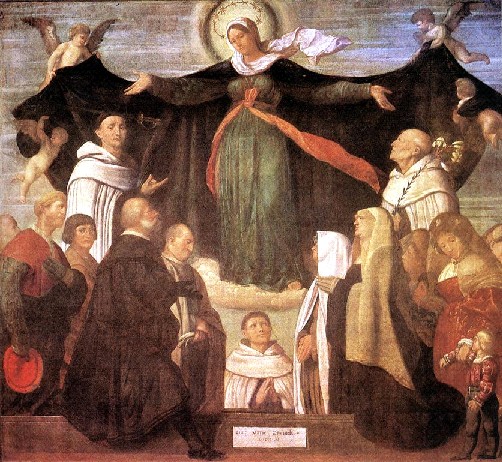
File:Moretto, Madonna del Carmelo, accademia.jpg - Wikimedia Commons

What was Mary's life but one long act of contemplation, a continual outpouring of devotion, the incessant burning of a spiritual flame? We are not told of the blessed Virgin that she performed many miracles and signs, or made long journeys to spread the gospel, or gave extraordinary alms (which would have been impossible, because she lacked the means), or tended the sick, or redeemed captives, or built large numbers of churches or endowed religious houses with particular generosity. No; all the glory of the king's daughter was within, in the fervor of her heart, and in those golden borders, her pure thoughts and keen desires and the virtues which she possessed in all their manifold variety.

This does not mean that she did not perform Martha's noble tasks as well: she did, and brilliantly—far better than we can: for where we serve God in the persons of his servants, her service was given to him directly. Doing Martha's work did not stop the holy Virgin from fulfilling Mary's function. I lie asleep; but oh, my heart is wakeful, we read of her. Which is as if she were to say:  'As far as my outward behavior is concerned, I am asleep, because I am busy with my work; but inwardly I am awake, since all the time I am intent on prayer".

From the time when she soared up like an eagle and fixed her strong eyes on the dazzling brightness of the Godhead, she never looked back at the things of earth. Before she bore God's Word in her womb she gave herself to prayer and contemplation day and night, in company with the other virgins who lived with her in the Temple, where at the age of three she had been presented by her parents. She knew God before she knew herself, and before she could pray in words she habitually prayed in her heart. After the angel had brought her the message and she had become God's mother, she was always absorbed by the thought of the great mysteries accomplished in her. It was as though she were totally immersed in a vast sea of light and inwardly ravished in continual ecstasy, as the gospel shows us when it says that she treasured up all these sayings, and reflected on them in her heart. How could she forget God when she had carried him inside her body, nursed him on her lap and held him at her breast with her hands? Could a mother forget the son she bore in her womb? Could she possibly forget him if he was a Son like this one? After his ascension into heaven, we are told nothing more about Mary, except that she is said to have lived enclosed in an oratory, turning over in her mind all that she had seen and heard. That is all there was in the Virgin's life. That, in brief, is the whole story of her pilgrimage.

St. Bonaventure: Sermon IV: The Assumption: "He that made me rested in my tabernacle"


The Virgin Mary can say, He that made me rested in my tabernacle, because the Creator of all that is chose her virginal womb to rest in on his wedding night, there to become our Brother; and made of it a royal throne, there to sit as our King; and put on a priestly robe in it, so to make himself our Priest. Through the marriage-union the Virgin became God's mother, the royal throne made her Queen of Heaven, the priestly robe the advocate of the human race. It was appropriate that she should be all these things, since she belonged to the human race herself and her ancestors had been kings and priests. How that Virgin loved God, and how justifiably she can say: He that made me rested in my tabernacle.
That God would consummate his marriage in her womb David foresaw in the Spirit with prophetic certitude when he said, He hath set his tabernacle in the sun. He added as a bridegroom because the Virgin's room was the bridal room in which God was united to human nature, the place where he kissed his bride as he made the contract that bound her to him in marriage.

In that womb also God set up his royal throne, there to sit as our King. As the prophet says: Mercy and faithfulness return; a throne set up in David's dwelling-place, for a judge that loves right and gives redress speedily.

And from that womb God took the priestly vestment which he would have to wear if he was to enter the holy of holies. Christ has taken his place as our high priest, to win us blessings that still lie in the future. He makes use of a greater, a more complete tabernacle, which human hands never fashioned; it does not belong to this order of creation at all. It is his own blood, nor the blood of goats and calves, that has enabled him to enter, once for all, the sanctuary. On his way to the holy of holies, Christ our high priest passed through the Virgin's womb, where he put on the priest's robe, and from there proceeded to the cross, where he offered the holiest Of all victims and so obtained for us God's friendship. The reason why the Lord was bent on robing in the tabernacle of the Virgin's womb was this: he wanted to make her our advocate as well as himself. There could be no resisting mother and Son together; the two of them would bring firm confidence to us poor wanderers, bidding us cling to the hope we have in view. I will set my tabernacle in the midst of you, he said, and my soul shall no more cast you off for the blessed Virgin, our advocate, can never ask in vain.

We can approach the Virgin, then, with every confidence; whatever our need, we can go to her in all security. We shall do well to honor this tabernacle and flee to it for refuge, since the Lord himself took his ease there and the blessed Virgin could say with literal truth: He that made me rested in my tabernacle.

Saturday, July 9, 2022


S. BENEDICTI, ABBATIS


Ad Officium lectionis & ad Vesperas: Petrus Venerabilis


Petrus, non minus religione et morum itegritate,  quam scientia,  venerabilis – John Trithemius, Abbot of Spanheim


Inter ætérnas súperum corónas,

quas sacro partas cólimus triúmpho,

émicas celsis méritis corúscus,

  o Benedícte!


Sancta te compsit púerum senéctus,

nil sibi de te rápuit volúptas,

áruit mundi tibi flos, ad alta

  mente leváto.


Hinc fuga lapsus pátriam, paréntes

déseris, fervens némorum colónus;

inde conscríbis documénta vitæ

  pulchra beátæ.


Iam docens omnes pópulos subésse

légibus tandem placitísque Christi,

fac tuis cuncti précibus petámus

  cælica semper.


Cláritas Patri genitæque Proli,

Flámini Sancto decus atque cultus,

grátia quorum tibi tanta laudis

  glória lucet. Amen.


Among the eternal and heavenly crowns imparted, which we celebrate in holy triumph, you glitter brightly with heavenly merits, O Benedict.  The holiness of old age characterized you even as a boy, you stole nothing of pleasure, to you the flowers of the world were dried up, your soul raised on high. Hence it happened that you fled your homeland, deserted your parents, fervent for the company of none; whence you wrote the beautiful rule of a blessed life.  Which teaches all the people to submit themselves to the great laws and to those things pleasing to Christ. Grant that by your prayers we may all ever seek heavenly things. Glory to the Father and to the begotten Son, to the Holy Spirit honor and worship, by whose glorious grace shines forth such praise to you. Amen.

Ad Laudes matutinas: novus


Légifer prudens, veneránde doctor,

qui nites celsis méritis per orbem,

dénuo comple, Benedícte, mundum

  lúmine Christi.


Flóruit per te novus atque miro

géntium nexu sociátus ordo;

iúribus sacris tua vox subégit

  dúlciter omnes.


Líberos Iesu paritérque servos

régula magna statuísti alúmnos,

quos amor fotus précibus revínxit

  et labor unus.


Iamque fratérne, duce te, labórent,

mútuo certent pópuli favóre,

gáudeant pacis refovére semper

  dona beátæ.


Cláritas Patri genitæque Proli,

Flámini Sancto decus atque cultus,

grátia quorum tibi tanta laudis

  glória lucet. Amen.


Wise lawgiver and venerable teacher, who shines with heavenly merits throughout the world, fill the world anew with the light of Christ. Through you a new society of nations flourished and was knit together in a wonderful order; your voice sweetly subjected all to holy laws. By the great rule you established, you nourished both free men and servants of Jesus, whom love cherished, prayers conquered, and work united. By your leading may the peoples work and strive in brotherhood and mutual favor, may they rejoice ever and cherish, the gifts of blessed peace.  Glory to the Father and to the begotten Son, to the Holy Spirit honor and worship, by whose glorious grace shines forth such praise to you. Amen.


Vespers 1 : St. Ambrose

Walpole: Ambrose probably wrote it for daily use throughout the year and Ambrosian MSS give as rubric simply hymnus uespertinalis. It was adopted into the later hymnary and there assigned to vespers on Saturday. 'Its general use is on Saturdays from that preceding the 1st Sunday after the Octave of the Epiphany to the Saturday before Quadragesima Sunday, both inclusive; and from the Saturday preceding the 1st Sunday in August to Advent.'


Walsh & Hutch: This hymn consoled Augustine at his mother's death: “I remembered the very true verses of your Ambrose . . .”  The first two stanzas then follow (Conf. 9.12.32). He recalled that earlier his mother had quoted the final line at Cassiciacum (De beata vita 35). At Arles, Caesarius prescribed it as an evening hymn. It is structured with a fourfold division: invocation to the Creator, who grants the night for necessary rest (SS 1—2); thanksgiving for the day now past (SS 3—4); prayer for faith to sustain us in sleep (SS 5—6); and entreaty to the Trinity to repel the devil's guile in the night hours (SS 7-8).


Deus, creátor ómnium (1)

políque rector, véstiens

diem decóro lúmine,

noctem sopóris grátia,


Artus solútos ut quies (2)

reddat labóris úsui

mentésque fessas állevet

luctúsque solvat ánxios,


Grates perácto iam die (3)

et noctis exórtu preces,

voti reos ut ádiuves, (4)

hymnum canéntes sólvimus.


Te cordis ima cóncinant,

te vox canóra cóncrepet,

te díligat castus amor,

te mens adóret sóbria,


Ut cum profúnda cláuserit

diem calígo nóctium, (5)

fides ténebras nésciat

et nox fide relúceat.


Christum rogámus et Patrem,

Christi Patrísque Spíritum;

unum potens per ómnia,

fove precántes, Trínitas. Amen.


O God, Creator of all, Ruler of the sky, vesting the day with beauteous light, night with the grace of rest. That quiet might loosen limbs and restore us for work and relieve weary minds, relax anxious grief. Grateful for the day that has passed and urged by the prayers of night, we sing and offer you a hymn that you would help us keep our vows. May our inmost hearts sing to you, tuneful voice resound, chaste desire love you, sober minds adore you. That when the deep darkness of night covers the day, faith may know no darkness and night may sparkle with faith. We ask this of Christ and his Father and the Spirit of Christ and the Father, one power through all things, O Trinity, favor those who pray. Amen.


Lauds : St. Ambrose


Ætérne rerum cónditor,

noctem diémque qui regis,

et témporum das témpora

ut álleves fastídium,


Præco diéi iam sonat,

noctis profúndæ pérvigil,

noctúrna lux viántibus

a nocte noctem ségregans.


Hoc excitátus lúcifer

solvit polum calígine;

hoc omnis errónum chorus

vias nocéndi déserit.


Hoc nauta vires cólligit

pontíque mitéscunt freta;

hoc, ipse Petra Ecclésiæ,

canénte, culpam díluit.


Iesu, labántes réspice

et nos vidéndo córrige;

si réspicis, lapsus cadunt

fletúque culpa sólvitur.


Tu, lux, refúlge sénsibus

mentísque somnum díscute;

te nostra vox primum sonet

et vota solvámus tibi.


Eternal Creator of things, you who rule night and day, and give the time of the seasons that you may relieve our boredom. The cock, the watchman through the deep of night, now sounds, a nocturnal light for travelers, separating one from another. By this the morning star is aroused, the sky is parted from the darkness; by this every band of errors  abandons its harmful ways. By this the sailor regains his strength and the raging sea is calmed; by this Peter himself, the rock of the Church, by song washes away his guilt. O Jesus, look upon those who are falling, for by one glance you correct; if you see us, our lapses fall and crime is absolved by tears. You, O Light, shine on our senses, may sleep of our souls depart; our voices sing to you and our promises to you are kept.


When the Office of Readings is read in the daytime: Aron 12th Century?


Dies ætásque céteris

octáva splendet sánctior

in te quam, Iesu, cónsecras,

primítiæ surgéntium.


Tu tibi nostras ánimas

nunc primo conresúscita;

tibi consúrgant córpora

secúnda morte líbera.


Tibíque mox in núbibus,

Christe, ferámur óbviam

tecum victúri pérpetim:

tu vita, resurréctio.


Cuius vidéntes fáciem,

configurémur glóriæ;

te cognoscámus sicut es,

lux vera et suávitas.


Regnum, cum Patri tráditos,

plenos septéno chrísmate,

in temet nos lætíficas,

consúmmet Sancta Trínitas. Amen.


The eighth day is more holy and brighter than other days, which you, O Jesus, consecrated as the first fruits of the resurrection.  First now raise our souls together with you; then may our bodies rise free from the second death. O Christ, may we soon be carried to meet you in the clouds, with you conquering forever: for you are life and resurrection. Seeing your face, may we be transfigured into glory; may we know you as you are: true light and goodness. May the Holy Trinity bring the kingdom to fulfillment: making us glad in Christ, handed over to the Father and filled with the seven-fold anointing.  Amen.


Vespers II: St. Gregory the Great ?


The five hymns, probably composed by the same author, are taken from the first five days of Creation in Genesis. This, the first, refers to the creation of light.


Lucis creátor óptime,

lucem diérum próferens,

primórdiis lucis novæ

mundi parans oríginem;


Qui mane iunctum vésperi

diem vocári prǽcipis:

tætrum chaos illábitur;

audi preces cum flétibus.


Ne mens graváta crímine

vitæ sit exsul múnere,

dum nil perénne cógitat

seséque culpis ílligat.


Cælórum pulset íntimum,

vitále tollat prǽmium;

vitémus omne nóxium,

purgémus omne péssimum.


Greatest Creator of light, providing the light of day and fashioning the first beginnings of new light at the beginning of the world; You who bid morning joined to evening to be called day: now dark disorder falls upon us: hear our prayers with tears. Let not our minds heavy with sin be deprived of the rewards of life and bind ourselves to sin with no thought for things eternal. May our soul knock at the door of heaven, carry away the prize of life; let us shun everything harmful, let us purge all that is evil.


Saturday, April 16, 2022

Christ factus est

 Christ became obedient for us unto death, even to the death of the cross. For which cause God also hath exalted him, and hath given him a name which is above all names.


Christus factus est pro nobis obediens usque ad mortem 

Mortem autem crucis

Propter quod et Deus exaltavit illum, et dedit illi nomen, quod est super omne nomen.

From the Treatise of St. Augustine, Bishop of Hippo, Upon the Psalms On Psalm lxiii, 7


We shall attain to thoughts that are very deep: but God shall still be exalted. The enemies of our Lord had communed of laying snares privily; they had said, Who shall see them? They had searched out iniquities; they had accomplished a diligent search. And Man attained even unto (the realization of) their counsels, for the Lord, as Man, suffered Himself to be taken. For He had not been taken at all, unless He had been a Man, or seen, unless He had been a Man, or smitten, unless He had been a Man, or crucified, unless He had been a Man, or have died, unless He had been a Man. Man therefore, He attained unto all those sufferings, which had had nothing in Him, unless He had been a Man. But if He had not been Man, man had not been redeemed. And the Lord as Man attained to thoughts that were very deep, yea, secret; showing the Manhood to the eyes of men, and keeping the Godhead within Him; veiling the form of God, as touching Which, He is Equal to the Father, and manifesting the form of a servant, as touching which, He is inferior to the Father.


How far did the accomplishment of their diligent search reach? Even to the setting a watch of soldiers at the sepulcher, to guard the Lord, even after He was dead and buried. For they said unto Pilate: Sir, we remember that that deceiver Matth. xxvii. 63. This was the term by which they designated the Lord Jesus Christ, and the remembrance that He was so named is a sweet consolation to us His servants, when we are called impostors. So, they said unto Pilate, that deceiver said, while He was yet alive: After three days I will rise again. Command therefore that the sepulcher be made sure until the third day, lest His disciples come and steal Him away, and say unto the people: He is risen again from the dead: so the last error shall be worse than the first. Pilate said unto them: Ye have a watch; go your way; make it as sure as ye can. So they went and made the sepulcher sure, sealing the stone, and setting a watch.


So they went, and made the sepulcher sure, sealing the stone, and setting a watch and anon, behold, there was a great earthquake, and the Lord arose. So great wonders were wrought about the sepulcher that the very soldiers, which were put to guard it, were witnesses thereto, if only they would have told the truth. But the same love of money which had made a slave of that disciple who was a companion of Christ, made slaves also of the soldiers that were put to watch His sepulcher. Some of the watch came into the city, and showed unto the chief-priests all the things that were done: and when they were assembled with the elders, and had taken counsel, they gave large money unto the soldiers, saying: Say ye, His disciples came by night and stole Him away while we slept. In good sooth, their diligent search had been accomplished and ended before this. What didst thou say, O stupid cunning? Wast thou indeed so utterly void of the light of godly wisdom, and confounded in the bottomless pit of thine own falsehood as to tell them to say: His disciples came by night, and stole Him away while we slept? Part of the testimony of thine eye-witnesses was that they were asleep at the time: thou thyself wast asleep not to be able to see that on their own testimony, their testimony must have been worthless.