Friday, April 25, 2025


Sedibus Cæli


From St. Augustine’s Lyre


This hymn is used for Vespers & Matins the Feast of Sts. Cyril and Methodius in the Extraordinary Form.


Sedibus cæli nitidis receptos
Dicite athletas geminos, fideles;
Slavicæ duplex columen, decusque
Dicite gentis.


Hos amor fratres sociavit unus,
Unaque abduxit pietas eremo,
Ferre quo multis celerent beatæ
Pignora vitæ.


Luce, quæ templis superis renidet,
Bulgaros complent, Moravos, Bohemos;
Mox feras turmas numerosa Petro
Agmina ducunt.


Debitam cincti meritis coronam
Pergite o flecti lacrimis precantum;
Prisca vos Slavis opus est datores
Dona tueri.


Quæque vos clamat generosa tellus
Servet æternæ fidei nitorem;
Quæ dedit princeps, dabit ipsa semper
Roma salutem.


Gentis humanæ Sator et Redemptor,
Qui bonus nobis bona cuncta præbes,
Sint tibi grates, tibi sit per omne
Gloria sæclum. Amen.


R. P. Leanetti & Rmo Salvati, late 19th C.


Sing, o ye faithful, sing two athlete brothers,

Welcomed above to thrones of light supernal;

Sing, of Slavonia’s race, the glory twofold

And strength eternal.


One love these brethren bound in sweetest union,

By pity same their solitude is broken;

Forth they would hasten, unto many bearing

Life’s blessed token.


Soon o’er Bulgaria, Moravia, Bohemia,

Light from the heavenly temple shineth glorious.

Once savage hordes, now countless flocks, to Peter

Lead they victorious.


Now with the well-earned crown your brow encircled,

Hear, blessed ones, to suppliant tears bending;

Unto the Slavs, erst by your gifts enriched,

Protection lending.


Oh, may each gen’rous land, your aid imploring,

Keep bright the faith through every generation;

Rome to that land first gave, and ever guardeth,

Life and salvation.


Lord, of our race Creator and Redeemer,

By nature good, all goods on us bestowing,

Glory to Thee through ages all, from grateful

Hearts overflowing.


tr. Benedictines of Stanbrook Abbey, 1916.


Friday, April 18, 2025

Friday 18 April 2025 Good Friday

 Friday 18 April 2025

Good Friday ●

Spiritual Reading

Your Second Reading from the Office of Readings:

Good Friday

Ex Catechésibus sancti Ioánnis Chrysóstomi epíscopi (Cat. 3, 13-19: SCh 50, 174-177)

Virtus sanguinis Christi

Vis Christi sánguinis audíre virtútem? Redeámus ad eius exémplum et priórem typum recordémur et prístinam scriptúram narrémus.

Occídite, inquit Móyses, agnum annículum et sánguine eius liníte iánuas. Quid ais, Móyses? Sanguis ovis rationábilem hóminem liberáre consuévit? Valde, inquit, non eo quod sanguis est, sed quia domínici sánguinis per eum demonstrátur exémplum. Nunc ergo si víderit inimícus non póstibus impósitum sánguinem typi, sed fidélium ore lucéntem sánguinem veritátis, Christi templi póstibus dedicátum, multo magis se súbtrahit.

Vis et áliam huius sánguinis scrutári virtútem? Volo unde primum cucúrrit inspícias et de quo fonte manávit. De ipsa primum cruce procéssit, latus illud domínicum inítium fuit. Mórtuo enim, ait, Iesu et adhuc in cruce pendénte, appróximat miles, latus láncea percússit et exínde aqua fluxit et sanguis. Unum baptísmatis sýmbolum, áliud sacraménti. Latus miles apéruit et templi sancti paríetem patefécit et ego thesáurum præclárum invéni et fulgéntes divítias me grátulor reperíre. Sic et de illo agno factum est. Iudǽi ovem occidérunt et ego fructum de sacrifício cognóvi.

De látere sanguis et aqua. Nolo tam fácile, audítor, tránseas tanti secréta mystérii. Restat enim mihi mýstica atque secretális orátio. Dixi baptísmatis sýmbolum et mysteriórum aquam illam et sánguinem demonstrári. Ex his enim sancta fundáta est Ecclésia, per lavácri regeneratiónem et renovatiónem Spíritus Sancti, per baptísma, inquam, et mystéria quæ ex látere vidéntur esse proláta. Ex látere ígitur suo Christus ædificávit Ecclésiam, sicut de látere Adam eius coniux Eva proláta est.

Nam hac de causa Paulus quoque testátur dicens: De córpore eius et de óssibus sumus, latus signíficans. Nam sicut de illo látere Deus fecit féminam procreári, sic et de suo látere Christus aquam nobis et sánguinem dedit, unde repararétur Ecclésia. Et sicut in sopóre quiescéntis Adæ, Deus láteris membra patefécit, sic modo post mortem aquam nobis donávit et sánguinem.

Vidéte quemádmodum sponsam sibi Christus coniúnxit, vidéte quo nos cibo enútrit. Eódem cibo náscimur et nutrímur. Nam sicut múlier, affectiónis natúra cogénte, génitum álere lacte suo et sánguine festínat, sic et Christus quos ipse regénerat suo sánguine semper enútrit.

From the Catecheses by Saint John Chrysostom, bishop

The power of Christ's blood

If we wish to understand the power of Christ’s blood, we should go back to the ancient account of its prefiguration in Egypt. “Sacrifice a lamb without blemish,” commanded Moses, “and sprinkle its blood on your doors.” If we were to ask him what he meant, and how the blood of an irrational beast could possibly save men endowed with reason, his answer would be that the saving power lies not in the blood itself, but in the fact that it is a sign of the Lord’s blood. In those days, when the destroying angel saw the blood on the doors he did not dare to enter, so how much less will the devil approach now when he sees, not that figurative blood on the doors, but the true blood on the lips of believers, the doors of the temple of Christ.

If you desire further proof of the power of this blood, remember where it came from, how it ran down from the cross, flowing from the Master’s side. The gospel records that when Christ was dead, but still hung on the cross, a soldier came and pierced his side with a lance and immediately there poured out water and blood. Now the water was a symbol of baptism and the blood, of the holy Eucharist. The soldier pierced the Lord’s side, he breached the wall of the sacred temple, and I have found the treasure and made it my own. So also with the lamb: the Jews sacrificed the victim and I have been saved by it.

“There flowed from his side water and blood.” Beloved, do not pass over this mystery without thought; it has yet another hidden meaning, which I will explain to you. I said that water and blood symbolised baptism and the holy Eucharist. From these two sacraments the Church is born: from baptism, “the cleansing water that gives rebirth and renewal through the Holy Spirit,” and from the holy Eucharist. Since the symbols of baptism and the Eucharist flowed from his side, it was from his side that Christ fashioned the Church, as he had fashioned Eve from the side of Adam. Moses gives a hint of this when he tells the story of the first man and makes him exclaim: “Bone from my bones and flesh from my flesh!” As God then took a rib from Adam’s side to fashion a woman, so Christ has given us blood and water from his side to fashion the Church. God took the rib when Adam was in a deep sleep, and in the same way Christ gave us the blood and the water after his own death.

Do you understand, then, how Christ has united his bride to himself and what food he gives us all to eat? By one and the same food we are both brought into being and nourished. As a woman nourishes her child with her own blood and milk, so does Christ unceasingly nourish with his own blood those to whom he himself has given life.

________ 


In other parts of the world and other calendars:

Blessed Mary of the Incarnation, Married, Religious

From 'The Way of Perfection' by St Teresa of Avila

The apostolic aim of the Teresian Carmel

When I began to take the first steps toward founding this monastery, it was not my intention that there be so much external austerity. At that time news reached me of the harm being done in France and of the havoc the Lutherans had caused and how much this miserable sect was growing. The news distressed me greatly, and, as though I could do something or were something, I cried to the Lord and begged him that I might remedy so much evil. It seemed to me that I would have given a thousand lives to save one soul out of the many that were being lost there.

I realized I was a woman and wretched and incapable of doing any of the useful things I desired to do in the service of the Lord. All my longing was and still is that since he has so many enemies and so few friends that these few friends be good ones. As a result I resolved to do the little that was in my power; that is, to follow the evangelical counsels as perfectly as I could and strive that these few persons who live here do the same. I did this trusting in the great goodness of God, who never fails to help anyone who is determined to give up everything for him. My trust was that if these sisters matched the ideal my desires had set for them, my faults would not have much strength in the midst of so many virtues; and I could thereby please the Lord in some way. Since we would all be occupied in prayer for those who are the defenders of the Church and for preachers and for learned men who protect her from attack, we could help as much as possible this Lord of mine who is roughly treated by those for whom he has done so much good; it seems these traitors would want him to be crucified again and that he have no place to lay his head. Still, my heart breaks to see how many souls are lost. Though I can’t grieve so much over the evil already done — that is irreparable — I would not want to see more of them lost each day.

O my Sisters in Christ, help me beg these things of the Lord. This is why he has gathered you together here. This is your vocation. These must be the things you desire, the things you weep about; these must be the objects of your petitions. The world is all in flames, they want to sentence Christ again, so to speak, since they raise a thousand false witnesses against him; they want to ravage his Church.

So, then, I beg you for the love of the Lord to ask His Majesty to hear us in this matter. Miserable though I am, I ask His Majesty this, since it is for his glory and the good of the Church; this glory and good is the object of my desires.

Thursday, April 17, 2025

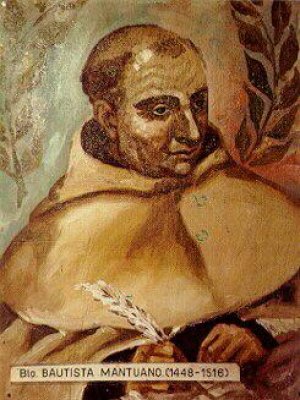
Blessed Baptist Spagnoli of Mantua


Blessed Baptist Spagnoli of Mantua

Baptist was born on 17th April 1447 to a family of civil servants to the Dukes of Mantua. He entered the Carmelites of the Congregation of Mantua at Ferrara as a young man and had a stellar rise in academics and administration of his order.
While not a poet of genius, he was a superb Latin stylist, imitating Virgil. His eclogues were used in European schools for a century and a half after his death as a model of style and he was quoted by Shakespeare, Boswell, and Nashe. He was friends with many of the leading Renaissance humanists, including the two Pico della Mirandolas, with whom some correspondence survives.
He made his religious profession in 1464 and served in many positions of responsibility in the community in addition to his literary work. Baptist performed a number of diplomatic missions for the popes; he was vicar general of his congregation six times and in 1513 he was elected Prior General of the whole Order. He was a renowned humanist who brought his richley varied poetry into the service of Christ.
He is the only Carmelite quoted in the works of William Shakespeare (Love’s Labor Lost, Act IV, scene 2, line 95ff.) He used his friendship with scholars as an opportunity of encouraging them to live a Christian life. He died in Mantua on 20th March 1516.
 
 
Prayer
Lord God,
you made Our Lady’s faithful servant,
Blessed Baptist Spagnoli,
a preacher of your Gospel by word and example.
Through his prayers may we ponder your word in Mary’s company,
and praise you with her by the way we live.
We ask this through Christ our Lord.

Bl. Baptist Spagnoli, Priest


  • image

Bl. Baptist Spagnoli, Priest

baptistmantua 35017 April Memorial

Born in Mantua on 17th April 1447, Bl. Baptist's father was of Spanish origin and hence his surname. He entered the Carmelites in Ferrara and professed his religious vows in 1464. He was awarded a doctorate in theology in Bologna in 1475 and subsequently held a number of different positions in a succession of convents. Six times elected Vicar General for the Reformed Congregation (the Mantuan Reform), at the end of his life he was elected Prior General for the whole Order (1513-16).

His activities were not limited to the Carmelite Order. In 1513 he was invited to participate in the Lateran Council and, in 1515, he was entrusted by Pope Leo X with a diplomatic mission to negotiate a peace between the king of France and the duke of Milan. He was noted especially for his spirited and determined denunciations of the spreading corruption in society and he gave expression to his desire for reform with elegant literary appeals and a moving discourse in 1489 in St. Peter's Basilica before the Pope and the cardinals. All this, though, did not distract him from living a very interior life and having a special devotion to the Virgin Mary.

He was a friend of many of the famous humanists and illustrious figures of his age, becoming an important figure in the literary world. Proclaimed by Erasmus as the "Christian Virgil" (he wrote with more than 50,000 Latin verses, besides other works of prose), he must be judged as one of the best poets of his time, a claim which is well attested by the numerous editions of his works.

He died in Mantua on 20th March 1516 and his incorrupt body is preserved in the Cathedral there. The cult of Blessed Baptist was approved by Pope Leo XIII on 17th December 1885 and his memorial day is celebrated on 17th April.

Monday, April 14, 2025

A reading from the letters of St Francis of Paola, Hermit


A reading from the letters of St Francis of Paola, Hermit (Letter AD 1486)


"May our Lord Jesus Christ, who repays most generously, reward your labor. You must flee from evil, and drive away dangers. We and all our brothers, although unworthy, pray constantly to God the Father and to his Son Jesus Christ, as well as to Mary the Virgin Mother, to be with you as you seek the salvation of your souls and your bodies.


Brothers, I most strongly urge you to work for the salvation of your souls with prudence and diligence. Death is certain, and life is short and vanishes like smoke. Therefore, you must fix your minds on the passion of our Lord Jesus Christ who so burned with love for us that he came down from heaven to redeem us. For our sakes he suffered all the agonies of body and mind, and did not shrink from any torment. He gave us a perfect example of patience and love. For our part, we too must be patient when things go against us.


Put aside hatred and hostility. See to it that you refrain from harsh words. But if you do speak them, do not be ashamed to apply the remedy from the same lips that inflicted the wounds. In this way you will show each other mercy and not keep alive the memories of past wrongs. Remembering grievances works great damage. It is accompanied by anger, fosters sin, and brings a hatred for justice. It is a rusty arrow spreading poison in the soul. It destroys virtue and is a cancer in the mind. It thwarts prayer and mangles the petitions we make to God. It drives out love and is a nail driven into the soul, an evil that never sleeps, a sin that never fades away, a kind of daily death.


Be lovers of peace, the most precious treasure that anyone can desire. You are already aware that our sins drive God to anger, "so you must repent of them, that God in his mercy may spare you. What men conceal is open to God. Turn to him with a sincere heart. Live in such a way that you bring upon yourselves the blessing of God, and that the peace of God our Father may be with you always."

Saturday, April 12, 2025


A Lesson on Love From St. Peter Chrysologus


DO YOU THINK THAT a mortal heart grasps the extent of the Lord's charity towards us? Do you think that a mind burdened by the weight of an earthly body can understand or realize God's affection towards us? For whatever sparkles, shines, and gleams with the splendor of heaven, whatever on earth bursts forth with flowers, whatever pleasant taste there is in fruit, and whatever joy there is in living beings, have all been made out of love for us, and have been designed to serve us. But although they are great, nevertheless, they are small insofar as indicating heavenly love towards us. To us the principalities of heaven, the heavenly powers, the celestial dominions, to us the choirs of angels give service with tireless vigilance. But even these are small and inferior as signs of the intimate bond God has with us, and as paltry in value as the creature is inferior to his Creator.


2. God, whose face cannot be seen, who is imperceptible to our sight, who cannot be grasped by our senses, who is inaccessible to our mind, and not even completely known when his voice is heard, how often, in how many ways, with how many varieties, and with what diversity has he adapted himself to human vision! How he has offered and submitted himself to communion and familiarity with human beings, when he made Noah a partner in his design! He forewarned him that very shortly the world was to be purified by a flood, and he carried out his plan for the whole world under his supervision over the little seed-vessel that was the ark.'


When he came as a guest to Abraham, he very graciously accepted the invitation, he did not refuse what was offered, he ate what was served like one who was hungry' and weary, and in this divine exchange he received and accepted human kindness like one who was in need. Shortly thereafter the dead members of the old man revive, the sterile womb of the childless old woman is now awakened, and the nature that had been buried in a living corpse rises to life to reveal its Author, and although her time had already passed, she who had believed the one Creator produces very many descendants.


To Moses he comes as a ball of fire in the bush, then he discusses with his servant what must be done, he is busy in Egypt with various acts of power, and he is revealed at the will of his servant. He imposes scourges or he removes them, and in the sea the avenging waves show by their obedience how great he is and how much he has given to the human being, when with its swell all dried up the wave yields to the holy ones, and it provides a wall out of water that solidified, it offers a defense for those to be freed, and with all its might it crashed down in triumph over the fiercest of enemies.


In his wondrously intimate bond with the Israelites God keeps company with them in their camp; at one moment he strikes a number of pagans with a thunderbolt, at another he pours down hail, at yet another he levels them with the noisy din of trumpets, so that without a battle and without a wound, God goes ahead of the battle lines and leads them to victory. He was present to their needs, he granted individuals their prayers, he responded quickly to what was asked, he revealed what was hidden, he foretold the future, he brought to light what was sought, he conferred the kingdom, he bestowed wealth, he provided rain in due season, he supplied fertile lands, and with prosperity and honor he endowed his children who kept holy the bond of marriage.


But he considered this to be still too little, if he were to show his affection towards us by bestowing blessings on us, but not also by enduring adversities. After all this he entered his own world in poverty, he lay in a cradle: thus, as a human being by his crying he implores, he seeks, he pleads for the loving kindness that he himself has shown to you. The Parent of a119 has made use of you as a parent, and the One who is higher than every height lived under your authority; 10 the One whom terrifying things fear was frightened, the Refuge of all fled, the Ruler of the heavens is a guest in the homes of sinners, the Judge of the guilty is fed on their bread.