Sunday, July 19, 2020

St. Thomas Aquinas: On 2 Corinthians

Beginning St. Thomas Aquinas - The Catholic Thing


PROLOGUE
“Men shall speak of you as ministers of our God” (Is. 61:6).
1. – The subject matter of this second epistle to the Corinthians is fittingly touched upon by these words. For in the first epistle the Apostle discussed the sacraments; in this one he discusses the ministers, both good and bad, of these sacraments. The reason he wrote this epistle was that he had preached to the Corinthians, but they had welcomed certain false apostles, whom they preferred to the Apostle. Therefore he writes them this epistle, in which he commends the apostles and the dignity of the true apostles, and discloses and reproves the falseness of the false apostles.
2. – He commends the dignity of the true apostles, because they are God’s ministers. Men shall speak of you, i.e., the apostles, as the ministers of God. They are called ministers under three aspects. First, inasmuch as they dispense the sacraments: “This is how one should regard us, as servants of Christ” (1 Cor. 4:1). For Christ instituted the sacraments, but the apostles and their successors dispense them; therefore the text just cited continues: and stewards of the mysteries of God. Secondly, inasmuch as they govern the people of God: “Because, as servants of his kingdom, you did not rule rightly, nor keep the law” (Wis. 6:4). For God governs all things by his wisdom, so that whoever governs any one is called God’s minister. Thirdly, because they labor for the salvation of men, namely, inasmuch as many are converted by their ministry and preaching. But God alone is the author of man’s salvation, because it was he who came to save that which had been lost; the apostles, however, are his ministers: “What then is Apollos? What is Paul? The ministers of him whom you have believed” (1 Cor. 3:5).
 Cor. 1:3-5
3 Blessed be the God and Father of our Lord Jesus Christ, the Father of mercies and God of all comfort, 4 who comforts us in all our affliction, so that we may be able to comfort those who are in any affliction, with the comfort with which we ourselves are comforted by God. 5 For as we share abundantly in Christ’s sufferings, so through Christ we share abundantly in comfort too.
11. – Here begins the message, in which the Apostle does two things: first, he excuses himself for not visiting them as he had promised; secondly, he begins to follow out his intention (chap. 3). In regard to the first he does two things: first, he wins their good will; secondly, he presents his excuse (v. 15). In regard to the first he does two things: first, he wins their good will be citing some general facts; secondly, some special ones (v. 8). The Apostle wins their good will by showing that whatever he does, it is all for their benefit. In regard to this he does two things: first, he mentions the profit others have obtained from him; secondly, the reason (v. 5). In regard to the first he does three things: first, he gives thanks; secondly, the manner of the thanks (v. 4); thirdly, the cause (b. 4b).
12. – He gives thanks, therefore, to the entire Trinity, the source of every good; hence he says, Blessed be the God, i.e., the entire Trinity; and to the person of the Father when he says, and Father of our Lord Jesus Christ, through whom the Father has given us all things. It should be noted that we bless God and God blesses us, but in different ways. For when God speaks, he accomplishes: “He spoke and they were made” (Ps. 148:5). Hence, for God to bless is to produce something good, and to infuse something good, and so to be a cause: “I will indeed bless you and multiply your descendants” (Gen. 22:17). But our speech does not cause things, but acknowledges or expresses them; hence, our blessing is the same as recognizing good. Therefore, when we thank God, we bless him, i.e., acknowledge that he is good and the giver of all good: “Bless God and acknowledge him in the presence of all the living for the good things he has done for you.” (Tob. 12:6); “Bless the Lord, all you works of the Lord; praise and exalt him above all for ever” (Dan. 3:57).
13. – It is fitting that he thank the Father, because he is merciful; hence he says, the Father of mercies: and because he is a comforter he says, and God of all comfort. He thanks God for the two things men especially need: first, to have evil removed from them, and this is done by mercy which takes away misery, for it is characteristic of a father to have compassion: “As a father pities his children, so the Lord pities those who fear him” (Ps. 103: 13). Secondly, they need to be supported in the face of evils which occur, and that is to receive comfort. Because unless a man had something in which his heart could rest, he would not stand firm when evils come upon him. Therefore a person comforts another by affording him something refreshing, in which he can rest in evil times. And although a man might be comforted by something and find rest and be supported by it in the case of some evils, it is God alone who comforts us in all evils; hence he says, the God of all comfort. For if you sin, God comforts you, because he is merciful; if you are afflicted, he comforts you either by rooting out the affliction by his power or by judging justly; if you labor, he comforts you with a reward: “I am your shield; your reward shall be very great (Gen. 15:1). Therefore, it says in Matthew (5:4): “Blessed are those who mourn, for they shall be comforted.”

Saturday, July 18, 2020

Sermon by S. Gregory the Great: Homily 25 on the Gospels: St. Mary Magdalene


Mary Magdalene at the tomb by Italian School-Genoa (17) on artnet

The Monastic Office had a somewhat different selection from the Liturgy of the Hours.

Sermon by S. Gregory the Great: Homily 25 on the Gospels: St. Mary Magdalene

MARY MAGDALENE, a woman of the city, which was a sinner, washed out the stains of her sins with her tears, by her love of the Truth; the Word of the Truth; and the Word of the Truth is fulfilled which says, her sins are forgiven, for she loved much. She who had previously been cold through sin, was afterward aflame with love.  She would not leave the Lord's sepulcher even when the disciples had left. She was seeking him and could not find him. As she sought, she wept, and enkindled with the fire of his love, she was aflame with longing for him whom she believed had been taken away. Whence it happened that she alone saw him, as she alone had stayed behind to seek him: for the power of good works lies in perseverance.

THE first time that she sought him she could in no wise find him: she persevered in seeking, and so it came about that she found him. And this happened, because longing increases when unsatisfied, and thus increased, can retain what it finds. For it is of him that the Church, the Bride in the Song of Solomon, says: By night on my bed I sought him whom my soul loveth. We seek the Beloved on our bed, when, in the brief rest of this present life we pine with love for our Redeemer. We seek by night, because, although our mind is now watching for him, yet is our eye still in darkness.

BUT it remains for her who finds not her Beloved to rise and go about the city; that is, by thought and questioning to go through the Church of the elect: let her seek in the streets and in the broad ways; that is, let her look upon the passers- by in the narrow and the wide paths, to see whether there is any among them whose footprints she may follow: for there are some even in this present life whose virtuous deeds we may strive to follow.

BUT the watchmen that go about the city find us as we search: for the holy fathers who guard the bulwarks of the Church hasten to meet our good endeavors, that they may teach us either by word or writing. When we have passed from them but a little, we find him whom our soul loveth: for although by his humility our Redeemer became a man among men, yet by his Divinity was he above men.


Thursday, July 16, 2020

Monastic Hymns: St. Mary Magdalene


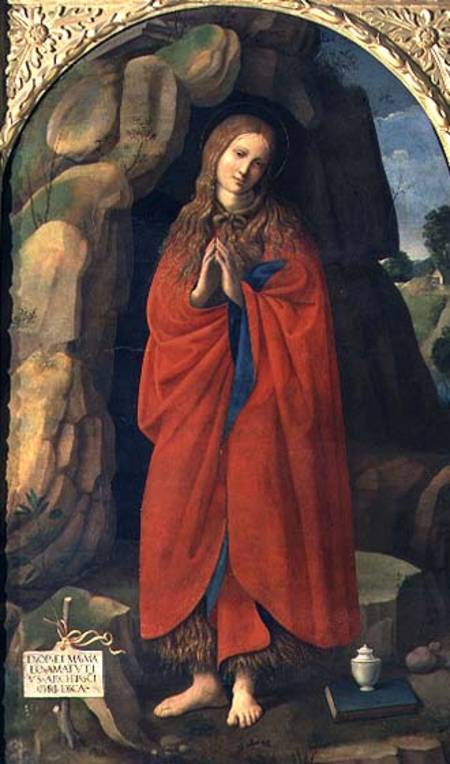
St. Mary Magdalene (panel) - Timoteo Viti as art print or hand ...

St. Mary Magdalene: Vespers: St. Robert Bellarmine, S.J. (1542-1621).

Pater superni luminis,
Cum Magdalenam respicis,
Flammas amoris excitas,
Geluque solvis pectoris.

Amore currit saucia
Pedes beatos ungere,
Lavare fletu, tergere
Comis, et ore lambere.

Astare non timet Cruci,
Sepulcro inhæret anxia:
Truces nec horret milites,
Pellit timorem caritas.

O vera, Christe, caritas,
Tu nostra purga crimina,
Tu corda reple gratia,
Tu redde cæli præmia.

Patri, simulque Filio,
Tibique Sancte Spiritus,
Sicut fuit, sit iugiter
Sæclum per omne gloria. Amen.


Monastic Diurnal

O FATHER of celestial rays,
When thou on Magdalene dost gaze,
The flame of burning love appears,
Her icy heart dissolves
in tears.

Wounded by love, she hastens o'er
The feet of Christ her tears to pour,
Anoints them, wipes them with her hair,
And prints adoring kisses there.

Fearless, the Cross she will not leave:
And grieving, to the Tomb doth cleave: 
No ruthless soldiers cause her dread:
For from her love all fear hath fled.

O Christ, true Charity thou art;
Purge thou the foulness of our heart,
Fill every soul with grace and love,
And give us thy rewards above.

All laud to God the Father be;
All praise, eternal Son, to thee;
All glory, as is ever meet,
To God the Holy Paraclete. Amen.

Matins: att. St. Gregory the Great

Nardo Maria pistico
Unxit beatos Domini
Pedes, rigando lacrimis,
Et detergendo crinibus.

Honor, decus, imperium,
Sit Trinitati unicæ,
Patri, Nato, Paraclito,
Per infinita sæcula. Amen.


His sacred feet with tears of agony
She bathes; and prostrate on the earth adores;
Steeps them in kisses chaste, and wipes them dry
With her own hair; then forth her precious ointment pours.

Praise in the highest to the Father be;
Praise to the mighty coeternal Son;
And praise, O Spirit Paraclete, to Thee,
While ages upon everlasting ages run.

 Lauds: attr. St. Odo of Cluny, (878-942).

Æterni Patris Unice,
Nos pio vultu respice,
Qui Magdalenam hodie
Vocas ad thronum gloriæ.

In thesauro recondita
Regis est drachma perdita,
Gemmaque lucet inclita
Ex luto luci reddita.

Iesu dulce refugium,
Spes una pœnitentium,
Per peccatricis meritum
Peccati solve debitum.

*Nos vitiorum stimuli
Iugi vexant instantia,
Et blandimentis sæculi
Corrumpunt lenocinia.

*Libet, nec licet libere
Tibi pro voto psallere,
Dum mens ægra sub miseræ
Carnis gemiscit onere.

Pia mater et humilis,
Naturæ memor fragilis,
Nos rege tuis precibus
In huius vitæ fluctibus.

Uni Deo sit gloria
Pro multiformi gratia,
Qui culpas et supplicia
Remittit, et dat præmia. Amen.

*Verses omitted in monastic texts and translations.

THOU only Son of God on high,
Regard us with a gracious eye,
Who weeping Magdalene dost own
And call unto thy glorious throne.

Lo! In the royal coffers laid
Again, the long lost coin displayed;
The noble gem of sparkling sheen,
From mire recovered, glows serene.

Jesu, our refuge sure and sweet,
Thee, hope of penitents, we greet;
Forgive the hearts that fain would break,
For that repentant sinner's sake.

And may that Mother kind and meek
Think on our nature frail and weak,
And raise her prayer that we may gain
A passage safe o'er life's rough main.

To God alone be honor paid
For grace so manifold displayed:
Their guilt he pardons who repent,
And gives reward for punishment. Amen

S. MARIÆ MAGDALENÆ

BIG-17e-century-ANTIQUE-FLEMISH-ENGRAVING-S-MARY-MAGDALEN-sign-Cor ...

Ad Officium lectionis & ad Vesperas: novus

Mágdalæ sidus, múlier beáta,
te pio cultu venerámur omnes,
quam sibi Christus sociávit arcti
  fœdere amóris.

Cum tibi illíus pátefit potéstas
dæmonum vires ábigens treménda,
tu fide gaudes potióre necti
  grata medénti.

Hæret hinc urgens tibi caritátis
vis ut insístas pédibus Magístri,
férvidis illum comitáta semper
  sédula curis.

Tuque complóras Dóminum, crucíque
ímpetu flagrans pietátis astas;
membra tu terges studiósa et ungis
  danda sepúlcro.

Quos amor Christi péperit, triúmphis
nos fac adiúngi sócios per ævum,
atque Dilécto simul affluénter
  pángere laudes. Amen.

O Star of Magdala, blessed woman, all venerate you with holy reverence, whom Christ united to himself in a strong bond of love. When he manifested to you his power, driving away fears, the forces of the demons, you rejoiced in stronger faith in the one who had healed you. Wherefore the power of love keep you and urged you to follow the steps of the Master, ever his companion, fervently dedicated to caring for him.  And you wept for your Lord as you stood under the cross, struck by burning love and you anxiously wiped and anointed his body laid in the tomb.  Make us companions of those to whom Christ’s love has given birth, joined to those who have triumphed forever, and abundantly to sing praises to the Beloved. Amen.

Ad Laudes matutinas: novus

Auróra surgit lúcida
Christi triúmphos áfferens,
cum corpus eius vísere,
María, vis et úngere.

Anhéla curris; ángelus
at ecce lætus prædocet
mortis refráctis póstibus
redísse quem desíderas.

Sed te manet iucúndius
intácti amóris præmium,
cum, voce pulsans vílicum,
tuum Magístrum cónspicis.

Quæ cum dolénti Vírgine
hæsísti acérbo stípiti,
tu prima vivi ab ínferis
es testis atque núntia.

O flos venúste Mágdalæ,
o Christi amóre sáucia,
tu caritátis ígnibus
fac nostra corda férveant.

Da, Christe, tantæ sérvulæ
dilectiónem pérsequi,
et nos tu in cæléstibus
tibi canámus glóriam. Amen.

The sparkling dawn arises, bringing the victories of Christ, when Mary desires to see his body and anoint him. Out of breath you run, but a glad angel proclaims “behold the one whom you desire has broken the doors of death and returned.  But there remains for you the happier reward of chaste love, when by the sound of the gardener’s voice you recognize your Master.  You with the sorrowful Virgin clinging to the bitter tree are the first witness and herald of the one who live from the dead. O lovely flower of Magdala, wounded by love of Christ, make our hearts to burn with the fires of love. Grant us, O Christ, to follow the love of such a great servant and also grant that we may sing your glory in heaven. Amen.

Homily of St. Peter Chrysologus: The parable of the sower: 16th Sunday: Year A

Landscape with the Parable of the Sower by Pieter the Elder ...

Here is an image of the kingdom of heaven. There was a man who sowed his field with clean seed; but while all the world was asleep, an enemy of his came and scattered tares among the wheat, and was gone. When the Creator formed the world in the beginning he put in it only what was good, and all that he created was good. It is the enemy who has introduced the germs of evil into the world, for evil does not come from the Creator.

An enemy of his came and scattered tares among the wheat, and was gone. The devil uses all his power to make us fall, but after the fall, he abandons us. What he loves is not man but the ruin of man. He rejoices in our misfortune, takes pride in our ruin, gloats over our wounds: he is only thirsty for our blood, hungry for our flesh: he only lives for our destruction. The devil does not wish to gain men, he wishes to ruin them, for he cannot wish, nor permit, nor endure, that they should reach the heaven from which he fell.

But his spite does not lack folly. What does our enemy do here? He comes while all the world is asleep. The servants are sound asleep: but does the Master sleep? It is in vain that the enemy shuns the light; his watching and machinations do not escape notice. When the servants sleep, the Master sees the deserter from heaven and all his efforts will lead to nothing. God cannot suffer loss: he guards his possessions himself; the devil's perfidy could not hinder the Master and only the servants would suffer, if he succeeded in making them responsible by their negligence for what is in reality the result of his treachery. But he, whom nothing escapes, sees his perfidy and their works. Those who do well, then, can wait for the fruit of their labor, but the perfidious enemy will receive the punishment of his malice. He will see them carry their harvest into the heavenly garners, while he will carry to hell his bundles of tares.

No; or perhaps while you are gathering the tares you will root up the wheat with them. Things would be shown later to be other than they seemed at the time. What might have been taken for tares could in the end be changed into corn. So it is that today there are heretics who will gain the true faith tomorrow and those who, for the moment, are evident sinners, will one day perhaps live a righteous life. That is why the Master bade the men wait till the harvest, i.e. the day of Judgement. He desired to be patient, leaving them time to change their lives. Then those who have renounced their sin in order to become just will be recognized as clean grain by the Lord and will have their place in the kingdom of heaven, whereas the faithful turned rebellious will be given up to the fires of hell. Ifs indeed, God had not been patient enough to spare the tares, Matthew, the publican, would not have become an Evangelist, and Paul, the persecutor, an Apostle in the service of the Church.

Wednesday, July 15, 2020

Traditional Sequence for Our Lady of Mt. Carmel


Flos Carmeli,
vitis florigera,
splendor caeli,
virgo puerpera
singularis.

Mater mitis
sed viri nescia
Carmelitis
da privilegia
Stella Maris.

Radix Jesse
germinans flosculum
nos ad esse
tecum in saeculum
patiaris.

Inter spinas
quae crescis lilium
serva puras
mentes fragilium
tutelaris.

Armatura
fortis pugnantium
furunt bella
tende praesidium
scapularis.

Per incerta
prudens consilium
per adversa
iuge solatium
largiaris.

Mater dulcis
Carmeli domina,
plebem tuam
reple laetitia
qua bearis.

Paradisi
clavis et ianua,
fac nos duci
quo, Mater, gloria
coronaris.
Amen.

Flower of Carmel,
Tall vine blossom laden;
Splendour of heaven,
Childbearing yet maiden.
None equals thee.

Mother so tender,
Who no man didst know,
On Carmel's children
Thy favours bestow.
Star of the Sea.

Strong stem of Jesse,
Who bore one bright flower,
Be ever near us
And guard us each hour,
who serve thee here.

Purest of lilies,
That flowers among thorns,
Bring help to the true heart
That in weakness turns
and trusts in thee.

Strongest of armour,
We trust in thy might:
Under thy mantle,
Hard press'd in the fight,
we call to thee.

Our way uncertain,
Surrounded by foes,
Unfailing counsel
You give to those
who turn to thee.

O gentle Mother
Who in Carmel reigns,
Share with your servants
That gladness you gained
and now enjoy.

Hail, Gate of Heaven,
With glory now crowned,
Bring us to safety
Where thy Son is found,
true joy to see.
Amen. (Alleluia.)

Tuesday, July 14, 2020

Officium sanctae Mariae in sabbato: Mense Julio: from the Monastic Office 1962


Famous Blessed Virgin Mary Art List | Popular Artwork & Paintings ...


From a Letter by St. Ambrose to Pope Siricius

But why should it be incredible that Mary, contrary to the usage of natural birth, should bring forth and yet remain a virgin; when contrary to the usage of nature, the sea saw and fled, and the floods of Jordan retired to their source. It should not exceed our belief that a virgin should bring forth, when we read that a rock poured forth water, and the waves of the sea were gathered up like a wall. Nor need it, again, exceed our belief that a man should be born of a virgin, when a running stream gushed forth from the rock, when iron swam upon the waters, and a man walked upon them. If therefore the waves carried a man, could not a virgin bring forth a man? But what man? Him of Whom we read, The Lord shall send them a Man Who shall deliver them; and the Lord shall be known to Egypt. Wherefore in the old Testament a Hebrew virgin led the people through the sea, in the New Testament a royal virgin was elected to be a heavenly abode for our salvation.

From St. Ambrose: Concerning Virginity: Book 2: Chapter 2

Let, then, the life of Mary be as it were virginity itself, set forth in a likeness, from which, as from a mirror, the appearance of chastity and the form of virtue is reflected. From this you may take your pattern of life, showing, as an example, the clear rules of virtue: what you have to correct, to effect, and to hold fast.

The first thing which kindles ardor in learning is the greatness of the teacher. What is greater than the Mother of God? What more glorious than she whom Glory Itself chose? What more chaste than she who bore a body without contact with another body? For why should I speak of her other virtues? She was a virgin not only in body but also in mind, who stained the sincerity of its disposition by no guile

HOMILY: ST. BEDE: Visitation BVM: Homily 2

“My soul proclaims the greatness of the Lord, and my spirit rejoices in God my savior. With these words, Mary first acknowledges the special gifts she has been given. Then she recalls God’s universal favors, bestowed unceasingly on the human race. When a man devotes all his thoughts to the praise and service of the Lord, he proclaims God’s greatness. His observance of God’s commands, moreover, shows that he has God’s power and greatness always at heart.

His spirit rejoices in God his savior and delights in the mere recollection of his creator who gives him hope for eternal salvation. These words are often for all God’s creations, but especially for the Mother of God. She alone was chosen, and she burned with spiritual love for the son she so joyously conceived. Above all other saints, she alone could truly rejoice in Jesus, her savior, for she knew that he who was the source of eternal salvation would be born in time, in her body, in one person both her own son and her Lord.